• HOME
  • NEWS
  • EXPLORE
    • CAREER
      • Companies
      • Jobs
    • EVENTS
    • iGEM
      • News
      • Team
    • PHOTOS
    • VIDEO
    • WIKI
  • BLOG
  • COMMUNITY
    • FACEBOOK
    • INSTAGRAM
    • TWITTER
Friday, October 9, 2026
BIOENGINEER.ORG
No Result
View All Result
  • Login
  • HOME
  • NEWS
  • EXPLORE
    • CAREER
      • Companies
      • Jobs
        • Lecturer
        • PhD Studentship
        • Postdoc
        • Research Assistant
    • EVENTS
    • iGEM
      • News
      • Team
    • PHOTOS
    • VIDEO
    • WIKI
  • BLOG
  • COMMUNITY
    • FACEBOOK
    • INSTAGRAM
    • TWITTER
  • HOME
  • NEWS
  • EXPLORE
    • CAREER
      • Companies
      • Jobs
        • Lecturer
        • PhD Studentship
        • Postdoc
        • Research Assistant
    • EVENTS
    • iGEM
      • News
      • Team
    • PHOTOS
    • VIDEO
    • WIKI
  • BLOG
  • COMMUNITY
    • FACEBOOK
    • INSTAGRAM
    • TWITTER
No Result
View All Result
Bioengineer.org
No Result
View All Result
Home NEWS Science News Biology

Major funding allocated to develop a method for tracking tuberculosis through saliva

Bioengineer by Bioengineer
April 26, 2024
in Biology
Reading Time: 2 mins read
0
Grant recipients
Share on FacebookShare on TwitterShare on LinkedinShare on RedditShare on Telegram

Tuberculosis is the infectious disease caused by a single bacterium that claims the most lives worldwide. Approximately 10 million people are diagnosed with tuberculosis each year, and about 1.5 million of them die from the disease. Around 3 million of these cases never receive a diagnosis because current diagnostic methods are either too expensive or unavailable. The research group aims to change that.
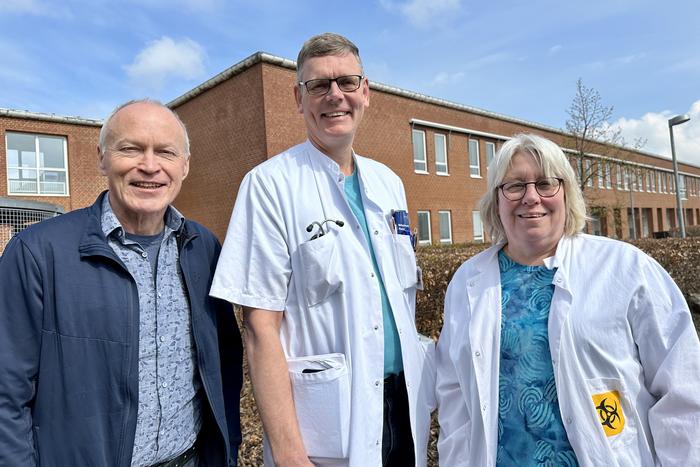
Grant recipients

Credit: Lisbeth Heilesen, Aarhus University

Tuberculosis is the infectious disease caused by a single bacterium that claims the most lives worldwide. Approximately 10 million people are diagnosed with tuberculosis each year, and about 1.5 million of them die from the disease. Around 3 million of these cases never receive a diagnosis because current diagnostic methods are either too expensive or unavailable. The research group aims to change that.

With the grant from the Innovation Fund Denmark’s Grand Solutions programme, the researchers will develop and test a method that can determine if a patient has tuberculosis by testing saliva. Initially, the method will be tested in Guinea-Bissau, West Africa.

The project is a collaboration between Christian Wejse from Aarhus University and Aarhus University Hospital, Birgitta Knudsen from the Department of Molecular Biology and Genetics at Aarhus University, and several international researchers from Guinea-Bissau and the company VPCIR Biosciences ApS.

“We don’t just want to detect tuberculosis in saliva but develop an entirely new testing method that can be performed close to the patient without the need for expensive equipment or an advanced laboratory. The project could have significant implications for a group of patients who currently either do not receive a tuberculosis diagnosis or receive it too late – this includes patients in low-income countries, socially disadvantaged individuals, and migrants,” says Christian Wejse.

“After many years of basic research, we have developed a new testing method that uses a specific marker to detect the tuberculosis bacterium in clinical samples. It’s a simple technology, but it’s very sensitive. With the grant from the Innovation Fund Denmark’s Grand Solutions programme, we look forward to completing the development of the testing method and testing it on a large number of patients in West Africa,” says Birgitta Knudsen.

“It is crucial that the test is economically feasible for healthcare systems in low-income countries and meets the WHO’s various requirements for such tests. Despite these challenges, we see significant commercial opportunities in this development, due to the large number of patients who could benefit from this test. ‘ Many a little makes a mickle’ as the saying goes,” says CEO Jørgen Schøller from VPCIR Biosystems.

Contact

Professor and Senior Consultant Christian Wejse
Aarhus University, Department of Clinical Medicine
and Aarhus University Hospital, Department of Infectious Diseases
Mobile: +45 51 94 45 19 – Email: [email protected]

Associate Professor Birgitta R. Knudsen
Department of Molecular Biology and Genetics
Aarhus University
Mobile: +45 6020 2673 – Email: [email protected]

CEO Jørgen Schøller
VPCIR Bioscience ApS
Email: [email protected]



Share12Tweet8Share2ShareShareShare2

Related Posts

Brain Timelines Unfold From Sensorimotor to Association Cortex Before Settling in Adulthood

Brain Timelines Unfold From Sensorimotor to Association Cortex Before Settling in Adulthood

October 9, 2026
Pasture Beats Feedlot for Lamb Growth, but Tannin Effects Depend on the Base Diet

Pasture Beats Feedlot for Lamb Growth, but Tannin Effects Depend on the Base Diet

October 9, 2026

HIV can dodge preventive antibody VRC01 after infection, trial sequencing reveals

October 9, 2026

Airborne fungi shift with the seasons, DNA reveals in year-long forest study

October 9, 2026

POPULAR NEWS

  • Alloys That Shrink Their Own Grains: New PIX Mechanism Refines Metals With Heat Alone

    Alloys That Shrink Their Own Grains: New PIX Mechanism Refines Metals With Heat Alone

    29 shares
    Share 12 Tweet 7
  • Endurance Exercise Reshapes the Liver in Males and Females Through Distinct Molecular Routes

    29 shares
    Share 12 Tweet 7
  • Single Transcription Factor PU.1 Rapidly Converts Fibroblasts into Macrophage-Lineage Cells

    29 shares
    Share 12 Tweet 7
  • New Scale Measures How Ready Nurse Educators Really Are for the AI Era

    29 shares
    Share 12 Tweet 7

About

We bring you the latest biotechnology news from best research centers and universities around the world. Check our website.

Follow us

Recent News

Alloys That Shrink Their Own Grains: New PIX Mechanism Refines Metals With Heat Alone

Endurance Exercise Reshapes the Liver in Males and Females Through Distinct Molecular Routes

Single Transcription Factor PU.1 Rapidly Converts Fibroblasts into Macrophage-Lineage Cells

Subscribe to Blog via Email

Success! An email was just sent to confirm your subscription. Please find the email now and click 'Confirm' to start subscribing.

Join 85 other subscribers
  • Contact Us

Bioengineer.org © Copyright 2023 All Rights Reserved.

Welcome Back!

Login to your account below

Forgotten Password?

Retrieve your password

Please enter your username or email address to reset your password.

Log In
No Result
View All Result
  • Homepages
    • Home Page 1
    • Home Page 2
  • News
  • National
  • Business
  • Health
  • Lifestyle
  • Science

Bioengineer.org © Copyright 2023 All Rights Reserved.