• HOME
  • NEWS
  • EXPLORE
    • CAREER
      • Companies
      • Jobs
    • EVENTS
    • iGEM
      • News
      • Team
    • PHOTOS
    • VIDEO
    • WIKI
  • BLOG
  • COMMUNITY
    • FACEBOOK
    • INSTAGRAM
    • TWITTER
Friday, March 27, 2026
BIOENGINEER.ORG
No Result
View All Result
  • Login
  • HOME
  • NEWS
  • EXPLORE
    • CAREER
      • Companies
      • Jobs
        • Lecturer
        • PhD Studentship
        • Postdoc
        • Research Assistant
    • EVENTS
    • iGEM
      • News
      • Team
    • PHOTOS
    • VIDEO
    • WIKI
  • BLOG
  • COMMUNITY
    • FACEBOOK
    • INSTAGRAM
    • TWITTER
  • HOME
  • NEWS
  • EXPLORE
    • CAREER
      • Companies
      • Jobs
        • Lecturer
        • PhD Studentship
        • Postdoc
        • Research Assistant
    • EVENTS
    • iGEM
      • News
      • Team
    • PHOTOS
    • VIDEO
    • WIKI
  • BLOG
  • COMMUNITY
    • FACEBOOK
    • INSTAGRAM
    • TWITTER
No Result
View All Result
Bioengineer.org
No Result
View All Result
Home NEWS Science News Chemistry

Fluorine enables separation-free ‘chiral chromatographic analysis’

Bioengineer by Bioengineer
July 2, 2020
in Chemistry
Reading Time: 2 mins read
0
IMAGE
Share on FacebookShare on TwitterShare on LinkedinShare on RedditShare on Telegram

IMAGE

Credit: ZHAO Yanchun

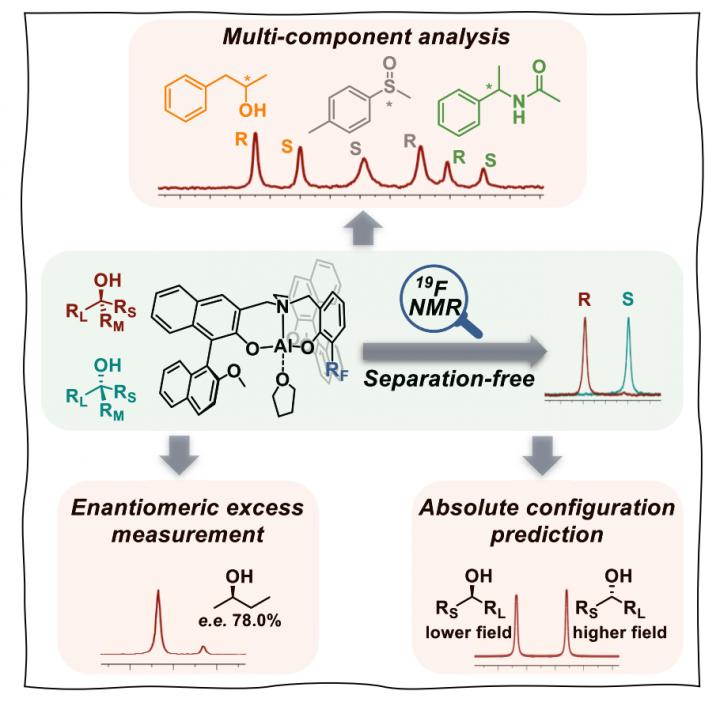
Researchers from the Shanghai Institute of Organic Chemistry of the Chinese Academy of Sciences recently developed a new platform for rapid chiral analysis, producing chromatogram-like output without the need for separation. The study was published in Cell Reports Physical Science.

Molecules not superimposable on their mirror images are chiral and play essential roles in the pharmaceutical industry, material sciences, and the origin of life. Distinguishing between mirror-image molecules is in great demand, but existing approaches usually achieve this goal with compromise in accuracy or efficiency.

Specifically, chromatographic methods resolve chiral molecules through easily interpretable chromatogram peaks, but require time-consuming separation. Chiroptical responsive systems allow in-situ chiral analysis, but are often plagued by sample interference issues.

In this study, the researchers developed a series of 19F-labeled chiral aluminum complexes that reversibly bind to various Lewis basic analytes.

The inclusion of chiral analytes to the confined binding pocket produced chromatogram-like 19F NMR signals, allowing rapid and unambiguous chiral analysis.

The method is operationally simple and effectively resolved a wide range of chiral molecules, including alcohols, ethers, amides, carbamates, oxazolidinones, sulfoxides, and sulfoximines.

The study shows that simultaneous analysis of three different classes of chiral compounds can be achieved in the absence of separation.

According to the researchers, the new method may also be used to determine the enantiopurity of crude reaction products and the assignment of absolute configurations. When used in conjunction with an autosampling NMR spectrometer, greater than 1,000 chiral analyses can be performed in a day.

“Such a method has the potential to simultaneously identify multiple analytes and existing interferences, which may eventually lead to real-time chiral analysis in complex biologically relevant systems,” said ZHAO Yanchun, corresponding author of the study.

###

This work was financially supported by the National Natural Science Foundation of China and the CAS Key Laboratory of Organofluorine Chemistry.

Media Contact
ZHAO Yanchun
[email protected]

Original Source

http://english.cas.cn/newsroom/research_news/chem/202007/t20200702_239516.shtml

Related Journal Article

http://dx.doi.org/10.1016/j.xcrp.2020.100100

Tags: Chemistry/Physics/Materials SciencesMolecular PhysicsPolymer Chemistry
Share12Tweet8Share2ShareShareShare2

Related Posts

Isolated H2-Reduced Clusters Boost CO2-to-Methanol Catalysis

Isolated H2-Reduced Clusters Boost CO2-to-Methanol Catalysis

March 25, 2026
blank

Physicists Identify Electronic Drivers Behind Flat Band Quantum Materials

March 21, 2026

Würzburg Chemistry Professor Claudia Höbartner Receives Prestigious Honor

March 20, 2026

Scientists Reveal How Magnets Control Metamaterial Behavior

March 20, 2026
Please login to join discussion

POPULAR NEWS

  • blank

    Revolutionary AI Model Enhances Precision in Detecting Food Contamination

    96 shares
    Share 38 Tweet 24
  • Imagine a Social Media Feed That Challenges Your Views Instead of Reinforcing Them

    1003 shares
    Share 397 Tweet 248
  • Uncovering Functions of Cavernous Malformation Proteins in Organoids

    54 shares
    Share 22 Tweet 14
  • Promising Outcomes from First Clinical Trials of Gene Regulation in Epilepsy

    51 shares
    Share 20 Tweet 13

About

We bring you the latest biotechnology news from best research centers and universities around the world. Check our website.

Follow us

Recent News

In-Sensor Cryptography Links Physical Process to Digital Identity

Can Psychosocial Factors Influence Cancer Risk?

Depression Factors in Elderly: Pre vs. Post-COVID Analysis

Subscribe to Blog via Email

Success! An email was just sent to confirm your subscription. Please find the email now and click 'Confirm' to start subscribing.

Join 78 other subscribers
  • Contact Us

Bioengineer.org © Copyright 2023 All Rights Reserved.

Welcome Back!

Login to your account below

Forgotten Password?

Retrieve your password

Please enter your username or email address to reset your password.

Log In
No Result
View All Result
  • Homepages
    • Home Page 1
    • Home Page 2
  • News
  • National
  • Business
  • Health
  • Lifestyle
  • Science

Bioengineer.org © Copyright 2023 All Rights Reserved.