Beneath the transparent skin of a microscopic roundworm lies one of biology’s most elegant pieces of engineering: a collagen-rich exoskeleton that must be built, remodeled, and rebuilt four times across the animal’s life, all while maintaining the precise body shape that lets the creature burrow, swim, and squeeze through soil. Now, a team of researchers has unveiled a resource that makes this hidden architecture visible in unprecedented detail. Writing in PLOS Biology, James Matthew Ragle, Jordan D. Ward, and colleagues describe a toolkit of 105 fluorescently tagged extracellular matrix proteins generated by genome editing in the nematode Caenorhabditis elegans, a collection that promises to transform how scientists study the assembly of barrier tissues.
Barrier epithelia, the sheets of cells that line surfaces exposed to the outside world, depend on a specialized coating called the apical extracellular matrix, or aECM, for protection and mechanical support. In humans, these matrices include the corneal stroma, the stratum corneum of the skin, and the apical surfaces of lung and gut epithelia. When aECM organization fails, the consequences range from blistering skin disorders to defective wound healing. Yet despite their importance, aECMs have remained stubbornly difficult to study. They contain dozens of collagens and hundreds of accessory proteins arranged in intricate, layered patterns at scales far smaller than the resolution of conventional light microscopy, and their assembly happens inside a living animal where it cannot be easily observed or manipulated.
The C. elegans cuticle has long been the model system of choice for tackling this problem. Secreted by the underlying epidermis, the cuticle is a multilayered aECM composed largely of collagens cross-linked into helical fiber arrays. These crossed fibers act as a hydrostatic skeleton, an external corset that works with internal fluid pressure to maintain the worm’s elongated shape. The cuticle also contains a cortical layer, a stratum whose molecular composition and organization have remained poorly understood, along with other distinct substructures that must each be assembled with remarkable precision. Because the worm is transparent, optically clear, and genetically tractable, it offers a unique window on how a complex matrix self-assembles in vivo.
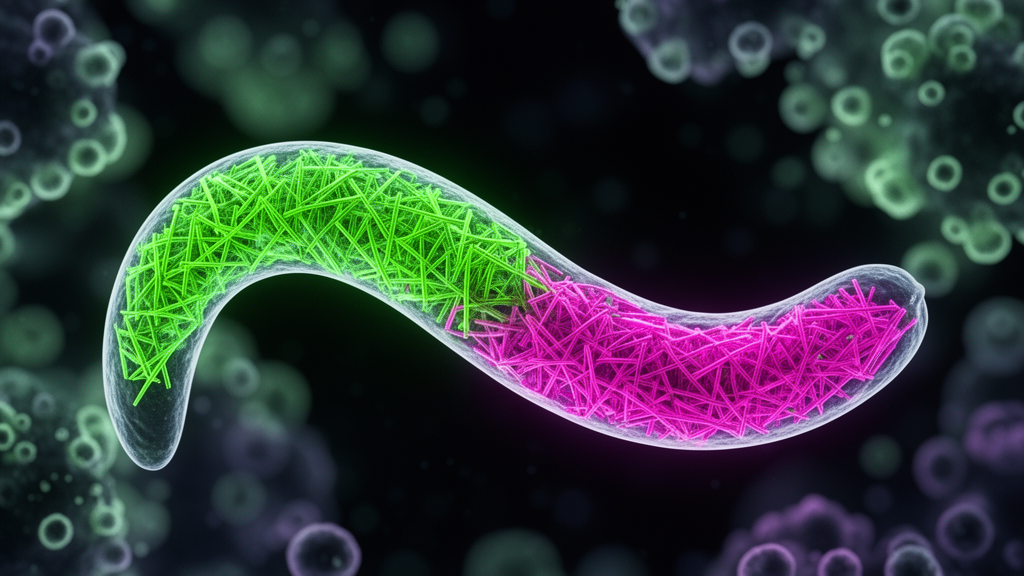
What has been missing is a systematic way to watch the individual components in place. Previous studies typically examined one or a few tagged proteins at a time, using methods that varied from lab to lab and often disrupted the very proteins being studied. The new work changes that calculus. The team used genome editing to insert fluorescent tags directly into the endogenous loci of aECM genes, so that each tagged protein is produced at its natural level, under its natural regulatory control, in its natural chromosomal context. This endogenous tagging strategy avoids the overexpression artifacts and mosaic patterns that plague conventional transgenic approaches.
Scale was the central challenge. The cuticle alone is built from a large family of collagens, and the researchers wanted to tag not only these structural proteins but also the enzymes, inhibitors, and transporters that regulate matrix dynamics. To do so efficiently, they developed pipelines for modular protein tagging, allowing the same editing strategy to be applied across dozens of genes, and for rapid fluorophore swapping, which lets a researcher replace one fluorescent marker with another at the same locus without redesigning the entire experiment. This modularity means the toolkit can grow and adapt: a marker optimized for one experiment can be recolored to fit a different imaging scheme or combined with a different tagged partner.
The results validate the approach. Most of the tagged collagens proved functional, meaning the fluorescent versions still did their structural jobs despite carrying an added fluorescent protein. That might sound like a technical footnote, but it is the critical quality-control step for any tagging project. A tag that cripples its protein produces beautiful images of a broken system. With function confirmed, the researchers could trust what they saw, and what they saw was striking: individual collagens exhibited exquisitely specific patterning, differing across developmental stages, across cell types within the epidermis, and across matrix substructures within a single cuticle.
That specificity carries real biological information. If two collagens localize to different layers or different regions of the animal, their distinct distributions point to distinct assembly mechanisms and distinct functional roles. The toolkit therefore functions as a molecular atlas, assigning each component an address within the matrix. Among the most significant contributions are reference markers for the cortical layer, the little-understood stratum that had lacked reliable fluorescent labels. With validated markers now in hand, researchers can begin to ask which proteins build this layer, when it assembles relative to the fiber arrays beneath it, and how its construction is coordinated with the rest of the cuticle.
The helical crossed fiber arrays received equally careful attention. These arrays, which wind around the worm’s circumference and lengthwise axis in opposing orientations, are the mechanical heart of the cuticle, functioning as a hydrostatic skeleton that maintains organismal shape. The new markers allow these fibers to be visualized with component-level resolution, opening the door to experiments that track how individual collagens are incorporated into the arrays during molting, when the entire cuticle is synthesized anew. Because the worm must rebuild this structure four times during its life, each molt represents a natural, synchronized assembly event that can now be watched in living animals.
Beyond the collagens themselves, the team tagged 30 members of other key aECM protein classes, including proteases, protease inhibitors, and lipid transporters. These accessory proteins are the regulators and remodelers of the matrix. Proteases sculpt and trim the growing cuticle, protease inhibitors restrain that activity to prevent runaway degradation, and lipid transporters contribute to the barrier properties of the matrix surface. Tagging these classes alongside the structural collagens means the toolkit captures not just the bricks of the cuticle but also the tools and foremen of the construction site, enabling integrated studies of how matrix assembly is regulated in time and space.
The broader significance of the work extends past nematodes. The principles it establishes, that endogenous fluorescent tagging can be scaled across an entire protein family, that modularity and fluorophore swapping make such resources practical, and that component-by-component localization reveals organizational logic invisible to bulk methods, apply to aECM biology in any organism. The standardized markers described in this study give the field a common vocabulary: rather than each laboratory building its own idiosyncratic tools, researchers can now share a validated set of reagents and compare results directly. For a structure as complex and dynamic as the apical extracellular matrix, that shared foundation may prove as important as any single discovery. The mechanistic basis of aECM spatiotemporal patterning, long obscured by molecular complexity, is now systematically open for dissection in vivo.
Subject of Research: A genome-edited fluorescent protein toolkit for mapping apical extracellular matrix patterning in C. elegans
Article Title: A systematic fluorescently tagged protein toolkit for dissecting apical extracellular matrix patterning in C. elegans
Article References: Ragle, J. M., Pooranachithra, M., Ashley, G. E., Cadena, E., Blank, B., Kang, K., Chen, C., Bhowmick, A. R., Mercado, S. H., Wells, T. E., Clancy, J. C., Chisholm, A. D., & Ward, J. D. (2026). A systematic fluorescently tagged protein toolkit for dissecting apical extracellular matrix patterning in C. elegans. PLOS Biology, 24(10), e3004059. https://doi.org/10.1371/journal.pbio.3004059
Image Credits: AI Generated
DOI: 10.1371/journal.pbio.3004059
Keywords: C. elegans, extracellular matrix, cuticle, collagen, fluorescent tagging, genome editing, apical ECM, epithelial biology, cortical layer, hydrostatic skeleton, proteases, fluorophore swapping
News Source: Drew Townsend. (October 14, 2026). Fluorescent Tagging Toolkit Illuminates the Hidden Architecture of the Worm Cuticle. Scienmag.