• HOME
  • NEWS
  • EXPLORE
    • CAREER
      • Companies
      • Jobs
    • EVENTS
    • iGEM
      • News
      • Team
    • PHOTOS
    • VIDEO
    • WIKI
  • BLOG
  • COMMUNITY
    • FACEBOOK
    • INSTAGRAM
    • TWITTER
Sunday, May 17, 2026
BIOENGINEER.ORG
No Result
View All Result
  • Login
  • HOME
  • NEWS
  • EXPLORE
    • CAREER
      • Companies
      • Jobs
        • Lecturer
        • PhD Studentship
        • Postdoc
        • Research Assistant
    • EVENTS
    • iGEM
      • News
      • Team
    • PHOTOS
    • VIDEO
    • WIKI
  • BLOG
  • COMMUNITY
    • FACEBOOK
    • INSTAGRAM
    • TWITTER
  • HOME
  • NEWS
  • EXPLORE
    • CAREER
      • Companies
      • Jobs
        • Lecturer
        • PhD Studentship
        • Postdoc
        • Research Assistant
    • EVENTS
    • iGEM
      • News
      • Team
    • PHOTOS
    • VIDEO
    • WIKI
  • BLOG
  • COMMUNITY
    • FACEBOOK
    • INSTAGRAM
    • TWITTER
No Result
View All Result
Bioengineer.org
No Result
View All Result
Home NEWS Science News Health

Fluconazole makes fungi sexually active

Bioengineer by Bioengineer
February 8, 2019
in Health
Reading Time: 2 mins read
0
IMAGE
Share on FacebookShare on TwitterShare on LinkedinShare on RedditShare on Telegram

IMAGE

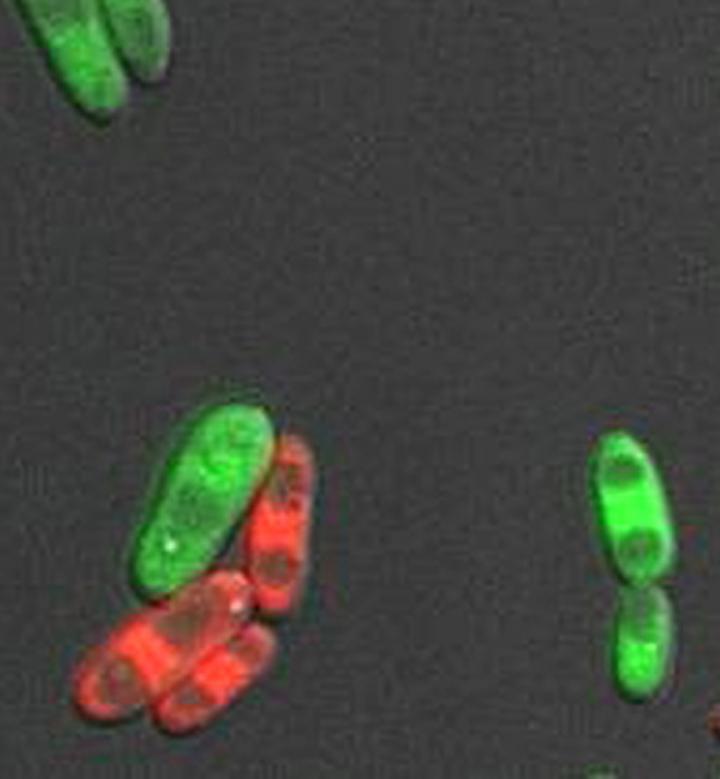
Credit: Bernardo Ramírez-Zavala/Universität Würzburg


The yeast Candida albicans occurs in most healthy people as a harmless colonizer in the digestive tract. However, it can also cause life-threatening infections, especially in immunocompromised patients.

These infections are usually treated with the drug fluconazole, which inhibits the synthesis of ergosterol in Candida. Ergosterol fulfils similar important functions in fungi as cholesterol in humans.

Candida albicans can, however, become resistant to this drug. Scientists have uncovered the main mechanisms of fluconazole resistance in recent years. The group of Professor Joachim Morschhäuser from the Institute for Molecular Infection Biology at Julius-Maximilians-Universität Würzburg (JMU) in Bavaria, Germany, has contributed important findings.

The fungus succeeds in becoming resistant with numerous mechanisms. For example, it uses pumps to transport the drug out of its cells. “Highly resistant Candida albicans, in which fluconazole therapy fails, usually use a combination of several of these mechanisms,” says Morschhäuser.

New combinations of resistance mechanisms

Normally Candida albicans reproduces asexually by cell division. Morschhäuser’s research group has now discovered that resistant fungal cells can quickly switch to sexual reproduction in the presence of fluconazole. In this case, the cells fuse and unite their genetic material. In the offspring cells, different resistance mechanisms are newly combined and the fungal population thus becomes even less sensitive to fluconazole.

“In our investigations, we found out that the cells that retained the advantageous resistance characteristics are selected and become dominant in the population when treated with fluconazole,” says first author Christina Popp. Fluconazole not only selects for resistance mutations, but can also lead to changes in the genome that make the normally asexual fungus “mating-competent”, thereby enabling the cells to combine individually acquired resistance mechanisms and produce highly resistant offspring.

Knowledge about the molecular mechanisms of drug resistance can be useful for the development of better and new drugs and help overcome resistance.

Morschhäuser assumes that the resistance mechanisms described here are only one example of how Candida albicans can change in its host. Next, his team wants to investigate whether other forms of adaptation can also contribute in a similar way to the successful establishment of the fungus in different host niches.

###

This research was funded by the German Research Foundation (DFG) and the Open Access Publication Programme of DFG and JMU.

Media Contact
Dr. Joachim Morschhäuser
[email protected]
49-931-318-2152

Original Source

https://www.uni-wuerzburg.de/en/news-and-events/news/detail/news/fluconazole-makes-fungi-sexually-active/

Related Journal Article

http://dx.doi.org/10.1128/mBio.02740-18

Tags: Medicine/Health
Share14Tweet8Share2ShareShareShare2

Related Posts

New Study Reveals the Massive Economic Impact of Tuberculosis

May 17, 2026

Age Discrimination Affects Healthcare Use in India

May 17, 2026

Advancements and Insights into Life Expectancy for Chronic Obstructive Pulmonary Disease Patients

May 17, 2026

Intrinsic Capacity, Resilience, Frailty in Stroke Recovery

May 17, 2026
Please login to join discussion

POPULAR NEWS

  • Research Indicates Potential Connection Between Prenatal Medication Exposure and Elevated Autism Risk

    844 shares
    Share 338 Tweet 211
  • New Study Reveals Plants Can Detect the Sound of Rain

    730 shares
    Share 291 Tweet 182
  • Salmonella Haem Blocks Macrophages, Boosts Infection

    62 shares
    Share 25 Tweet 16
  • Breastmilk Balances E. coli and Beneficial Bacteria in Infant Gut Microbiomes

    58 shares
    Share 23 Tweet 15

About

We bring you the latest biotechnology news from best research centers and universities around the world. Check our website.

Follow us

Recent News

Detecting Illicit Bitcoin Transactions with Temporal Graph Learning

New Study Reveals the Massive Economic Impact of Tuberculosis

Age Discrimination Affects Healthcare Use in India

Subscribe to Blog via Email

Enter your email address to subscribe to this blog and receive notifications of new posts by email.

Join 82 other subscribers
  • Contact Us

Bioengineer.org © Copyright 2023 All Rights Reserved.

Welcome Back!

Login to your account below

Forgotten Password?

Retrieve your password

Please enter your username or email address to reset your password.

Log In
No Result
View All Result
  • Homepages
    • Home Page 1
    • Home Page 2
  • News
  • National
  • Business
  • Health
  • Lifestyle
  • Science

Bioengineer.org © Copyright 2023 All Rights Reserved.