Just like us, the humble sweat bee has a daily routine
Credit: Jacob Cecala
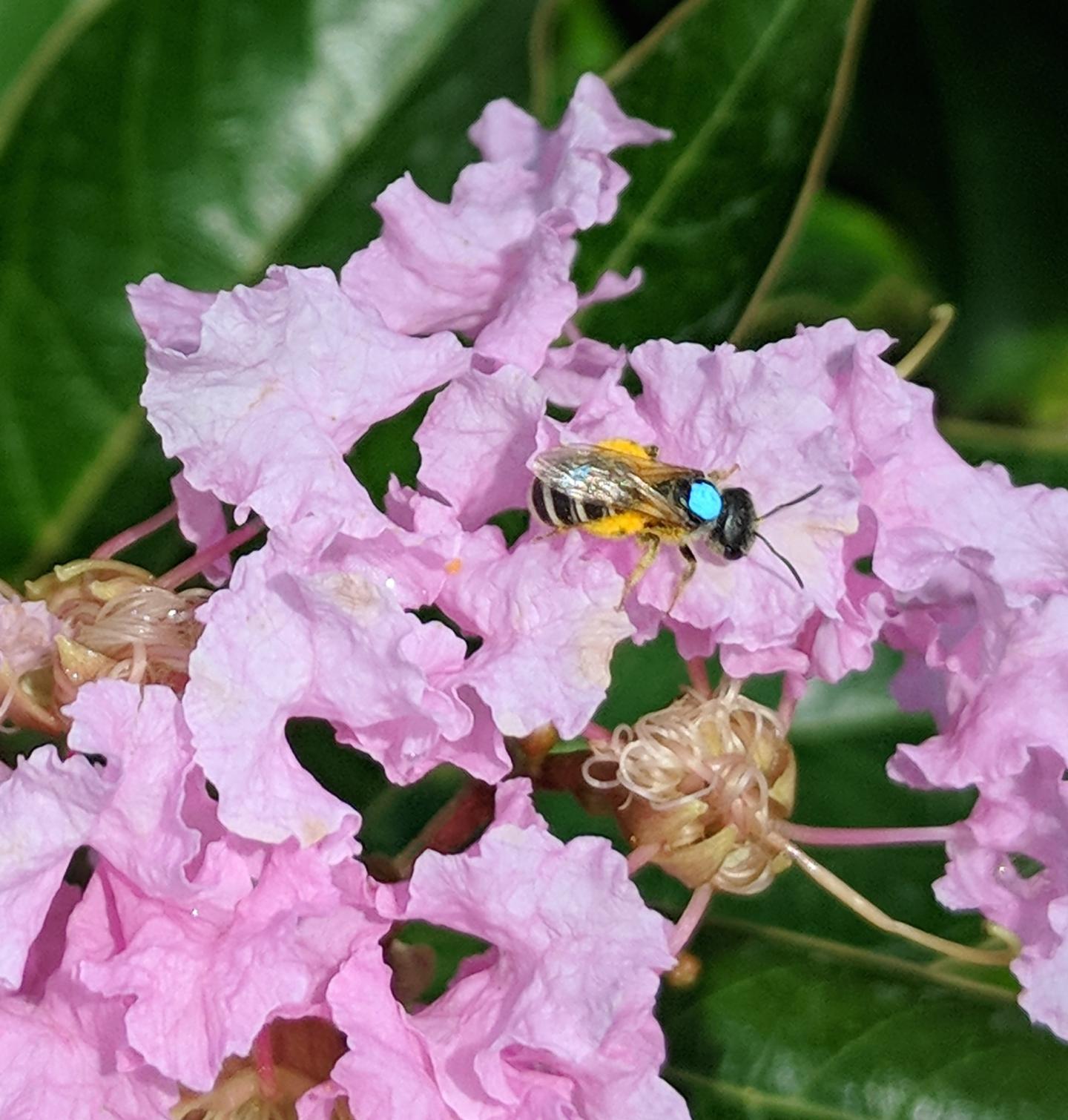
Entomologists at UC Riverside have documented that a species of native sweat bee widespread throughout North and South America has a daily routine that makes it a promising pollinator.
Because the bee can thrive in environments that have been highly modified by humans, such as cities and agricultural areas, it could become a suitable supplement to honeybees, which are expensive for farmers to rent and threatened by pesticides and climate change.
Sweat bees are not as famous as their prolific cousin, the European honeybee, but are common in natural, urban, and agricultural areas in North America. Sweat bees, along with other native bees like bumble bees, are valuable pollinators of many wildflowers and cultivated crop plants, yet often do not receive the level of public attention that honeybees do.
In a paper published in the journal Ecology, Ph.D. candidate Jacob Cecala, and Erin Wilson Rankin, an associate professor of entomology, describe in-depth for the first time a foraging behavior of a small, common, and often-overlooked species of sweat bee, Halictus ligatus. The species is classified as a “generalist,” meaning it is known to feed on many kinds of flowers. But no one knew how flexible individuals are in their flower selection, and whether an individual’s floral choices varied day-to-day.
To explore this species’ daily routine, Cecala captured sweat bees while feeding on flowers in several commercial plant nurseries across Southern California. Nurseries grow many different species of plants in close proximity to one another, so they are useful for studying bees’ foraging choices. He marked the bees with different colored dots of non-toxic paint to track which plants they were visiting.
He returned the next day and caught almost 52% of the marked bees again. Cecala repeated this experiment four times in summer and four times in autumn and recaptured around 50% each time. Virtually all–96%–were found on the same plant species as on the first day, indicating that most individual bees fed on the same plant species day-to-day. The findings suggest it is common for individual bees to make consistent choices about what to forage on across days.
“These results are encouraging given that plant nurseries are, relatively speaking, artificial man-made habitats. You would expect really intense agricultural and urban areas to be pretty devoid of biodiversity but these native bees are flying around and visiting the plants and using them as pollen and nectar resources,” Cecala said.
The study also documented a 45% higher probability of recapturing the bees on California native plant species than on plant species exotic to California. This varied somewhat by season. Recapture rates were higher on the native plants in the summer, suggesting seasonal differences in how the bees forage. While this suggests native plants are more valuable to these bees, many individuals still showed fidelity to non-native plants.
Much remains to be learned about Halictus ligatus feeding behaviors, but the high plant fidelity reported in the study probably indicates a smaller foraging range, which would be consistent with their small body size, and useful for commercial pollination.
Even though the study took place inside plant nurseries, its findings have implications for commercial crop pollination on farms. While farmers must pay to rent commercial honeybee hives, native bees like sweat bees provide pollination services free of charge.
“Honeybees, which are larger, forage much farther,” Rankin added. “Even if you put honeybees in your field there’s nothing to say they’re not actually going two farms over, whereas these sweat bees forage repeatedly on plants right around the area where they live.”
“These wild bees are pretty good, consistent pollinators,” Cecala said. “If you have these sweat bees in the area, it’s in your best interest to conserve them in whatever way you can, because they are probably visiting crops each day, not just passing through.”
This study reinforces that certain plants publicly available at nurseries can serve as dependable resources for native bees. By planting a variety of different flowers around their homes, and ensuring they are free of insecticides, anyone can help these native bees.
###
Media Contact
Holly Ober
[email protected]
951-827-5893
Original Source
https:/
Related Journal Article
http://dx.