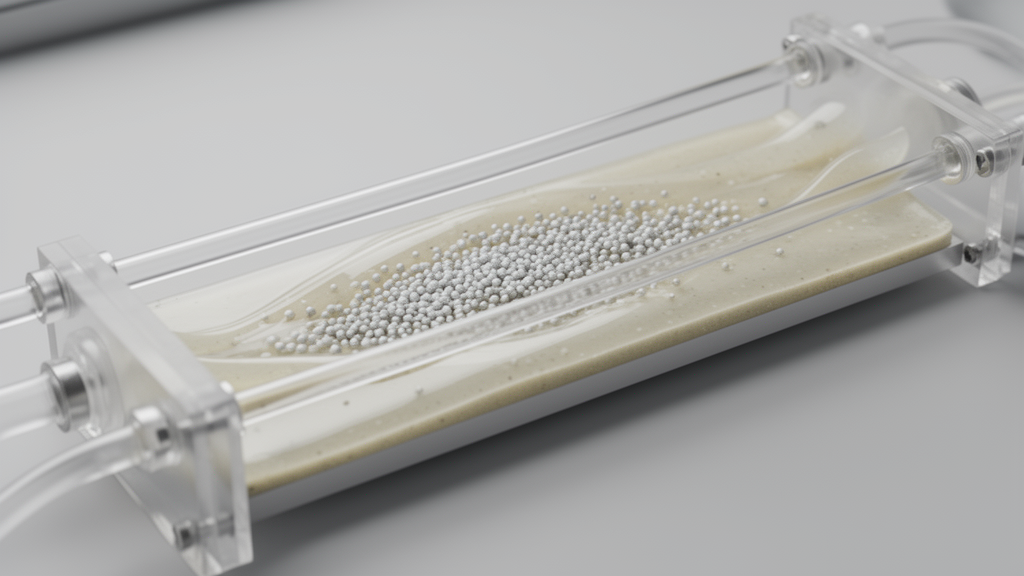
A laboratory comparison of three fabrication methods found that flow-through chemical deposition (FTCD) produced the smoothest ZnO/stearic acid nanocomposite thin films on glass, while chemical bath deposition (CBD) and successive ionic layer adsorption and reaction (SILAR) produced rougher surfaces with higher water contact angles. The study examined how the deposition route affected film morphology and wetting, using scanning probe microscopy and water contact angle measurements alongside structural, chemical, optical and surface characterization.
Scanning probe microscopy measurements gave root-mean-square surface roughness values, expressed as Rq, of 80.91 nm for CBD, 78.18 nm for SILAR and 42.29 nm for FTCD. Thus, the FTCD coating had a markedly lower measured roughness than the two conventionally deposited films. Its Rq value was about 52% of the CBD value and slightly more than half the SILAR value. The authors described the continuous-flow reactor approach as producing a coating with lower surface roughness and better wetting behavior than the conventional coating methods, while the reported contact-angle data provide a more specific picture of the difference in water repellency.
All three coatings were hydrophobic according to their water contact angles. The measured values were 145.26° ± 3.04° for CBD, 141.09° ± 3.50° for SILAR and 130.63° ± 3.78° for FTCD. The CBD and SILAR films therefore had higher water contact angles than the FTCD film, with the FTCD value lower by about 15 degrees than CBD and 10 degrees than SILAR when the reported means are compared. Within this set of three films, the rougher CBD and SILAR surfaces were associated with greater measured water repellency, whereas the smoother FTCD surface had a lower contact angle. The results establish a relationship between surface roughness and wettability for the tested coatings, but they do not isolate roughness as the sole cause of the differences or show that the same relationship applies to other compositions or substrates.
The researchers characterized the nanocomposite films with X-ray diffraction, scanning electron microscopy, energy-dispersive X-ray spectroscopy, ultraviolet–visible spectroscopy, Fourier transform infrared spectroscopy and scanning probe microscopy. These methods were used to examine structural, optical, chemical and morphological properties. Water contact angle measurements assessed the hydrophobic character of the ZnO coatings. The study’s evidence supports a comparison of the fabrication methods through the reported roughness and contact-angle values, together with the broader characterization of film structure and composition; the available summary does not specify individual values for every characterization technique or the full preparation parameters used for each method.
The findings identify a measurable trade-off between surface smoothness and water repellency in ZnO/stearic acid nanocomposite thin films. FTCD produced the lowest roughness, but CBD and SILAR produced the highest contact angles. The results may help inform the design of hydrophobic nanostructured coatings for applications including self-cleaning surfaces and corrosion inhibition, which the authors identified as potential uses for hydrophobic ZnO coatings. Because the reported comparison concerns laboratory thin films deposited on glass, the results describe fabrication-dependent differences in this material system rather than performance across different applications or operating conditions.
Subject of Research: Comparison of fabrication methods for hydrophobic ZnO/stearic acid nanocomposite thin films
Article Title: Effect of the fabrication method on the hydrophobicity of ZnO/stearic acid nanocomposite thin films: comparison of flow-through chemical deposition (FTCD) with SILAR and CBD methods
Article References: Yücel, Y., & Yücel, E. (2026). Effect of the fabrication method on the hydrophobicity of ZnO/stearic acid nanocomposite thin films: comparison of flow-through chemical deposition (FTCD) with SILAR and CBD methods. Journal of Nanoparticle Research, 28(11), Article 274. https://doi.org/10.1007/s11051-026-06794-9
Image Credits: AI Generated
DOI: 10.1007/s11051-026-06794-9
Keywords: ZnO nanocomposites, flow-through chemical deposition, chemical bath deposition, SILAR, surface roughness, water contact angle, hydrophobic coatings, wettability, thin films, Effect, fabrication, method
News Source: Denise Maddox. (October 20, 2026). Flow-through deposition yields smoother ZnO nanocomposite coatings. Scienmag.