In a groundbreaking advancement poised to revolutionize environmental monitoring, a team of researchers from the Institute of Science Tokyo has unveiled an innovative, self-powered microfluidic device capable of detecting toxic amines in water without relying on any external power source. This pioneering technology leverages electrochemiluminescence (ECL) facilitated by the streaming potential generated naturally as fluid flows through the system, effectively transforming the kinetic energy of flowing liquid into electrical energy. By eliminating the need for batteries or external electricity, this device offers a portable, cost-effective, and practical solution for real-time pollutant detection in diverse settings, including remote or resource-limited environments.
Traditional methodologies for measuring water pollution, especially for detecting hazardous substances like amines, typically require sophisticated instrumentation, extensive sample preparation, and a stable power supply. These constraints hinder rapid and widespread deployment, particularly in field conditions where accessibility and power availability are major challenges. Addressing these limitations, the research team led by Professor Shinsuke Inagi has designed a microfluidic platform that ingeniously converts the streaming potential—a voltage difference created by the movement of liquid through a specialized channel—into the driving force for electrochemical reactions. This innovation signifies a paradigm shift toward sustainable environmental sensing technologies.
The operational principle at the heart of this device is electrochemiluminescence, a phenomenon wherein species undergoing redox reactions emit light. In this system, two principal molecular components orchestrate the light-emitting reaction: the chromophore, specifically benzothiadiazole-triphenylamine (BTD-TPA), and the coreactant tri-n-propylamine (TPrA). When an aqueous solution containing TPrA flows through the device, the movement induces a streaming potential of approximately 2 to 3 volts across platinum wire electrodes situated within two distinct chambers connected by a porous channel. This voltage is sufficient to drive oxidation reactions at the electrodes, leading to the excitation of the chromophore and subsequent photon emission. The intensity of the emitted light correlates directly with the concentration of amines, enabling sensitive detection.
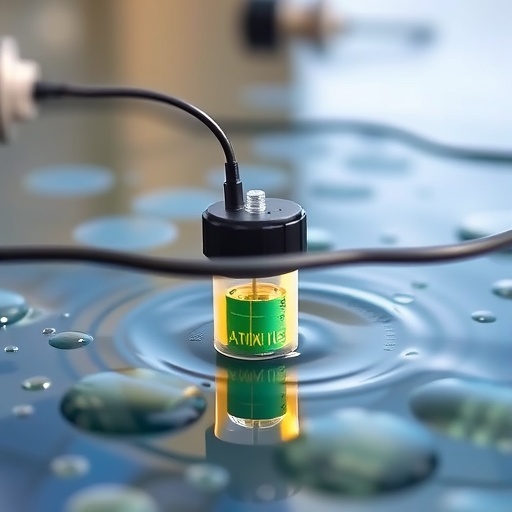
Constructed as a split bipolar electrode system, the device incorporates two platinum electrodes linked via an ammeter, embedded within a microfluidic channel filled with a porous medium to facilitate fluid flow and voltage generation. Remarkably, this setup can be activated by as simple a mechanism as a hand-operated syringe, demonstrating the device’s user-friendly and low-resource design ethos. The resulting electrochemiluminescence is sufficiently bright to be captured via standard digital imaging equipment, enabling both qualitative visualization and quantitative analysis.
One notable achievement of this technology lies in its capacity to detect a range of amines beyond tri-n-propylamine, including industrially relevant compounds like 2-(dibutylamino)ethanol and triethanolamine. While the efficiency of detection varies among different amine species, the device’s sensitivity reaches down to nanomolar levels, with a detection limit as low as 0.01 millimolar for TPrA in distilled and tap water samples. This sensitivity not only establishes the device’s suitability for environmental monitoring but also opens pathways for detecting trace pollutants that pose significant health risks, considering that many amines are known toxins and potential carcinogens.
The elimination of external power requirements imparts distinct advantages, particularly for continuous, on-site monitoring in natural water bodies such as rivers and pipelines. The natural flow of water itself can sustain the device’s operation, ensuring uninterrupted pollutant surveillance even in settings where electricity is absent or unreliable. Such real-time monitoring capabilities are crucial for timely responses to contamination events, facilitating immediate intervention and mitigation strategies.
Moreover, the researchers envision broad applicability beyond environmental contexts. Given the universality of the electrochemiluminescence mechanism and the versatile detection range of amines and other analytes, the technology shows promise for adoption in food quality control, water safety testing, and even counter-bioterrorism efforts. Its portability and robustness make it especially suitable for field deployments requiring rapid and reliable analysis without cumbersome equipment.
The development process was spearheaded by a multidisciplinary team combining expertise in chemical science and engineering, electrochemistry, and materials science. The researchers meticulously optimized the electrode materials and microfluidic architecture to maximize voltage generation and light emission efficiency. Deposition of the chromophore onto the anode ensured effective electron transfer and photonic output, while the choice of coreactant optimized the redox cycling essential for sustained luminescence.
Crucially, the system capitalizes on the physics of streaming potentials, wherein an electrolyte solution flowing through charged porous networks produces an electrical potential difference due to ion migration and electrokinetic effects. By harnessing this naturally occurring phenomenon within a microfluidic scale, the device symbolizes an elegant intersection of fluid mechanics, electrochemistry, and photophysics. Its success demonstrates the potential for integrating sustainable energy harvesting with analytical sensing technologies.
Published in the prestigious journal Nature Communications on September 8, 2025, the findings have already sparked considerable interest within the scientific community. The revelation of a functional prototype that operates solely on the electrical energy derived from flowing liquids addresses a long-standing challenge in environmental monitoring: developing robust, energy-independent analytical tools. This innovation paves the way for further exploration into deploying autonomous sensors in various remote and critical environments, creating a new class of self-sufficient electrochemical devices.
Looking ahead, the project team expresses optimism about refining the technology to enhance durability, sensitivity, and analyte specificity. The ultimate goal is a seamless integration wherein continuous natural water flows, like those found in rivers, continuously energize the system, enabling persistent surveillance and data collection. Such autonomous environmental sensors could dramatically improve pollutant tracking, ecosystem health assessments, and public safety by providing consistent, real-time data streams.
Professor Shinsuke Inagi emphasized the implications of this technology: “By eliminating reliance on external power supplies, our electrochemiluminescence approach harnesses the electrical energy of nature itself, enabling pollutant detection in situ and in real time. Beyond environmental monitoring, this concept can be extended to various analytes relevant to food safety and biosecurity, addressing critical global challenges with an elegant, sustainable solution.” The team’s pioneering work represents a significant stride toward resilient, eco-friendly sensing methodologies that leverage the physics of flowing fluids for practical environmental diagnostics.
This innovation underscores the emergent trend of merging microfluidics with green energy concepts, opening pathways toward low-cost analytical platforms that function autonomously in demanding conditions. As environmental monitoring becomes more critical amid escalating pollution concerns globally, such technologies will be indispensable in ensuring water quality and safeguarding public health across diverse regions, from urban centers to remote natural habitats.
Subject of Research:
Not applicable
Article Title:
An Electrochemiluminescence Device Powered by Streaming Potential for the Detection of Amines in Flowing Solution
News Publication Date:
8-Sep-2025
Web References:
https://doi.org/10.1038/s41467-025-63548-2
Image Credits:
Institute of Science Tokyo
Keywords
Environmental monitoring, Applied sciences and engineering, Polymer chemistry, Environmental chemistry, Sustainability, Electronic devices
Tags: advancements in electrochemical sensingamine detection in waterchallenges in water quality assessmentcost-effective environmental technologieselectrochemiluminescence in environmental monitoringflow-driven sensor technologyInstitute of Science Tokyo research breakthroughsportable pollution detection solutionsreal-time water pollution monitoringremote monitoring of toxic substancesself-powered microfluidic devicessustainable environmental sensing innovations