• HOME
  • NEWS
  • EXPLORE
    • CAREER
      • Companies
      • Jobs
    • EVENTS
    • iGEM
      • News
      • Team
    • PHOTOS
    • VIDEO
    • WIKI
  • BLOG
  • COMMUNITY
    • FACEBOOK
    • INSTAGRAM
    • TWITTER
Wednesday, May 13, 2026
BIOENGINEER.ORG
No Result
View All Result
  • Login
  • HOME
  • NEWS
  • EXPLORE
    • CAREER
      • Companies
      • Jobs
        • Lecturer
        • PhD Studentship
        • Postdoc
        • Research Assistant
    • EVENTS
    • iGEM
      • News
      • Team
    • PHOTOS
    • VIDEO
    • WIKI
  • BLOG
  • COMMUNITY
    • FACEBOOK
    • INSTAGRAM
    • TWITTER
  • HOME
  • NEWS
  • EXPLORE
    • CAREER
      • Companies
      • Jobs
        • Lecturer
        • PhD Studentship
        • Postdoc
        • Research Assistant
    • EVENTS
    • iGEM
      • News
      • Team
    • PHOTOS
    • VIDEO
    • WIKI
  • BLOG
  • COMMUNITY
    • FACEBOOK
    • INSTAGRAM
    • TWITTER
No Result
View All Result
Bioengineer.org
No Result
View All Result
Home NEWS Science News Health

Flipping the script on novel cancer therapy leads to insights into lupus

Bioengineer by Bioengineer
December 11, 2019
in Health
Reading Time: 2 mins read
0
IMAGE
Share on FacebookShare on TwitterShare on LinkedinShare on RedditShare on Telegram

IMAGE

Credit: (Image credit: Chen Lab)


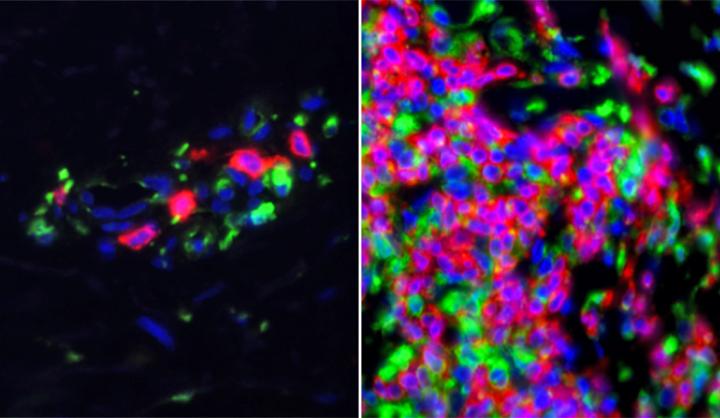
In the last decade, scientists discovered that blocking a key regulator of the immune system helped unleash the body’s natural defenses against several forms of cancer, opening up a new era of cancer immunotherapy. Now Yale scientists have essentially flipped this script and found that when impaired a molecularly similar regulator can cause the damaging immune system attacks on skin and organs that are the hallmark of the autoimmune disease lupus, they report Dec. 11 in the journal Science Translational Medicine.

The study results help explain the origins of lupus and suggest novel ways researchers might be able to restore function of this inhibitor and provide much needed new therapy to treat the disease, the scientists said.

The immune system has a series of regulators designed to prevent it from attacking tissues in its host, a system that goes awry in autoimmune diseases. Yale researchers found that mice lacking an immune system inhibitor called programmed death-1 homolog, or PD-1H, spontaneously developed symptoms that resemble two forms of lupus — systemic, in which the immune system attacks multiple organs; and cutaneous, which is marked by pronounced skin deformities.

“This molecule is clearly involved in inhibiting lupus, but it seems to be selective because it does not have the same effect in several other autoimmune diseases,” said senior author Lieping Chen, the United Technologies Corporation Professor in Cancer Research, and professor of immunobiology, dermatology, and medicine.

PD-1H is molecularly similar to the more commonly known PD-1 molecule, which also helps suppress immune system response. Chen was a pioneer in identifying and developing inhibitors to PD-1, which freed T cells to attack several forms of cancer. Several labs have also tried to use PD-1H as a cancer treatment but so far have been unsuccessful.

Chen said his findings suggest that in people with lupus the function of PD-1H is critical. When it is impaired, they are vulnerable to the immune system attacks on skin and multiple organs that are the hallmark of the disease.

Lupus patients currently have very limited options for treatment, but the new findings suggest a novel approach called protein fusion might mimic PD-1H and help control the immune system and combat the disease, Chen said.

###

The research was primarily funded by Boehringer Ingelheim, which had investigated PD-1H as a potential cancer treatment, and by a United Technologies endowment.

Yale’s Xue Han and Matthew Vesely are co-lead authors of the study.

Media Contact
Bess Connolly
[email protected]

Related Journal Article

http://dx.doi.org/10.1126/scitranslmed.aax1159

Tags: cancerDermatologyImmunology/Allergies/AsthmaMedicine/Health
Share12Tweet8Share2ShareShareShare2

Related Posts

Engineered Water Channels Boost MRI Nanoprobe Sensitivity

May 13, 2026

Boosting Microglia Repair Accelerates Stroke Recovery

May 13, 2026

Flexible High-Resolution ECM Micropatterning Advances Science

May 13, 2026

New Frailty Questionnaire-5 Enhances Primary Care Screening

May 13, 2026
Please login to join discussion

POPULAR NEWS

  • Research Indicates Potential Connection Between Prenatal Medication Exposure and Elevated Autism Risk

    842 shares
    Share 337 Tweet 211
  • New Study Reveals Plants Can Detect the Sound of Rain

    728 shares
    Share 290 Tweet 182
  • Salmonella Haem Blocks Macrophages, Boosts Infection

    62 shares
    Share 25 Tweet 16
  • Breastmilk Balances E. coli and Beneficial Bacteria in Infant Gut Microbiomes

    57 shares
    Share 23 Tweet 14

About

We bring you the latest biotechnology news from best research centers and universities around the world. Check our website.

Follow us

Recent News

Engineered Water Channels Boost MRI Nanoprobe Sensitivity

Fearless Young Scientist Reveals Hidden Biodiversity in Snow and Glacier Ecosystems of Remote Antarctic Island

Boosting Microglia Repair Accelerates Stroke Recovery

Subscribe to Blog via Email

Success! An email was just sent to confirm your subscription. Please find the email now and click 'Confirm' to start subscribing.

Join 82 other subscribers
  • Contact Us

Bioengineer.org © Copyright 2023 All Rights Reserved.

Welcome Back!

Login to your account below

Forgotten Password?

Retrieve your password

Please enter your username or email address to reset your password.

Log In
No Result
View All Result
  • Homepages
    • Home Page 1
    • Home Page 2
  • News
  • National
  • Business
  • Health
  • Lifestyle
  • Science

Bioengineer.org © Copyright 2023 All Rights Reserved.