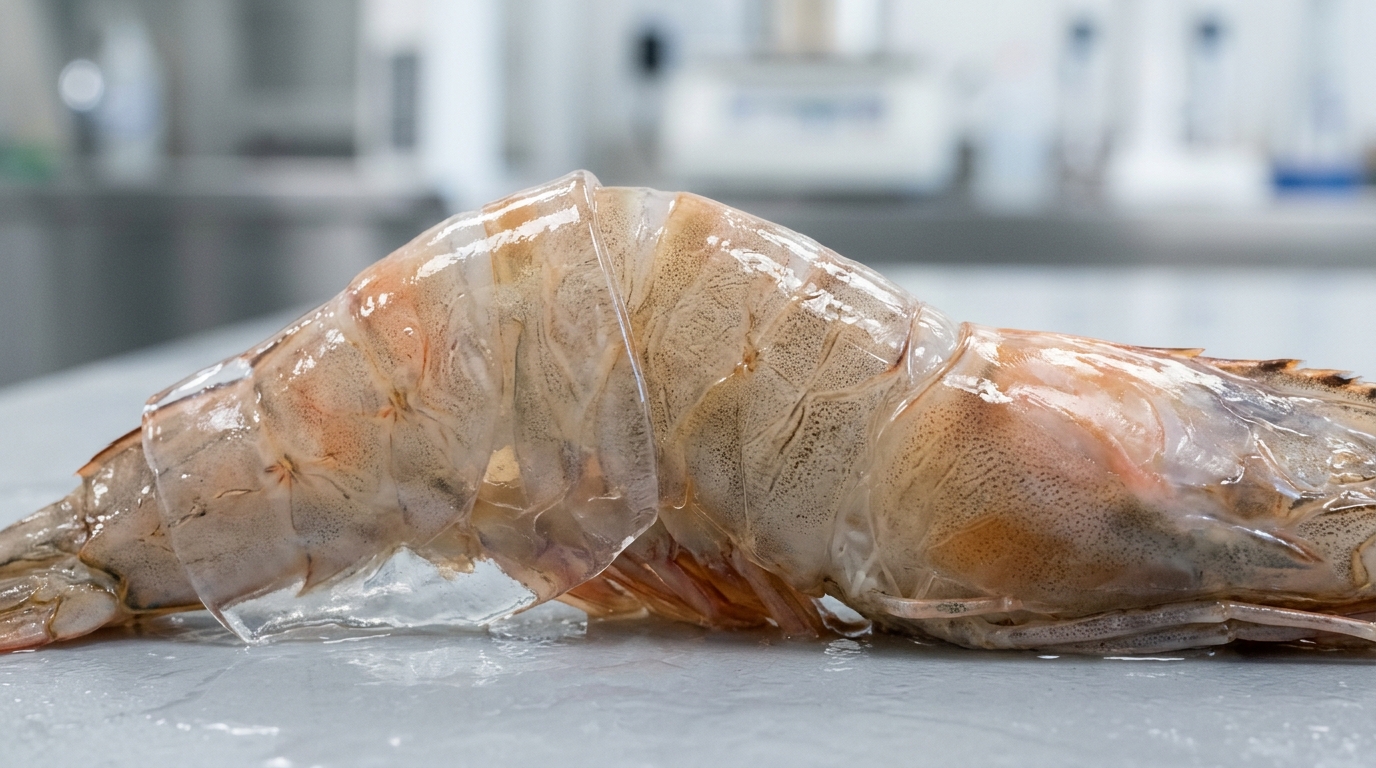
A flexible hydrogel that can be pressed directly onto the curved surface of a contaminated shrimp has been shown to capture and identify trace amounts of malachite green, a banned aquaculture dye, without any sample pretreatment. The substrate, described in the Journal of Materials Science, is an agarose hydrogel embedded with dense silver and silver bromide nanoparticles, and it was fabricated in a single reaction vessel using temperature and pH control. According to the study’s abstract, the material combines the electromagnetic field enhancement of silver nanoparticles, plasmonic coupling across nanoscale gaps, and charge-transfer chemical enhancement at the metal–semiconductor interface, producing a surface-enhanced Raman scattering (SERS) platform that is both sensitive and mechanically conformable.
According to the study's abstract, traditional rigid SERS substrates suffer from poor flexibility and cannot conform to complex three-dimensional geometries. The abstract states that this limitation severely restricts the practical field utility of SERS technology, which otherwise offers non-destructive in situ extraction and rapid on-site screening of hazardous residues on irregular sample surfaces. The new substrate addresses this by anchoring the active nanoparticles inside a three-dimensional porous agarose network. The result is a soft, flexible film that maintains intimate contact with irregular surfaces, so analyte molecules on a curved or rough sample can still reach the electromagnetic hotspots responsible for signal amplification.
The fabrication strategy is described as a green one-pot synthesis. By regulating reaction kinetics through temperature and pH, the researchers achieved uniform anchoring of high-density Ag/AgBr heterojunction hotspots within the three-dimensional porous agarose network. The abstract reports that kinetic regulation via temperature and pH control enabled the uniform anchoring of high-density Ag/AgBr heterojunction hotspots within the 3D porous agarose network. The heterojunction between metallic silver and the semiconductor silver bromide adds a second enhancement channel: charge transfer at the metal–semiconductor interface provides a chemical contribution to the Raman signal on top of the electromagnetic amplification from the silver nanostructures themselves.
Performance was first benchmarked with Rhodamine 6G, a standard Raman probe molecule. The flexible substrate achieved an ultra-low limit of detection down to 10⁻¹² mol/L, a spatial signal relative standard deviation of 9.55 percent, and an ambient shelf life exceeding 30 days. The abstract reports a spatial signal relative standard deviation of 9.55 percent for the substrate. The abstract reports an ambient shelf life exceeding 30 days for the flexible substrate.
For malachite green, the target analyte with direct food-safety relevance, the substrate reached an enhancement factor of up to 1.85 × 10⁷. For malachite green, the abstract reports an enhancement factor reaching up to 1.85 × 10⁷. The abstract describes malachite green as a hazardous residue and states that the substrate holds broad application prospects for the rapid, on-site safety screening of aquaculture products.
The practical demonstration moved beyond laboratory solutions. In trials described in the abstract, the flexible substrate was directly attached to the surfaces of contaminated fresh shrimp without any complex sample pretreatment, enabling in situ capture of trace malachite green at concentrations as low as 0.003 ppm, with a practical relative standard deviation of 14.48 percent. According to the abstract, the flexible substrate could be directly attached to the surfaces of contaminated fresh shrimp without any complex sample pretreatment, enabling the in situ sensitive capture of trace malachite green.
The abstract reports a practical relative standard deviation of 14.48 percent for the in situ shrimp measurements, which is higher than the spatial signal RSD of 9.55 percent reported for the substrate. The abstract does not state a threshold for acceptable field performance, so no claim about the acceptability of the 14.48 percent practical RSD can be made from the supplied evidence. The abstract reports that the substrate enabled in situ capture of trace malachite green at concentrations as low as 0.003 ppm on contaminated fresh shrimp.
The authors frame the work as demonstrating a facile, low-cost and sustainable pathway for fabricating robust, highly stable and flexible SERS platforms. The abstract describes the fabrication as a green one-pot strategy and frames the work as a facile, low-cost, and sustainable pathway for fabricating robust, highly stable, and flexible SERS platforms. The abstract describes the substrate as fabricated through a one-pot strategy and frames the work as a low-cost pathway, but it does not provide cost comparisons with other substrate types.
According to the abstract, the work holds broad application prospects for the rapid, on-site safety screening of aquaculture products. The reported figures are drawn from the study’s abstract, which presents the headline performance metrics of the substrate; the full peer-reviewed article provides the supporting experimental detail. The abstract presents the headline performance metrics of the substrate, and the full peer-reviewed article provides the supporting experimental detail.
Subject of Research: A flexible agarose/Ag/AgBr hydrogel SERS substrate for in situ detection of malachite green residues on aquaculture products
Article Title: Flexible agarose/Ag/AgBr composite hydrogel via a facile one-pot synthesis as a robust SERS substrate for in situ malachite green detection
Article References: Zheng, X., Chen, Y., Chen, F., Zhang, C., Ma, L., Li, L., Shen, Z., Cao, Y., & Jiang, L. (2026). Flexible agarose/Ag/AgBr composite hydrogel via a facile one-pot synthesis as a robust SERS substrate for in situ malachite green detection. Journal of Materials Science. https://doi.org/10.1007/s10853-026-14036-5
Image Credits: AI Generated
DOI: 10.1007/s10853-026-14036-5
Keywords: SERS, agarose hydrogel, malachite green, silver nanoparticles, Ag/AgBr heterojunction, food safety, aquaculture, in situ detection, Raman spectroscopy, one-pot synthesis, shrimp, surface-enhanced Raman scattering
News Source: Denise Maddox. (November 6, 2026). Flexible Hydrogel SERS Substrate Detects Malachite Green on Shrimp Surfaces. Scienmag.