


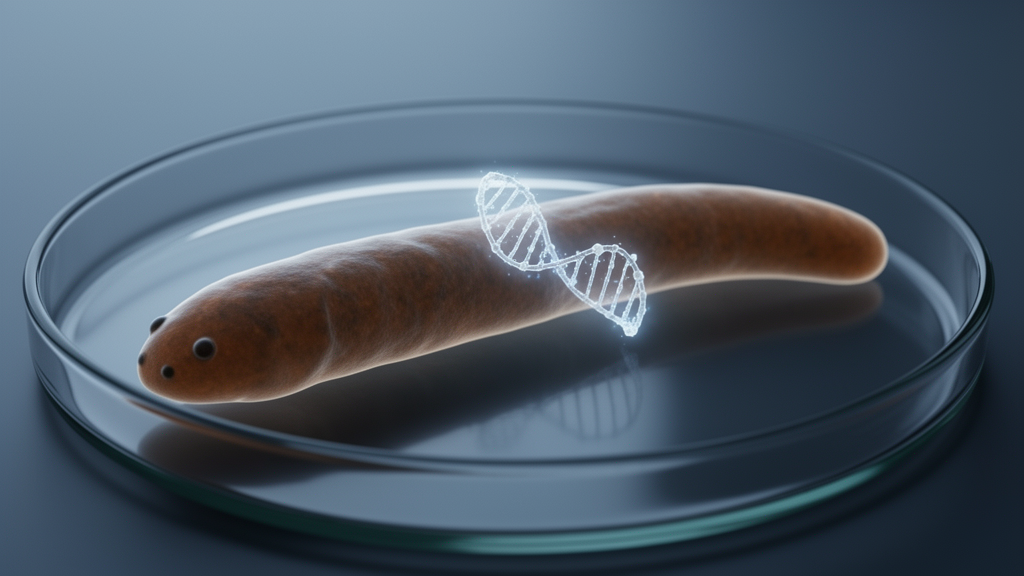
In the flatworm Macrostomum lignano, switching off a single gene called β-catenin1 stops the animal from rebuilding its tail after amputation, yet — unlike in planarian flatworms — it never causes a head to sprout where the tail should be.
β-Catenin is a bifunctional molecule with an unusually prominent place in animal biology. At the cell membrane it anchors classical cadherins to the actin cytoskeleton, and inside the nucleus it serves as the main transcriptional effector of the canonical Wnt pathway, steering axial patterning, germ layer formation, organogenesis and stem cell fate decisions. Because of this dual role, it has repeatedly surfaced in regeneration research: β-catenin signalling is required for regeneration in hydra, planarians, newts, axolotls, zebrafish, fruit flies and mice. In planarians, the model flatworms of regeneration biology, four β-catenin homologs exist, and only one of them, Smed-β-catenin1, transmits the Wnt signal and defines posterior identity. Silencing it produces one of the most striking phenotypes in the field: ectopic heads form at posterior-facing wounds, and even head-regeneration-deficient planarian species such as Dendrocoelum lacteum and Procotyla fluviatilis regain the ability to rebuild a head.
Whether that head-rescuing trick is a general flatworm feature or a planarian specialty was the question motivating the new work. The team, led by Moses Kitilit Kibet and Bernhard Egger, first reconstructed the evolutionary history of β-catenin across the phylum. They retrieved sequences from 20 flatworm and 5 non-flatworm species, aligned them with MAFFT, and built a maximum-likelihood tree rooted with the sea anemone Nematostella vectensis. The result was clear: catenulids, an early-branching flatworm lineage, carry a single β-catenin homolog, while essentially all rhabditophoran flatworms carry at least two. This pattern indicates that the ancestral flatworm possessed one bifunctional β-catenin and that the first gene duplication occurred in the ancestor of Rhabditophora. Planarians went further still, multiplying the gene into four copies — a derived trait apparently unique to that group.
Macrostomum lignano, a small free-living flatworm with an established inbred laboratory line, turned out to possess three β-catenin homologs, which the authors named Mlig-β-catenin1, Mlig-β-catenin2a and Mlig-β-catenin2b. A detailed comparison of their protein sequences against human β-catenin revealed that the three proteins share more than 25 percent identical amino acid positions and about 40 percent similar ones. Crucially, only Mlig-β-catenin1 conserves the N-terminal GSK3β-CK1α phosphorylation motif, the regulatory gate through which the Wnt pathway controls β-catenin degradation. The other two homologs instead conserve the two α-catenin binding domains, suggesting they function as structural components of adherens junctions rather than as signalling molecules. None of the three retains the C-terminal PDZ interaction domain found in vertebrate β-catenin.
The functional experiments began with knockdown efficiency checks. Using feeding-free soaking RNAi with double-stranded RNA, the researchers achieved transcript reductions of 86 percent for Mlig-β-catenin1, 83 percent for Mlig-β-catenin2a and 65 percent for Mlig-β-catenin2b, as measured by RT-qPCR. They then amputated worms through the gonads and followed posterior regeneration. In Mlig-β-catenin1 knockdowns the effect was dramatic: treated worms closed their wounds within hours but never formed a blastema, the mound of proliferating cells from which the new tail grows. Across four treatment conditions, 86 individuals completely failed to regenerate any posterior structure during treatment, while controls regenerated tails with adhesive organs and, eventually, the stylet — the male copulatory organ that marks a fully restored tail plate.
The block was reversible but left scars. After RNAi was withdrawn, all 86 previously blocked worms eventually regrew tails, yet the outcome was often messy: 59 percent regenerated misplaced tails, 13 percent grew multiple tails, and only 28 percent produced a normal tail. Individuals carrying multiple tails survived for up to 94 days post-amputation without any change in phenotype. In a refined set of experiments using only worms with clean, unruffled wound surfaces, the heteromorphosis rate dropped sharply, from 71 percent in ragged-wound amputees to 8 percent, leading the authors to hypothesise that uneven cuts create multiple tail-formation centres whose β-catenin expression re-emerges unevenly once silencing fades.
By contrast, single knockdowns of Mlig-β-catenin2a and Mlig-β-catenin2b produced no phenotype at all, and double knockdowns of the two together also left posterior regeneration untouched — consistent with their proposed structural role in cell junctions. Unexpectedly, combining Mlig-β-catenin1 with either of the other homologs, or knocking down all three simultaneously, actually weakened the tail-regeneration block: double-knockdown worms showed only a slight delay and fully regenerated tails by ten days. The authors note that a weaker knockdown efficiency for Mlig-β-catenin1 in some of these experiments may partly explain this, but the underlying interaction among the homologs remains unresolved.
The anterior side of the story delivered the study’s evolutionary punchline. In planarians, β-catenin1 knockdown rescues head regeneration even from posterior-most pieces. In M. lignano, nothing of the sort happened. Across three amputation levels — through the gonads, behind the pharynx, and behind the eyes — and across single, double and triple knockdowns, no anterior regenerate ever formed a blastema or any anterior structure, behaving just like luciferase-treated controls. Continuous 19-day knockdown in intact, uncut worms likewise produced no ectopic heads or morphological defects, in stark contrast to planarians, where such treatment transforms posterior tissue into heads. The authors conclude that the capacity to rescue a head by removing β-catenin1 is likely an apomorphy — a derived specialization — of planarians, not an ancestral flatworm trait, and they suggest that a planarian head-inducing gene such as notum is either missing or differently regulated in Macrostomum.
Cell-level measurements reinforced the picture of β-catenin1 acting at the very start of the regeneration program. BrdU labelling of S-phase cells two days after amputation showed far fewer proliferating nuclei in knockdown animals than in controls: 136 versus 231 across the body from eyes to testes, and 49 ± 15 versus 155 ± 26 BrdU-positive nuclei in the posterior-most region, where controls built a highly proliferative blastema and knockdowns showed only moderate proliferation at the wound site. Whole-mount in situ hybridisation added a species-specific twist: Mlig-β-catenin1 expression was ubiquitous in intact worms except in the epidermis and tail plate, was strong in testes, ovaries and developing eggs, and — unlike its planarian counterpart — did not stain the brain or nerve cords.
Taken together, the study draws a clean evolutionary line. Rhabditophoran flatworms conserved a single Wnt-transducing β-catenin1 required for specifying posterior identity and for launching blastema formation after tail amputation, while the head-regeneration response to its loss evolved independently within planarians. Elsewhere in the animal kingdom, removing β-catenin signalling likewise blocks regeneration outright — hydra cannot rebuild head or foot, and axolotl limb regeneration fails when the Wnt inhibitor axin is deployed — making planarians the standout exception. For M. lignano, silencing β-catenin1 leaves the animal headless and, for a while, tailless too: proof that the deepest conserved function of this gene in flatworm regeneration is not to suppress a head, but to permit a tail.
Subject of Research: The role of β-catenin gene homologs in tail and head regeneration of the flatworm Macrostomum lignano
Article Title: Silencing of β-catenin1 blocks tail regeneration, but does not induce head regeneration in the flatworm Macrostomum lignano
Article References: Kibet, M. K., Hilchenbach, J., Neumann, L., Mayer, R., Aigner, G. P., Höckner, M., Hobmayer, B., & Egger, B. (2025). Silencing of β-catenin1 blocks tail regeneration, but does not induce head regeneration in the flatworm Macrostomum lignano. Discover Developmental Biology, 235(1), Article 1. https://doi.org/10.1007/s00427-025-00726-8
Image Credits: AI Generated
DOI: 10.1007/s00427-025-00726-8
Keywords: β-catenin, Macrostomum lignano, flatworm regeneration, Wnt signalling, RNA interference, planarians, blastema, posterior identity, gene duplication, phylogenetics, BrdU cell proliferation, head regeneration
News Source: Drew Townsend. (October 29, 2026). Flatworm Study Shows β-catenin1 Silencing Halts Tail Regrowth but Fails to Trigger Head Regeneration. Scienmag.



