Electronically controlled 2-D reflector promises improved microwave communications, beam steering without moving pieces, and one-way microwave mirrors
Credit: Los Alamos National Laboratory
LOS ALAMOS, N.M., March 20, 2020 — Researchers at Los Alamos National Laboratory are reinventing the mirror, at least for microwaves, potentially replacing the familiar 3-D dishes and microwave horns we see on rooftops and cell towers with flat panels that are compact, versatile, and better adapted for modern communication technologies.
“Our new reflectors offer lightweight, low-profile alternatives to conventional antennas. This is a potential boon for satellites, where minimizing weight and size is crucial,” said Abul Azad, of the MPA-CINT group at Los Alamos National Laboratory. “The panels could be easily incorporated onto surfaces of buildings or terrestrial vehicles as well.”
Most reflectors are reciprocal: in the case of a bathroom mirror, for example, if you can see someone reflected in it, they can see you too. The new reflector design breaks reciprocity, effectively turning it into a one-way mirror.
The flat-panel reflector can be controlled electronically, which means its characteristics can be reconfigured on the fly. This opens the window for beam steering, customized focusing, and other functions that are difficult to achieve with conventional antenna designs. Miniaturized versions could improve chip-based circuitry by ensuring that signals go only to the intended components and don’t lead to inadvertent signals in other parts of the circuit, a problem that chip designers often have to worry about.
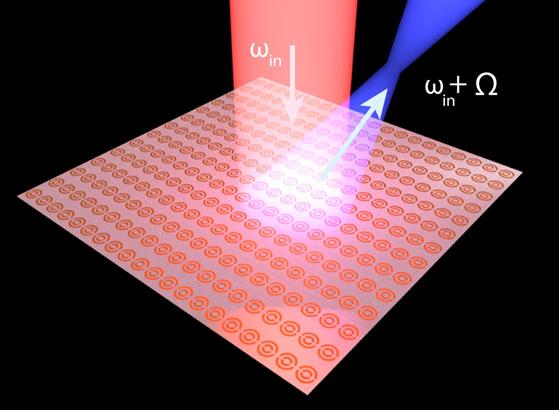
The reflectors are composed of an array of finely structured electronic components on a planar surface. Applying signals to the components allows the 2-D reflector to perform much like a 3-D antenna, and in some cases do things no conventional antenna could do. This sort of a device is known as a “metasurface” because its characteristics can be electronically changed to act in different ways without modifying the physical shape of the surface.
By applying electrical signals to the reflector components, the researchers managed to modulate the metasurface to control the direction and frequency of reflected light. The nonreciprocal response of the reflector can help prevent antennas from picking up echoes from their outgoing broadcasts and protect delicate circuitry from powerful, potentially damaging incoming signals.
“We have demonstrated the first dynamic metasurface capable of achieving extreme non-reciprocity by converting microwaves into plasmons, which are electric charge waves on the reflector’s surface,” said Diego Dalvit, of the T-4 group at Los Alamos. “This is key to controlling the way the reflectors function.”
The new Los Alamos reflector platform opens exciting opportunities in various applications, including adaptive optics that can account for distortions that disrupt signals, one-way wireless transmission, and novel antenna designs.
###
Publication: Surface-Wave-Assisted Nonreciprocity in Spatio-Temporally Modulated Metasurfaces, Nature Communications, DOI: https:/
Funding: Laboratory Directed Research and Development program at Los Alamos National Laboratory
About Los Alamos National Laboratory
Los Alamos National Laboratory, a multidisciplinary research institution engaged in strategic science on behalf of national security, is operated by Triad, a public service oriented, national security science organization equally owned by its three founding members: Battelle Memorial Institute (Battelle), the Texas A&M University System (TAMUS), and the Regents of the University of California (UC) for the Department of Energy’s National Nuclear Security Administration.
Los Alamos enhances national security by ensuring the safety and reliability of the U.S. nuclear stockpile, developing technologies to reduce threats from weapons of mass destruction, and solving problems related to energy, environment, infrastructure, health, and global security concerns.
Media Contact
James Riordon
[email protected]
505-667-3272
Related Journal Article
http://dx.