• HOME
  • NEWS
  • EXPLORE
    • CAREER
      • Companies
      • Jobs
    • EVENTS
    • iGEM
      • News
      • Team
    • PHOTOS
    • VIDEO
    • WIKI
  • BLOG
  • COMMUNITY
    • FACEBOOK
    • INSTAGRAM
    • TWITTER
Sunday, May 10, 2026
BIOENGINEER.ORG
No Result
View All Result
  • Login
  • HOME
  • NEWS
  • EXPLORE
    • CAREER
      • Companies
      • Jobs
        • Lecturer
        • PhD Studentship
        • Postdoc
        • Research Assistant
    • EVENTS
    • iGEM
      • News
      • Team
    • PHOTOS
    • VIDEO
    • WIKI
  • BLOG
  • COMMUNITY
    • FACEBOOK
    • INSTAGRAM
    • TWITTER
  • HOME
  • NEWS
  • EXPLORE
    • CAREER
      • Companies
      • Jobs
        • Lecturer
        • PhD Studentship
        • Postdoc
        • Research Assistant
    • EVENTS
    • iGEM
      • News
      • Team
    • PHOTOS
    • VIDEO
    • WIKI
  • BLOG
  • COMMUNITY
    • FACEBOOK
    • INSTAGRAM
    • TWITTER
No Result
View All Result
Bioengineer.org
No Result
View All Result
Home NEWS Science News Biology

Fishing rod ‘selfie stick’ and scientific sleuthing turn up clues to extinct sea reptile

Bioengineer by Bioengineer
May 19, 2020
in Biology
Reading Time: 3 mins read
0
IMAGE
Share on FacebookShare on TwitterShare on LinkedinShare on RedditShare on Telegram

Skeleton high on a London museum wall — mostly ignored for a century — spurs a study finding that the creatures swam in seas from England to Russia to the Arctic, Baylor University researcher says
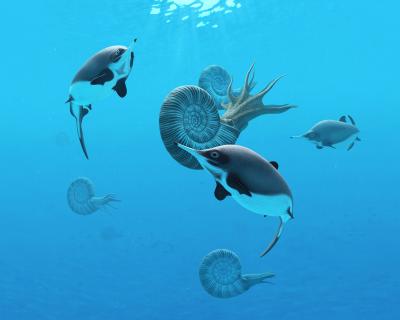
IMAGE

Credit: Andrey Atuchin

A Russian paleontologist visiting the Natural History Museum in London desperately wanted a good look at the skeleton of an extinct aquatic reptile, but its glass case was too far up the wall. So he attached his digital camera to a fishing rod and — with several clicks — snagged a big one, scientifically speaking.

Images from the “selfie stick” revealed that the creature, whose bones were unearthed more than a century ago on a coast in southern England, seemed very similar to a genus of ichthyosaurs he recognized from Russian collections.

He emailed the photos of the dolphin-like ichthyosaur to fellow paleontologist Megan L. Jacobs, a Baylor University doctoral candidate in geosciences. She quickly realized that the animal’s skeletal structure matched not only some ichthyosaurs she was studying in a fossil museum on the English Channel coast, but also some elsewhere in the United Kingdom.

Jacobs and paleontologist Nikolay G. Zverkov of the Russian Academy of Sciences — who “fished” for the ichthyosaur — merged their research, studying their collective photos and other materials and ultimately determining that the Russian and English ichthyosaurs were of the same genus and far more common and widespread than scientists believed.

Their study is published in the Zoological Journal of the Linnean Society.

“Ichthyosaurs swam the seas of our planet for about 76 million years,” Jacobs said. “But this 5-foot ichthyosaur from some 150 million years ago was the least known and believed to be among the rarest ichthyosaurs. The skeleton in the case, thought to be the only example of the genus, has been on display in the Natural History Museum in London since 1922.

“Nikolay’s excellent detailed photos significantly expand knowledge of Nannopterygius enthekiodon,” she said. “Now, after finding examples from museum collections across the United Kingdom, Russia and the Arctic — as well as several other Nannopterygius species — we can say Nannopterygius is one of the most widespread genera of ichthyosaurs in the Northern Hemisphere.”

Additionally, the study described a new species, Nannopterygius borealis, dating from about 145 million years ago in a Russian archipelago in the Arctic. The new species is the northernmost and youngest representative of its kind, Jacobs said.

Previously, for the Middle and Late Jurassic epochs, the only abundant and most commonly found ichthyosaur was Ophthalmosaurus, which had huge eyes and was about 20 feet long. It was known from hundreds of specimens, including well-preserved skeletons from the Middle Jurassic Oxford Clay Formation of England, Jacobs said.

“For decades, the scientific community thought that Nannopterygius was the rarest and most poorly known ichthyosaur of England,” Zverkov said. “Finally, we can say that we know nearly every skeletal detail of these small ichthyosaurs and that these animals were widespread. The answer was very close; what was needed was just a fishing rod.”

###

Media Contact
Terry Goodrich
[email protected]

Original Source

https://www.baylor.edu/mediacommunications/news.php?action=story&story=219051

Related Journal Article

http://dx.doi.org/10.1093/zoolinnean/zlaa028

Tags: ArchaeologyBiologyEarth ScienceEvolutionOld WorldPaleontology
Share13Tweet8Share2ShareShareShare2

Related Posts

Ancient Plant Populations Reveal Fresh Insights into Climate Resilience — Biology

Ancient Plant Populations Reveal Fresh Insights into Climate Resilience

May 8, 2026
Rare Brain Disorders in Children Linked to Mutations in Lesser-Known Protein Complex — Biology

Rare Brain Disorders in Children Linked to Mutations in Lesser-Known Protein Complex

May 8, 2026

From Odd Insect to Underwater Predator: The Remarkable Evolution of a Bloodthirsty Fruit Fly

May 8, 2026

SNU Professor Sangwoo Seo’s Team Develops Next-Generation CRISPR Biocontainment Technology to Control Microbial Survival Without DNA Cleavage

May 8, 2026
Please login to join discussion

POPULAR NEWS

  • Research Indicates Potential Connection Between Prenatal Medication Exposure and Elevated Autism Risk

    840 shares
    Share 336 Tweet 210
  • New Study Reveals Plants Can Detect the Sound of Rain

    727 shares
    Share 290 Tweet 181
  • Scientists Investigate Possible Connection Between COVID-19 and Increased Lung Cancer Risk

    68 shares
    Share 27 Tweet 17
  • Salmonella Haem Blocks Macrophages, Boosts Infection

    61 shares
    Share 24 Tweet 15

About

We bring you the latest biotechnology news from best research centers and universities around the world. Check our website.

Follow us

Recent News

Evaluating Digoxin Use in Patients with Symptomatic Rheumatic Heart Disease

Evaluating the Effectiveness and Safety of Digitalis Glycosides in Treating Heart Failure

Urdu Fall Risk Questionnaire Adapted for Elderly

Subscribe to Blog via Email

Enter your email address to subscribe to this blog and receive notifications of new posts by email.

Join 82 other subscribers
  • Contact Us

Bioengineer.org © Copyright 2023 All Rights Reserved.

Welcome Back!

Login to your account below

Forgotten Password?

Retrieve your password

Please enter your username or email address to reset your password.

Log In
No Result
View All Result
  • Homepages
    • Home Page 1
    • Home Page 2
  • News
  • National
  • Business
  • Health
  • Lifestyle
  • Science

Bioengineer.org © Copyright 2023 All Rights Reserved.