Astronomers have successfully launched a balloon-borne telescope which has begun capturing images of the Universe on its first research flight.
Credit: SuperBIT
Astronomers have successfully launched a balloon-borne telescope which has begun capturing images of the Universe on its first research flight.
The super pressure balloon-borne Imaging Telescope (SuperBIT) was flown to the edge of space by a helium-filled NASA scientific balloon the size of a football stadium where it will help researchers investigate the mystery of dark matter.
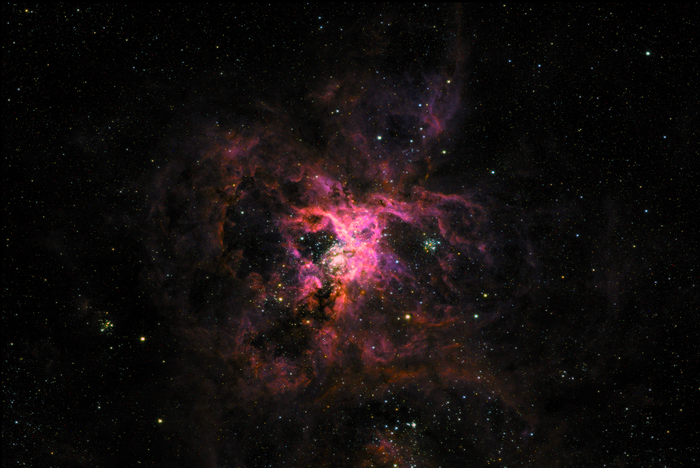
SuperBIT has already taken its first images on this flight, showing the “Tarantula Nebula” – a neighbourhood of the Large Magellanic Cloud where new stars are being born, and the collision between the “Antennae galaxies” NGC 4038 and NGC 4039.
SuperBIT is a collaboration between Durham University, UK, the University of Toronto, Canada, Princeton University, USA, and NASA.
It launched from Wānaka, New Zealand (Aotearoa) earlier this week, following a two-year delay due to the Covid pandemic.
Carried by seasonally stable winds for about three months, it will circumnavigate the southern hemisphere several times – imaging the sky all night, then using solar panels to recharge its batteries during the day.
SuperBIT flies at 33.5km altitude, above 99.5 per cent of the Earth’s atmosphere. It takes high-resolution images like those of the Hubble Space Telescope, but with a wider field of view.
The science goal for this first flight is to measure the properties of dark matter, a heavy but invisible type of material. Dark matter is all around us but poorly understood.
SuperBIT will test whether dark matter particles can bounce off each other, by mapping the dark matter around clusters of galaxies that are colliding with neighbouring galaxy clusters.
Various theories about dark matter suggest that, during a collision, some dark matter might either slow down, spread out, or get chipped off.
The researchers say that if they can map dark matter leaving the collision, they could finally start to learn what it is made of.
Professor Richard Massey, of Durham University’s Department of Physics, said: “It takes the gravity from an entire galaxy to move dark matter and SuperBIT will look at clusters of galaxies that happen to be colliding with each other.
“Essentially, we’re using the largest particle accelerators in the Universe, to smash lumps of dark matter and see where the bits fly.
“If dark matter goes ‘crunch’, or if bits are chipped off, we could finally start to learn what it’s made of.”
Although dark matter is invisible, SuperBIT will map where it is by the way it bends passing rays of light, a technique known as gravitational lensing.
While telescopes on the ground have to squint through the Earth’s atmosphere – meaning their view can become blurred – space-based telescopes get a clear view of the light that has travelled billions of years from the distant universe.
SuperBIT is the first ever balloon-borne telescope capable of taking wide-field images with resolution limited only by the laws of optics.
During its final test flight in 2019, SuperBIT demonstrated extraordinary pointing stability, with variation of less than one thirty-six thousandth of a degree for more than an hour.
SuperBIT cost about $5million/£4.1million, almost 1,000 times less than an equivalent satellite. Not only is helium cheaper than rocket fuel, but the ability of SuperBIT to return to Earth via parachute meant the team could tweak its design over several test flights.
Reusable spacecraft can also be reconfigured and upgraded. For example, the development team buy a new camera shortly before each launch, because modern detectors are improving so rapidly. Using cutting-edge technology has kept SuperBIT young.
The team already has funding to upgrade SuperBIT’s 0.5 metre aperture telescope to 1.6 metres, which would boost light gathering power tenfold, with a wider-angle lens and more megapixels. The relatively cheap cost may even make it possible for a fleet of space telescopes to offer time to astronomers around the world.
The public can follow SuperBIT’s flight status on NASA’s website here.
Funding for the SuperBIT mission has been provided by NASA, the Canadian Space Agency, and the Royal Society.
ENDS