• HOME
  • NEWS
  • EXPLORE
    • CAREER
      • Companies
      • Jobs
    • EVENTS
    • iGEM
      • News
      • Team
    • PHOTOS
    • VIDEO
    • WIKI
  • BLOG
  • COMMUNITY
    • FACEBOOK
    • INSTAGRAM
    • TWITTER
Tuesday, August 18, 2026
BIOENGINEER.ORG
No Result
View All Result
  • Login
  • HOME
  • NEWS
  • EXPLORE
    • CAREER
      • Companies
      • Jobs
        • Lecturer
        • PhD Studentship
        • Postdoc
        • Research Assistant
    • EVENTS
    • iGEM
      • News
      • Team
    • PHOTOS
    • VIDEO
    • WIKI
  • BLOG
  • COMMUNITY
    • FACEBOOK
    • INSTAGRAM
    • TWITTER
  • HOME
  • NEWS
  • EXPLORE
    • CAREER
      • Companies
      • Jobs
        • Lecturer
        • PhD Studentship
        • Postdoc
        • Research Assistant
    • EVENTS
    • iGEM
      • News
      • Team
    • PHOTOS
    • VIDEO
    • WIKI
  • BLOG
  • COMMUNITY
    • FACEBOOK
    • INSTAGRAM
    • TWITTER
No Result
View All Result
Bioengineer.org
No Result
View All Result
Home NEWS Science News Health

First ‘pathoconnectome’ could point toward new treatments for neurodegenerative diseases

Bioengineer by Bioengineer
September 29, 2020
in Health
Reading Time: 2 mins read
0
IMAGE
Share on FacebookShare on TwitterShare on LinkedinShare on RedditShare on Telegram

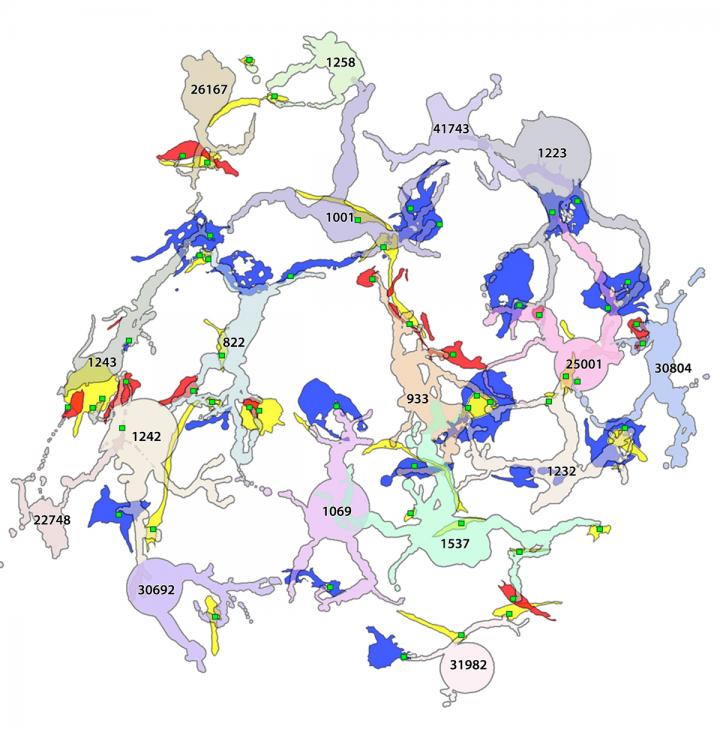
The pathoconnectome can be used to identify potential new treatments for neurodegenerative diseases, including epilepsy and Alzheimer’s, by showing how they rewire neural systems
IMAGE

Credit: John A. Moran Eye Center

SALT LAKE CITY–Scientists from the John A. Moran Eye Center at the University of Utah have achieved another first in the field of connectomics, which studies the synaptic connections between neurons.

Moran’s Marclab for Connectomics was the first to complete a map of the circuitry of the retina, or connectome, in 2011. Now, the National Institutes of Health (NIH)-funded lab has produced the first pathoconnectome, showing how eye disease alters retinal circuitry.

The implications of the published research, A pathoconnectome of early neurodegeneration: Network changes in retinal degeneration, extend far beyond eye diseases. The eye holds lessons applicable to a host of neurodegenerative diseases including Alzheimer’s, Parkinson’s, epilepsy, and Lou Gehrig’s disease.

“The components of neurodegeneration we see in the eye seem to mimic those we see in the brain,” explained the paper’s lead author, Moran’s Rebecca L. Pfeiffer, PhD. “So this pathoconnectome is allowing us to learn fundamental rules of how neurodegenerative diseases alter neural networks in general. The ultimate goal is to identify how we might develop new therapies based on preventing or interfering with the network rewiring prompted by disease.”

The Marclab developed the pathoconnectome from a model of early-stage retinitis pigmentosa (RP), an inherited retinal disease that can lead to blindness. The immense data set compiled to construct the pathoconnectome has taken years to assemble and is open for use by other scientists. The Marclab is working on a second and third pathoconnectome that will show how the retina rewires itself in later stages of RP.

###

In addition to Pfeiffer, 12 other Marclab researchers are authors on the publication: James R. Anderson, PhD; Jeebika Dahal; Jessica C. Garcia; Jia-Hui Yang; Crystal L. Sigulinsky PhD; Kevin Rapp; Daniel P. Emrich; Carl B. Watt, PhD; Hope AB Johnstun; Alexis R. Houser; Robert E. Marc, PhD; and lab director Bryan W. Jones, PhD.

The Marclab constructed the pathoconnectome by studying 946 tissue sections with two transmission electron microscopes, which work nonstop nearly every day of the year to produce an unprecedented amount of data to understand retinal circuitry. In 2018, the Lawrence T. and Janet T. Dee Foundation generously funded the lab’s second transmission electron microscope. The first was provided by Moran donor Martha Ann Dumke Healy.

Watch a video to learn more about the pathoconnectome.

Media Contact
Elizabeth Neff
[email protected]

Original Source

https://healthcare.utah.edu/moran/news/2020/09/pathoconnectome.php

Related Journal Article

http://dx.doi.org/10.1016/j.exer.2020.108196

Tags: BiologyCell BiologyMedicine/HealthneurobiologyOphthalmology
Share13Tweet8Share2ShareShareShare2

Related Posts

Severe mental illness tied to higher dementia risk and earlier strokes

August 18, 2026

Cardiac stress marker changes may better predict heart disease in older adults

August 17, 2026

New framework organizes complex knowledge, evidence, and records across data lakehouses

August 17, 2026

Level III Neonatal ICUs Vary in Patients, Services, and Outcomes

August 17, 2026
Please login to join discussion

POPULAR NEWS

  • Last common ancestor may have climbed vertically, regardless of limb structure

    29 shares
    Share 12 Tweet 7
  • SUNY Poly Receives $15K Health Forward Foundation Grant for Respiratory Care Research

    29 shares
    Share 12 Tweet 7
  • Patient-specific blood–brain tumor barrier chip predicts glioblastoma treatment responses

    29 shares
    Share 12 Tweet 7
  • Natural leaf coatings could help hydrochar store carbon more effectively

    29 shares
    Share 12 Tweet 7

About

We bring you the latest biotechnology news from best research centers and universities around the world. Check our website.

Follow us

Recent News

Last common ancestor may have climbed vertically, regardless of limb structure

SUNY Poly Receives $15K Health Forward Foundation Grant for Respiratory Care Research

Patient-specific blood–brain tumor barrier chip predicts glioblastoma treatment responses

Subscribe to Blog via Email

Enter your email address to subscribe to this blog and receive notifications of new posts by email.

Join 85 other subscribers
  • Contact Us

Bioengineer.org © Copyright 2023 All Rights Reserved.

Welcome Back!

Login to your account below

Forgotten Password?

Retrieve your password

Please enter your username or email address to reset your password.

Log In
No Result
View All Result
  • Homepages
    • Home Page 1
    • Home Page 2
  • News
  • National
  • Business
  • Health
  • Lifestyle
  • Science

Bioengineer.org © Copyright 2023 All Rights Reserved.