An Austrian-Swiss research team was able to find a previously unknown glacial relic in the Alps, the Alpine rose leaf-miner moth. It is the first known species to have its caterpillars specializing on the rust-red alpine rose, a very poisonous, widely distributed plant that most animals, including moths and butterflies, strictly avoid. The extraordinary record was just published in the peer-reviewed scientific journal Alpine Entomology.
Credit: Ingrid Huemer
An Austrian-Swiss research team was able to find a previously unknown glacial relic in the Alps, the Alpine rose leaf-miner moth. It is the first known species to have its caterpillars specializing on the rust-red alpine rose, a very poisonous, widely distributed plant that most animals, including moths and butterflies, strictly avoid. The extraordinary record was just published in the peer-reviewed scientific journal Alpine Entomology.
Poisonous host plant
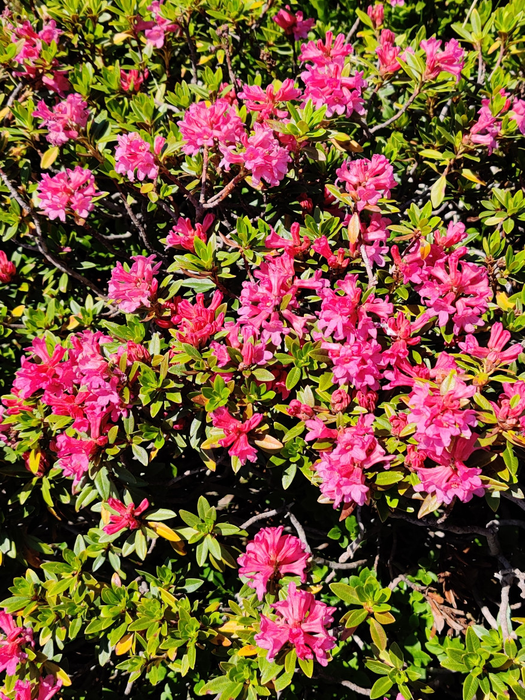
The rust-red alpine rose (Rhododendron ferrugineum) is among the best-known and most attractive plants due to its flowering splendor – at least for humans. It is, in fact, a highly poisonous plant, strictly avoided by grazing animals. For insects, the alpine rose is attractive at most as a nectar plant; insect larvae, on the other hand, develop on it only in exceptional cases. This also applies to Alpine butterflies and moths, which leave Alpine roses largely untouched despite their wide distribution. Therefore, the discovery of a highly specialized species in the Alps came as a complete surprise.
Chance find
Since alpine roses are unattractive to caterpillars and no insect the entire Alpine region was previously known to specialize on them, butterfly and moth experts had considered them rather uninteresting and ignored them in their research. The discovery of the alpine rose leaf-miner wasn’t the result of a targeted search: it was a pure stroke of luck.
During a cloudy spell in July this year, researchers surveying the butterflies in Ardez in the Engadine valley, Switzerland, happened to take a break exactly at an infested alpine rose bush.
“The accidental sighting of the first caterpillar in an alpine rose leaf was an absolute adrenaline rush, it was immediately clear that this must be an extraordinary species,” explains Peter Huemer, researcher and head of the natural sciences department of the Tyrolean State Museums. Together with the Swiss butterfly and moth expert Jürg Schmid, he came back in late July and early August to look for caterpillars and pupae and find out more about this curious insect. The extended search yielded evidence of a stable population of a species that was initially a complete enigma.
Life in the leaf
The alpine rose leaf-miner moth drills through the upper leaf skin and into the leaf interior immediately after the caterpillar hatches. The caterpillar then spends its entire life until pupation between the intact leaf skins, eating the leaf from the inside. Thanks to this behavior, the caterpillar is just as well protected from bad weather as from many predators such as birds, spiders, or some carnivore insects. The feeding trail, called a leaf mine, begins with a long corridor and ends in a large square-like mine section. The feces are deposited inside this mine. When the time comes for pupation, the caterpillar leaves the infested leaf and makes a typical web on the underside or a nearby leaf. With the help of several fine silk threads, it produces an elaborate “hammock”, in which the pupation finally takes place. In the laboratory, after about 10 days, the successful breeding to a moth succeeded, with a striking result.
Enigmatic glacial relic
Huemer and Schmid were surprised to find out that the moths belonged to a species that was widespread in northern Europe, northern Asia and North America – the swamp porst leaf-miner butterfly Lyonetia ledi. By looking at its morphological features, such as wing color and pattern, and comparing its DNA barcodes to those of northern European specimens, they were able to confirm its identity.
The Engadine population, however, is located more than 400 km away from the nearest other known populations, which are on the border of Austria and the Czech Republic. Furthermore, the species lives in northern Europe exclusively on swamp porst and Gagel bush – two shrubs that are typical for raised bogs and absent from the Alps. However, the researchers suggest that in earlier cold phases – some 22,000 years ago – the swamp porst and the alpine rose did share a habitat in perialpine lowland habitats north of the Alps. It is very likely that after the last cold period and the melting of the glaciers, some populations of the species shifted their host preference from the swamp porst to the alpine rose. The separation of the distribution areas of the two plants caused by subsequent warm phases inevitably led to the separation of the moth populations.
Extinction risk
The Alpine Rose Leaf-miner Moth is so far only known from the Lower Engadine. It lives in a steep, north-exposed, spruce-larch-pine forest at about 1,800 m above sea level. The high snow coverage in winter and the largely shady conditions in summer mean that alpine roses don’t get to bloom there. The scientists suspect that the moth species can still be discovered in places with similar conditions in the northern Alps, such as in neighboring Tyrol and Vorarlberg. Since the moth is likely nocturnal and flies late in the year, probably hibernating in the adult stage, the search for the caterpillars and pupae is more promising. However, the special microclimate of the Swiss location does not suggest that this species, which has so far been overlooked despite 250 years of research, is widespread. On the contrary, there are legitimate concerns that it could be one of the first victims of climate change.
Original source:
Huemer P, Schmid J (2021) Relict populations of Lyonetia ledi Wocke, 1859 (Lepidoptera, Lyonetiidae) from the Alps indicate postglacial host-plant shift to the famous Alpenrose (Rhododendron ferrugineum L.). Alpine Entomology 5: 101-106. https://doi.org/10.3897/alpento.5.76930
Journal
Alpine Entomology
DOI
10.3897/alpento.5.76930
Article Title
Relict populations of Lyonetia ledi Wocke, 1859 (Lepidoptera, Lyonetiidae) from the Alps indicate postglacial host-plant shift to the famous Alpenrose (Rhododendron ferrugineum L.)
Article Publication Date
22-Nov-2021