• HOME
  • NEWS
  • EXPLORE
    • CAREER
      • Companies
      • Jobs
    • EVENTS
    • iGEM
      • News
      • Team
    • PHOTOS
    • VIDEO
    • WIKI
  • BLOG
  • COMMUNITY
    • FACEBOOK
    • INSTAGRAM
    • TWITTER
Monday, May 11, 2026
BIOENGINEER.ORG
No Result
View All Result
  • Login
  • HOME
  • NEWS
  • EXPLORE
    • CAREER
      • Companies
      • Jobs
        • Lecturer
        • PhD Studentship
        • Postdoc
        • Research Assistant
    • EVENTS
    • iGEM
      • News
      • Team
    • PHOTOS
    • VIDEO
    • WIKI
  • BLOG
  • COMMUNITY
    • FACEBOOK
    • INSTAGRAM
    • TWITTER
  • HOME
  • NEWS
  • EXPLORE
    • CAREER
      • Companies
      • Jobs
        • Lecturer
        • PhD Studentship
        • Postdoc
        • Research Assistant
    • EVENTS
    • iGEM
      • News
      • Team
    • PHOTOS
    • VIDEO
    • WIKI
  • BLOG
  • COMMUNITY
    • FACEBOOK
    • INSTAGRAM
    • TWITTER
No Result
View All Result
Bioengineer.org
No Result
View All Result
Home NEWS Science News Biology

First maps of areas suitable for spotted lanternfly’s establishment in US and world

Bioengineer by Bioengineer
October 3, 2019
in Biology
Reading Time: 2 mins read
0
IMAGE
Share on FacebookShare on TwitterShare on LinkedinShare on RedditShare on Telegram

IMAGE

Credit: ARS-USDA

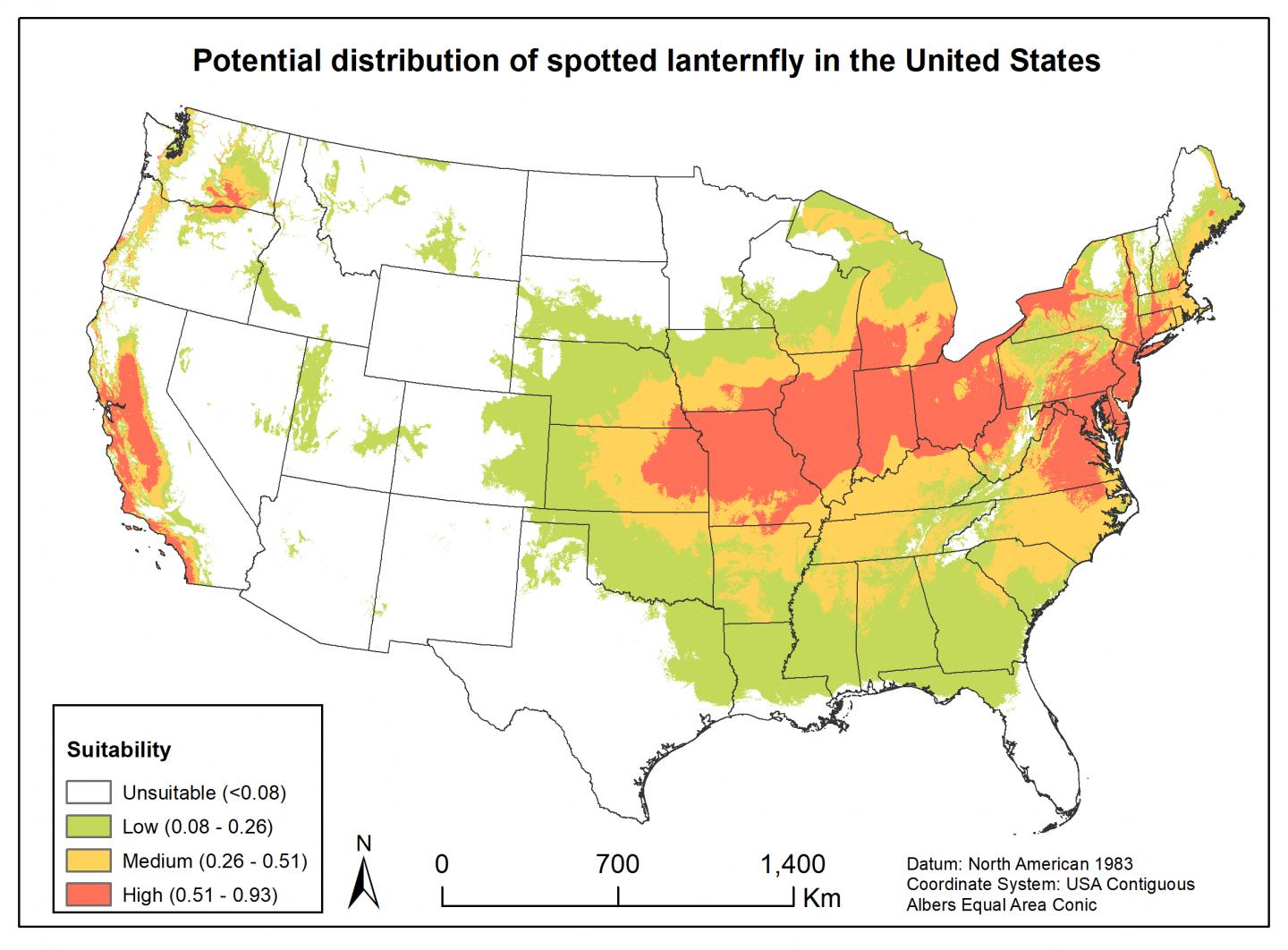
WAPATO, WASHINGTON, October 3, 2019–Maps identifying the areas suitable for establishment of the spotted lanternfly (SLF) in the United States and other countries have been published in the Journal of Economic Entomology by Agricultural Research Service scientists.

The SLF, originally from China, has spread to Korea and Japan, and has been found most recently in the United States in Pennsylvania, New Jersey, Virginia and Delaware. These insects are pests of many agricultural crops including almonds, apples, blueberries, cherries, peaches, grapes and hops as well as hardwoods such as oak, walnut and poplar, among others. USDA and state partners have been working to contain SLF populations since 2014.

There is the potential for far reaching economic damage if the SLF becomes widely established in the United States.

Within the United States, SLF could eventually become established in most of New England and the mid-Atlantic states, the central United States, and Pacific coastal states, explained ecologist Tewodros Wakie with the ARS Temperate Tree Fruit and Vegetable Research Unit in Wapato, Washington, who led the project.

“Earlier attempts to predict the spread of the spotted lanternfly using a less sophisticated model had indicated a potential for the pest to become established in warmer areas such as southeastern Florida and in tropical countries,” Wakie said. “But we made use of a more complex model called MAXENT that depends on a wider number of environmental factors including temperature, elevation and rainfall as well as the current known locations of the species.

MAXENT has proven to be much more accurate at predicting where species are likely to spread compared to 16 other methods on 266 species.

“There are numerous examples where new populations of species were discovered following MAXENT predictions. Our lab group used MAXENT to predict the potential distribution of oriental fruit moth, and apple maggot, and predictions have been more accurate than anything previously,” said Wakie.

Eleven European countries and large parts of the Northeast United States and the Pacific Northwest were found to be prime habitat for SLF establishment in place of tropical locales with MAXENT.

The most important factor in predicting SLF establishment is the mean temperature of the driest quarter of the year; it cannot be too hot or too cold, about 0 degrees C plus or minus 7 degrees C (a temperature range between 19 and 45 degrees F), Wakie explained.

Another important factor in predicting SLF’s possible range is the presence of the tree of heaven–an invasive plant that also originated from China. Although not the only host plant for SLF, it is a highly important host plant for the insect. Studies are underway to identify additional host plants and to find the right biocontrol system.

Results from this study can be used to guide SLF surveys and prioritize management interventions for this pest, Wakie added.

###

The Agricultural Research Service is the U.S. Department of Agriculture’s chief scientific in-house research agency. Daily, ARS focuses on solutions to agricultural problems affecting America. Each dollar invested in agricultural research results in $20 of economic impact.

Media Contact
Kim Kaplan
[email protected]

Tags: Agricultural Production/EconomicsAgricultureBiodiversityEcology/EnvironmentEntomology
Share12Tweet8Share2ShareShareShare2

Related Posts

Ancient Plant Populations Reveal Fresh Insights into Climate Resilience — Biology

Ancient Plant Populations Reveal Fresh Insights into Climate Resilience

May 8, 2026
Rare Brain Disorders in Children Linked to Mutations in Lesser-Known Protein Complex — Biology

Rare Brain Disorders in Children Linked to Mutations in Lesser-Known Protein Complex

May 8, 2026

From Odd Insect to Underwater Predator: The Remarkable Evolution of a Bloodthirsty Fruit Fly

May 8, 2026

SNU Professor Sangwoo Seo’s Team Develops Next-Generation CRISPR Biocontainment Technology to Control Microbial Survival Without DNA Cleavage

May 8, 2026
Please login to join discussion

POPULAR NEWS

  • Research Indicates Potential Connection Between Prenatal Medication Exposure and Elevated Autism Risk

    840 shares
    Share 336 Tweet 210
  • New Study Reveals Plants Can Detect the Sound of Rain

    727 shares
    Share 290 Tweet 181
  • Salmonella Haem Blocks Macrophages, Boosts Infection

    61 shares
    Share 24 Tweet 15
  • Breastmilk Balances E. coli and Beneficial Bacteria in Infant Gut Microbiomes

    57 shares
    Share 23 Tweet 14

About

We bring you the latest biotechnology news from best research centers and universities around the world. Check our website.

Follow us

Recent News

New Post-Hoc Analysis Explores Daily Oral Orforglipron Use in Adults Over 65 with Obesity, Regardless of Diabetes Status

Evaluating Digoxin Use in Patients with Symptomatic Rheumatic Heart Disease

Evaluating the Effectiveness and Safety of Digitalis Glycosides in Treating Heart Failure

Subscribe to Blog via Email

Enter your email address to subscribe to this blog and receive notifications of new posts by email.

Join 82 other subscribers
  • Contact Us

Bioengineer.org © Copyright 2023 All Rights Reserved.

Welcome Back!

Login to your account below

Forgotten Password?

Retrieve your password

Please enter your username or email address to reset your password.

Log In
No Result
View All Result
  • Homepages
    • Home Page 1
    • Home Page 2
  • News
  • National
  • Business
  • Health
  • Lifestyle
  • Science

Bioengineer.org © Copyright 2023 All Rights Reserved.