Groundbreaking all-sky survey will bolster our understanding of the formation and evolution of galaxies
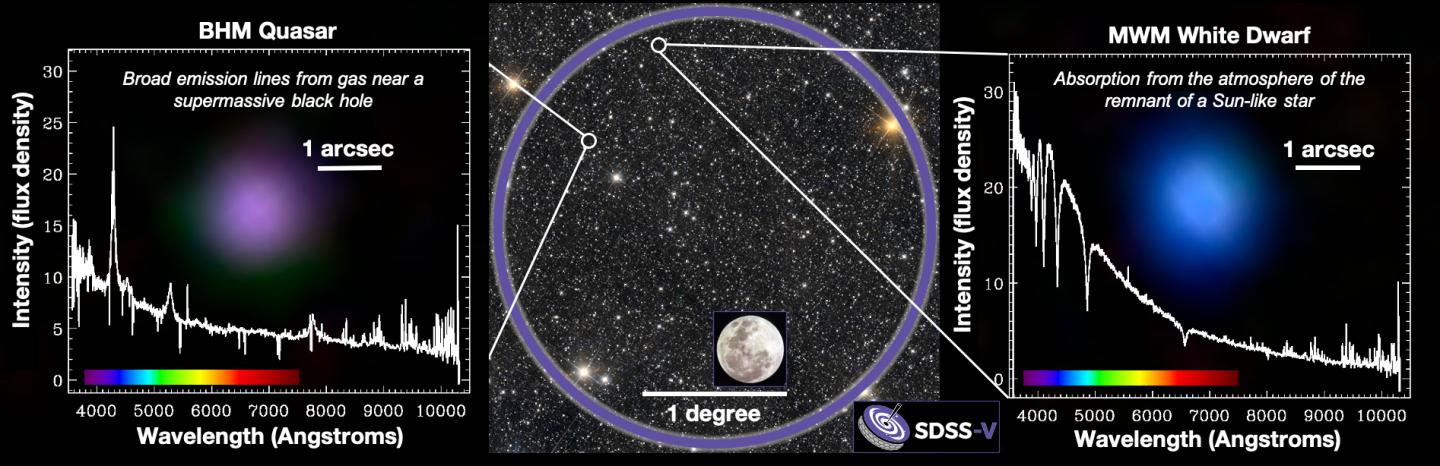
Credit: Image Credit: Hector Ibarra Medel, Jon Trump, Yue Shen, Gail Zasowski, and the SDSS-V Collaboration. Central background image: unWISE / NASA/JPL-Caltech / D.Lang (Perimeter Institute).
Pasadena, CA– The Sloan Digital Sky Survey’s fifth generation collected its very first observations of the cosmos at 1:47 a.m. on October 24, 2020. This groundbreaking all-sky survey will bolster our understanding of the formation and evolution of galaxies–including our own Milky Way–and the supermassive black holes that lurk at their centers.
The newly-launched SDSS-V will continue the path-breaking tradition set by the survey’s previous generations, with a focus on the ever-changing night sky and the physical processes that drive these changes, from flickers and flares of supermassive black holes to the back-and-forth shifts of stars being orbited by distant worlds. SDSS-V will provide the spectroscopic backbone needed to achieve the full science potential of satellites like NASA’s TESS, ESA’s Gaia, and the latest all-sky X-ray mission, eROSITA.
“In a year when humanity has been challenged across the globe, I am so proud of the worldwide SDSS team for demonstrating–every day–the very best of human creativity, ingenuity, improvisation, and resilience. It has been a challenging period for the team, but I’m happy to say that the pandemic may have slowed us, but it has not stopped us” said SDSS-V Director Juna Kollmeier.
As an international consortium, SDSS has always relied heavily on phone and digital communication. But adapting to exclusively virtual communication tactics was a challenge, as was tracking global supply chains and laboratory availability at various university partners while they shifted in and out of lockdown during the final ramp-up to the survey’s start. Particularly inspiring were the project’s expert observing staff, who worked in even-greater-than-usual isolation to shut down, and then reopen, operations at the survey’s mountain-top observatories.
Funded primarily by member institutions, along with grants from the Alfred P. Sloan Foundation, the U.S. National Science Foundation, and the Heising-Simons Foundation, SDSS-V will focus on three primary areas of investigation, each exploring different aspects of the cosmos using different spectroscopic tools. Together these three project pillars–called “Mappers”–will observe more than six million objects in the sky, and monitor changes in more than a million of those objects over time.
The survey’s Local Volume Mapper will enhance our understanding of galaxy formation and evolution by probing the interactions between the stars that make up galaxies and the interstellar gas and dust that is dispersed between them. The Milky Way Mapper will reveal the physics of stars in our Milky Way, the diverse architectures of its star and planetary systems, and the chemical enrichment of our galaxy since the early universe. The Black Hole Mapper will measure masses and growth over cosmic time of the supermassive black holes that reside in the hearts of galaxies as well as the smaller black holes left behind when stars die.
“We are thrilled to start taking the first data for two of our three Mappers,” added SDSS-V Spokesperson Gail Zasowski of the University of Utah. “These early observations are already important for a wide range of science goals. Even these first targets cover goals from mapping the inner regions of supermassive black holes and searching for exotic multiple-black hole systems, to studying nearby stars and their dead cores, to tracing the chemistry of potential planet-hosting stars across the Milky Way.”
“SDSS-V will continue to transform astronomy by building on a 20-year legacy of path-breaking science, shedding light on the most fundamental questions about the origins and nature of the universe. It demonstrates all the hallmark characteristics that have made SDSS so successful in the past: open sharing of data, inclusion of diverse scientists, and collaboration across numerous institutions,” said Evan Michelson, program director at the Sloan Foundation. “We are so pleased to support Juna Kollmeier and the entire SDSS team, and we are excited for this next phase of discovery.”
SDSS-V will operate out of both Apache Point Observatory in New Mexico, home of the survey’s original 2.5-meter telescope, and Carnegie’s Las Campanas Observatory in Chile, where it uses the 2.5-meter du Pont telescope.
“SDSS V is one of the most important astronomical projects of the decade. It will set new standards not only in astrophysics but also in robotics and big data,” said the observatory’s Director Leopoldo Infante. “Consequently, to ensure its success, the Las Campanas Observatory is prepared to carry out the project with all the human and technical resources available on the mountain.”
SDSS-V’s first observations were gathered in New Mexico with existing SDSS instruments, as a necessary change of plans due to the pandemic. As laboratories and workshops around the world navigate safe reopening, SDSS-V’s own suite of new innovative hardware is on the horizon—in particular, systems of automated robots to aim the fiber optic cables used to collect the light from the night sky. These will be installed at both observatories over the next year. New spectrographs and telescopes are also being constructed to enable the Local Volume Mapper observations.
“Carnegie has enabled SDSS to expand its reach to the Southern Hemisphere. I’m so pleased to see our role in this foundational effort expand with this next generation,” concluded Carnegie Observatories Director John Mulchaey.
###
Media Contact
Juna Kollmeier
[email protected]