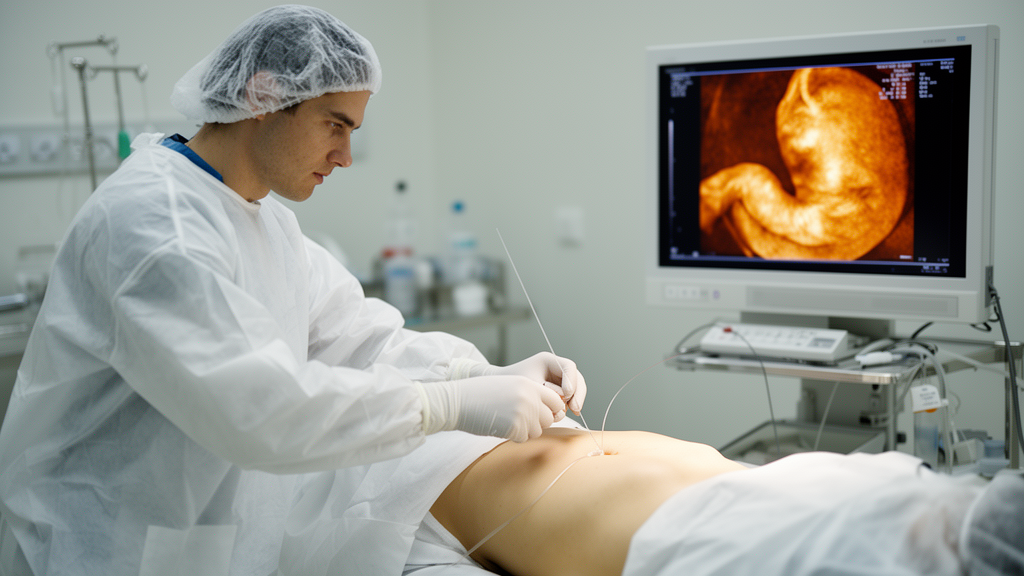
At the UCI Health Chao Family Comprehensive Cancer Center in Orange, California, a clinical team is testing a treatment that sounds almost like science fiction: destroying pancreatic tumors with laser light. The center is one of only two cancer centers in the United States conducting a first-in-human, phase 1 clinical trial of vascular targeted photodynamic therapy, or VTP, for patients with localized but inoperable pancreatic tumors. The therapy, developed by the Israel-based biotechnology company ImPact Biotech, combines a light-sensitive drug called padeliporfin with a laser delivered inside a balloon catheter that is threaded into a blood vessel encased by the tumor. The published report describes the study as an ongoing multicenter, phase 1 light dose escalation study of intra-arterial padeliporfin VTP in unresectable locally advanced pancreatic ductal adenocarcinoma, and the early findings have now appeared in the Journal of Vascular and Interventional Radiology.
When the laser is switched on, it activates the drug, triggering a photochemical reaction that destroys the tumor tissue surrounding the vessel. The goal is ambitious but precise: to clear major abdominal arteries of tumor so that patients who were previously denied surgery can become candidates for an operation that could save their lives. We use the light-sensitive drug padeliporfin to destroy pancreatic tumors encasing major arteries in the abdomen, and once the vessels are clear of tumors, patients can undergo what can be a lifesaving surgery, said Dr. Nadine Abi-Jaoudeh, a UCI Health radiologist, nationally recognized expert in interventional approaches to treating cancers, and lead investigator of the clinical trial. The stakes could hardly be higher for the patients the trial is designed to reach.
Pancreatic cancer has one of the lowest survival rates of all cancers, and a large share of patients face a particularly cruel obstacle. Roughly half of patients are diagnosed with localized disease that has not yet spread, but of that group, about two-thirds are not candidates for surgery. The reason is usually anatomical: their tumors wrap around major arteries that deliver blood to the abdomen, and attempting to remove the tumor would risk damaging those vessels. Without surgery, patients with localized cancers face survival rates similarly low to those of patients whose disease has already metastasized, according to Abi-Jaoudeh, who is also a professor of radiology at the UC Irvine School of Medicine. It is this gap between localized disease and operable disease that the new therapy is designed to close.
The mechanics of the procedure are as intricate as the biology it targets. First, the clinical team injects the patient with the light-sensitive drug padeliporfin. Next, the interventional team inserts a balloon into the tumor-encased blood vessel. Inside the balloon sits a laser. When the laser is turned on, light fills the vessel and activates the drug, killing the tumor tissue that surrounds the artery. What happens at the tissue level is a cascade of vascular destruction: illuminating padeliporfin causes a photochemical reaction within the blood vessel that breaks down the tumor’s network of blood vessels, and ultimately, the tumor itself. The treatment is delivered in two increments of five minutes each after participants have been injected with the drug, a tightly controlled illumination schedule that reflects how precisely the therapy must be dosed.
As part of the phase 1 trial, the clinical research team is testing three incremental doses of laser illumination to determine the most effective one, a light-dose escalation design that gives each participant one of the planned illumination levels. Although tissue destruction begins immediately after treatment, the team does not rush to the operating room. Instead, the researchers wait two weeks before surgically removing the residual tumor tissue, allowing the treated region to be assessed and the remaining disease to be addressed through a separate procedure. This sequencing, from drug injection to intra-arterial illumination to delayed surgical removal, defines the full pathway a patient moves through on the trial.
The early results, while preliminary, are striking. In findings published in the Journal of Vascular and Interventional Radiology, Abi-Jaoudeh reported on three trial participants treated with the padeliporfin VTP therapy. Since that report, another three patients have received the targeted low-light therapy, bringing the total to six. Of those six patients, four went on to have the remaining tumor tissue surgically removed. For a disease in which most locally advanced patients are never operated on at all, the conversion of four patients to surgery represents a meaningful early signal from a first-in-human study.
The margin findings are the most detailed outcome reported so far. Of the four patients who underwent surgical removal of residual tumor tissue, three had no evidence of cancer cells at the surgical margins. Abi-Jaoudeh emphasized the significance of the finding for a patient population with few options, noting that because patients with localized cancers who cannot undergo surgery have similarly low survival rates as patients with metastasized pancreatic cancer, any therapy that can convert inoperable tumors into operable ones addresses one of the most stubborn bottlenecks in pancreatic cancer care. The trial’s co-investigators include UCI Health medical oncologist Dr. Jennifer B. Valerin and surgeons Dr. David K. Imagawa and Dr. Zeljka Jutric, reflecting the multidisciplinary effort required to move patients from interventional radiology through oncology and into the operating room.
The small number of patients treated so far means the margin findings should be read as encouraging preliminary observations from a dose escalation study rather than established outcomes, and the therapy remains investigational until larger trials confirm both its safety and its benefit. The treatment also comes with unusual demands on patients. After receiving the light-activated drug, patients must spend three days in a dark room, because exposure to light could cause damage to other areas of the body, including the skin. According to the research team, that constraint is a key reason this therapy has not been used to treat larger areas of the body. The dark-room requirement underscores how the very property that makes padeliporfin a targeted weapon against tumors, its responsiveness to light, also shapes every stage of how patients must be cared for around the procedure.
The path forward depends on whether the early signals hold. If the investigative team confirms that the approach is effective, the hope is to move on to the next phases of the trial. Phase 2 and phase 3 studies, once approved by the U.S. Food and Drug Administration, would test VTP therapy in significantly more patients than the handful treated so far. Such trials would be needed to establish whether the surgical conversion and margin results seen in the first six patients are reproduced at scale, and whether the therapy translates into the outcomes that matter most to patients with locally advanced pancreatic cancer, a group that today has limited treatment options.
For now, the trial remains one of only two such efforts in the country, and the UCI Health team continues to treat patients under the phase 1 protocol at the Chao Family Comprehensive Cancer Center, the only National Cancer Institute-designated comprehensive cancer center based in Orange County. The study’s reported results, published with the abstract describing intra-arterial padeliporfin vascular-targeted photodynamic therapy in unresectable locally advanced pancreatic ductal adenocarcinoma, mark an early step in a long clinical evaluation process. The research team reported no conflicts of interest. What the first six patients have shown, that laser-activated drug therapy can be delivered inside tumor-encased arteries and followed by surgery in some cases, gives the field a starting point from which the larger trials of the future will be judged.
Subject of Research: Padeliporfin vascular-targeted photodynamic therapy for unresectable locally advanced pancreatic cancer
Article Title: First-in-human study at UCI Health attacks pancreatic cancer with laser light
Article References: First-in-human study at UCI Health attacks pancreatic cancer with laser light. Original publication (Bibliographic details unavailable.)
Image Credits: AI Generated
DOI: Not provided
Keywords: pancreatic cancer, photodynamic therapy, padeliporfin, phase 1 trial, UCI Health, interventional radiology, vascular-targeted therapy, locally advanced pancreatic ductal adenocarcinoma, laser ablation, clinical trial, surgical margins, ImPact Biotech
News Source: Nathaniel Bowman. (October 27, 2026). First-in-Human Trial Uses Laser Light to Attack Inoperable Pancreatic Tumors. Scienmag.