• HOME
  • NEWS
  • EXPLORE
    • CAREER
      • Companies
      • Jobs
    • EVENTS
    • iGEM
      • News
      • Team
    • PHOTOS
    • VIDEO
    • WIKI
  • BLOG
  • COMMUNITY
    • FACEBOOK
    • INSTAGRAM
    • TWITTER
Thursday, May 21, 2026
BIOENGINEER.ORG
No Result
View All Result
  • Login
  • HOME
  • NEWS
  • EXPLORE
    • CAREER
      • Companies
      • Jobs
        • Lecturer
        • PhD Studentship
        • Postdoc
        • Research Assistant
    • EVENTS
    • iGEM
      • News
      • Team
    • PHOTOS
    • VIDEO
    • WIKI
  • BLOG
  • COMMUNITY
    • FACEBOOK
    • INSTAGRAM
    • TWITTER
  • HOME
  • NEWS
  • EXPLORE
    • CAREER
      • Companies
      • Jobs
        • Lecturer
        • PhD Studentship
        • Postdoc
        • Research Assistant
    • EVENTS
    • iGEM
      • News
      • Team
    • PHOTOS
    • VIDEO
    • WIKI
  • BLOG
  • COMMUNITY
    • FACEBOOK
    • INSTAGRAM
    • TWITTER
No Result
View All Result
Bioengineer.org
No Result
View All Result
Home NEWS Science News Chemistry

First 3D-printed proton-conductive membrane paves way for tailored energy storage devices

Bioengineer by Bioengineer
April 15, 2021
in Chemistry
Reading Time: 3 mins read
0
IMAGE
Share on FacebookShare on TwitterShare on LinkedinShare on RedditShare on Telegram

IMAGE

Credit: Tohoku University

The advent and increased availability of 3D printing is leading to more customizable parts at lower costs across a spectrum of applications, from wearable smart devices to autonomous vehicles. Now, a research team based at Tohoku University has 3D printed the first proton exchange membrane, a critical component of batteries, electrochemical capacitors and fuel cells. The achievement also brings the possibility of custom solid-state energy devices closer to reality, according to the researchers.

The results were published on March 29 in ACS Applied Energy Materials, a journal of the American Chemical Society.

“Energy storage devices whose shapes can be tailored enable entirely new possibilities for applications related, for example, to smart wearable, electronic medical devices, and electronic appliances such as drones,” said Kazuyuki Iwase, paper author and assistant professor in professor Itaru Honma’s group at the Institute of Multidisciplinary Research for Advanced Materials at Tohoku University. “3D printing is a technology that enables the realization of such on-demand structures.”

Current 3D printing fabrication focuses on structural parts contributing to a final product’s function, rather than imbuing parts with their own function.

“However, 3D printing of energy storage devices requires specialized, functional inks,” Iwase said. “We developed a fabrication process and synthesized functionalized nano inks that enables the realization of quasi-solid-state energy storage devices based on 3D printing.”

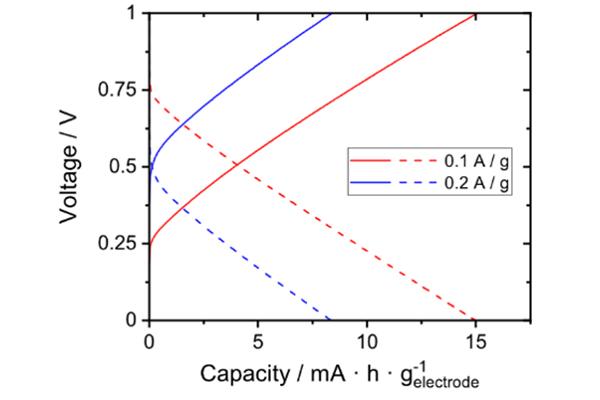
The team mixed inorganic silica nanoparticles with photo-curable resins and liquid capable of conducting protons, with rapt attention paid to the viscosity of the resulting ink. Previous studies, the researchers said, resulted in inks that could not be 3D printed. By mixing the ratios of the ingredients, the researchers developed inks that could be employed in a dispensing 3D printer and still retain their properties even after cured with ultraviolet irradiation. To test the properties, the researchers assembled a printed membrane between two carbon electron electrodes to make an operational quasi-solid-state electrochemical capacitor – a key component needed to facilitate energy storage and discharge in electronic devices.

“As we can freely choose the inorganic materials or resins for curing, we hypothesize that this technique can be applied to various types of quasi-solid-state energy conversion devices,” Iwase said.

“Compared to conventional fabrication techniques, the ability to 3D print such devices opens up new possibilities for proton-conducting devices, such as shapes that can be adjusted to fit to the devices they power or that can be adapted to the personal needs of a patient wearing a smart medical device,” Iwase said.

The team plans to improve the ink formulas with the goal of fully 3D printing energy storage devices with more complex shapes and look for industrial partners who might be interested in applying this technique or other possibilities to commercialize it.

###

Media Contact
Kazuyuki Iwase
[email protected]

Original Source

https://www.tohoku.ac.jp/en/press/first_3d_printed_proton_conductive_membrane.html

Related Journal Article

http://dx.doi.org/10.1021/acsaem.1c00076

Tags: Chemistry/Physics/Materials SciencesMaterialsTechnology/Engineering/Computer Science
Share13Tweet8Share2ShareShareShare2

Related Posts

Advancing In Vivo and In Situ Monitoring: Science Bulletin Highlights Host-Based Antifouling Gold Nanotube Sensor for Selective Detection of Mechanically Sensitive Serotonin Release in Intestinal Mucosa — Chemistry

Advancing In Vivo and In Situ Monitoring: Science Bulletin Highlights Host-Based Antifouling Gold Nanotube Sensor for Selective Detection of Mechanically Sensitive Serotonin Release in Intestinal Mucosa

May 20, 2026
How Magnetic Orientation Could Influence the Building Blocks of Life — Chemistry

How Magnetic Orientation Could Influence the Building Blocks of Life

May 20, 2026

Breaking a 200-Year-Old Belief: Novel Surface Design Achieves Two Distinct Wetting States on One Substrate

May 20, 2026

Unveiling Sound Waves: Scientists Discover Hidden Behaviors in Acoustic Phenomena

May 20, 2026
Please login to join discussion

POPULAR NEWS

  • blank

    New Study Reveals Plants Can Detect the Sound of Rain

    733 shares
    Share 292 Tweet 183
  • ESMO 2025: mRNA COVID Vaccines Enhance Efficacy of Cancer Immunotherapy

    302 shares
    Share 121 Tweet 76
  • Research Indicates Potential Connection Between Prenatal Medication Exposure and Elevated Autism Risk

    846 shares
    Share 338 Tweet 212
  • Breastmilk Balances E. coli and Beneficial Bacteria in Infant Gut Microbiomes

    58 shares
    Share 23 Tweet 15

About

BIOENGINEER.ORG

We bring you the latest biotechnology news from best research centers and universities around the world. Check our website.

Follow us

Recent News

Cusp Singularity Boosts Chip-Scale Gyroscope Sensitivity

NutriGrow Delphi Sets Standards for Preterm Nutrition Reporting

Critical Path Institute Unveils New Coalition to Propel Human-Relevant Drug Development Tools

Subscribe to Blog via Email

Enter your email address to subscribe to this blog and receive notifications of new posts by email.

Join 82 other subscribers
  • Contact Us

Bioengineer.org © Copyright 2023 All Rights Reserved.

Welcome Back!

Login to your account below

Forgotten Password?

Retrieve your password

Please enter your username or email address to reset your password.

Log In
No Result
View All Result
  • Homepages
    • Home Page 1
    • Home Page 2
  • News
  • National
  • Business
  • Health
  • Lifestyle
  • Science

Bioengineer.org © Copyright 2023 All Rights Reserved.