A tightly linked cluster of more than 500 genes gives certain fire ants a developmental advantage by increasing their likelihood of growing larger and maturing into reproductive queens, according to a peer-reviewed study conducted by entomologists at the University of Georgia. Published in Proceedings of the Royal Society B Biological Sciences, the research investigates the developmental mechanisms through which genetic architecture shapes caste determination and physical outcomes in ant colonies. In fire ant populations, social organization typically falls into two distinct categories: colonies governed by a single egg-laying queen and colonies containing multiple reproductive queens. The specific supergene under investigation is known to be directly associated with the multi-queen colony structure, and the new findings illuminate how this genetic package improves its own transmission to future generations by biasing the growth trajectories of individual ants.
A supergene functions as an integrated collection of genes that are inherited together as a single block rather than segregating independently during sexual reproduction. Co-author Brendan Hunt, an associate professor in the Department of Entomology within the University of Georgia College of Agricultural and Environmental Sciences, explained that these units are described as supergenes because their individual genes are so tightly linked that they effectively operate as one large gene. Working alongside fellow entomologist Haolin “Horace” Zeng, Hunt aimed to determine whether the same supergene responsible for orchestrating colony organization also exerts direct control over the physiological growth and maturation of individual developing ants.
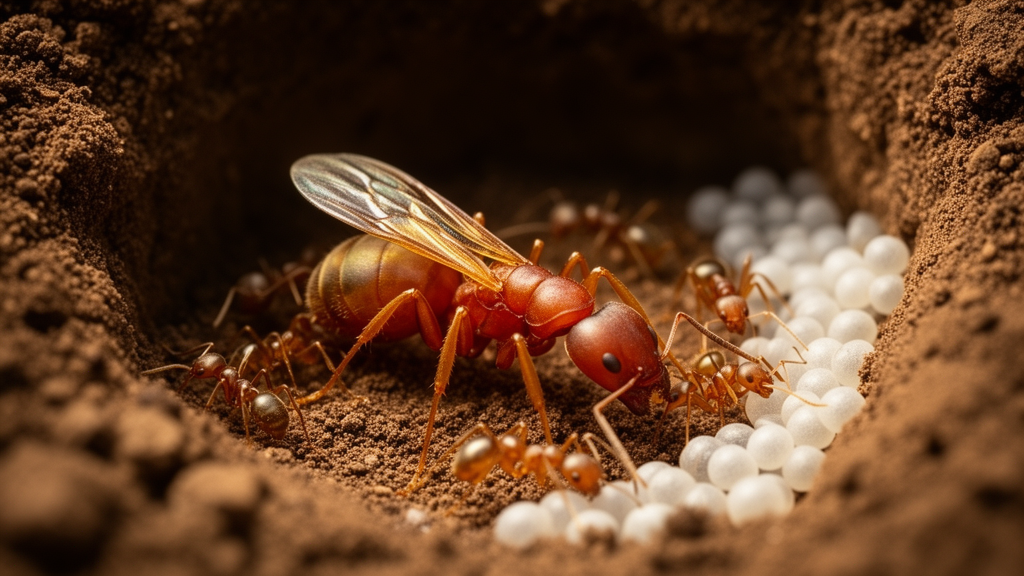
Within a typical fire ant colony, division of labor corresponds closely to body size, caste identity, and reproductive role. The vast majority of colony inhabitants are female workers that dedicate their lives to foraging for sustenance, caring for developing young, and defending the communal nest against threats. Among workers, body dimensions correlate with behavioral duties, as smaller workers typically tend to the brood and maintain nest infrastructure, whereas larger workers are substantially more likely to forage outside the nest. Queens represent the largest caste in the entire colony and, unlike the non-reproductive worker castes, are solely responsible for laying eggs and passing their genes forward to subsequent generations. While entomologists previously established that external factors such as larval nutrition, environmental circumstances, and physical interactions with nestmates direct caste outcomes, the University of Georgia researchers designed experiments to test whether genetics could also bias the developmental scales.
To investigate this genetic influence, the research team compared developing fire ants carrying the supergene against counterparts that lacked the genetic element. Growth in fire ants does not follow the pattern seen in animals that attain larger adult dimensions by accelerating their growth rate; instead, fire ants grow larger by extending the duration of time they spend actively feeding as larvae prior to reaching adulthood. The researchers focused their experimental investigation on juvenile hormone, an internal chemical messenger that regulates developmental timing and metamorphosis in insects. The team exposed developing larvae to methoprene, an established chemical analog that mimics the physiological action of juvenile hormone, to evaluate whether carriers of the supergene responded differently during development than non-carriers.
The experimental treatments with methoprene caused exposed ants to develop into larger individuals, but detailed analysis of the resulting adults revealed an unexpected developmental distribution between the two genetic groups. Both groups of ants demonstrated equivalent overall responsiveness to the hormone mimic and remained capable of attaining the identical maximum body size range. However, ants possessing the supergene were consistently overrepresented among the largest individuals produced by the treatment. Hunt noted that approximately half of the smallest workers carried the supergene, but that proportion expanded to roughly 65 percent among the largest workers. Among fully developed queens, between 75 percent and 83 percent possessed the genetic package, demonstrating that more than three out of every four queens carry the supergene.
Because adult body size serves as a critical biological determinant in whether an immature ant develops into a sterile worker or a reproductive queen, the researchers concluded that this size advantage significantly elevates a supergene carrier’s probability of achieving queen status. Hunt noted that this developmental mechanism allows a genetic element to alter caste differentiation through body size and essentially cheat its way into producing a reproductive queen. In evolutionary biology, researchers refer to such hereditary structures as selfish genetic elements because they promote their own transmission into subsequent generations at the expense of other genes. As Zeng pointed out, passing genetic material to future generations in an ant colony requires an individual to become a queen rather than an infertile worker.
Despite demonstrating this pronounced developmental bias, the researchers noted that the precise biological pathways through which the supergene alters larval growth remain unknown. The investigators suggested two primary working hypotheses: larvae possessing the supergene may spend a longer period feeding during their larval stages, or they may utilize dietary nutrients with greater metabolic efficiency during growth. In addition, the research team identified a specific individual gene within the supergene cluster that could help account for these developmental discrepancies. Zeng described the study as the initial step in a new research trajectory investigating how the social supergene shapes insect physiology and development, while Hunt emphasized that the discovery facilitates broader investigations into how complex inherited gene groupings interact with hormones and environmental factors across animal species.
Subject of Research: Genetic and hormonal regulation of fire ant body size and queen caste development
Article Title: Born to be queen: A look inside fire ant hierarchy
Article References: Born to be queen: A look inside fire ant hierarchy. Original publication (Bibliographic details unavailable.)
Image Credits: AI Generated
DOI: Not provided
Keywords: fire ants, supergenes, caste determination, entomology, juvenile hormone, University of Georgia, evolutionary genetics, Proceedings of the Royal Society B, Born, queen, look, inside
News Source: Drew Townsend. (November 9, 2026). Fire Ant Supergene Increases Body Size and Queen Caste Chances. Scienmag.