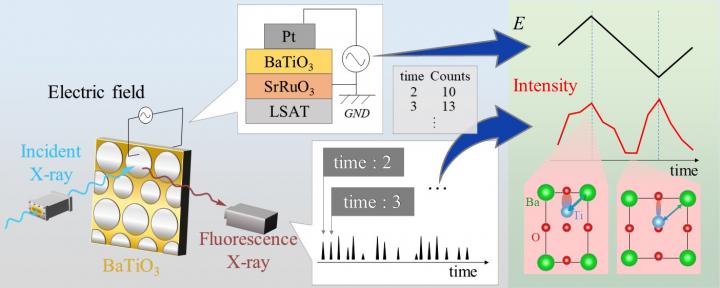
Credit: Nobuo Nakajima, Hiroshima University
Researchers in Japan have used a novel, ultra-fast technique to explore the fine structure of a potential alternative material to lead titanate, a ferroelectric material widely used for sensors in many everyday devices. Understanding this structure takes us a step closer to eliminating these remaining sources of lead pollution.
The study appeared in the materials science journal Acta Materialia on 21 January.
Ferroelectric materials are used in a wide range of practical applications, from capacitors to memory cells, medical ultrasound to data storage and displays. These materials have a spontaneous polarization, or direction, of their electrons that can be switched back and forth via the application of an electric field, called ferroelectricity.
Worldwide, society is increasingly recognizing the need to reduce pollution from all activities and devices, but in order to advance this goal, an even deeper understanding of the structure of many materials currently used must first be achieved. Among the very large family of various ferroelectric materials, lead titanate is commonly used in sensors that measure pressure, acceleration, temperature, strain, or force in a raft of common devices. Lead pollution has long since been shown to be tremendously damaging to the human brain, and while most jurisdictions have outlawed lead in paint and gasoline, the quest to develop alternative materials for such devices remains yet to be completed.
Some research has been performed on perovskite titanates, a family of ferroelectric materials that combine titanium oxide (TiO) with either lead, barium, strontium or calcium. The perovskite prefix simply describes the crystal structure, each of which the members of the family share. A common crystal structure in turn means that lead could potentially be substituted with the less environmentally threatening barium (due to their ions having a similar size and charge).
This earlier research had identified a clear link between the hybridization of electron orbitals of perovskite titanate’s different constituent atoms and its ferroelectric properties.
“The next step therefore was to somehow achieve direct observation of the state of these electrons as the electric field was being applied,” says Nobuo Nakajima of the Graduate School of Advanced Science and Engineering at Hiroshima University, a co-author of the study. “This required ultra-fast observations.”
So the team combined x-ray absorption spectroscopy (XAS) with a time-resolved approach. XAS involves the interaction of an x-ray with the deep-core electrons of an atom rather than its outer (or valence) electrons. Measurement of this interaction permits description of the fine structure of the material. A time-resolved approach involves use of this technique to study the dynamic changes in the material on the sort of extremely short time scales in which phenomena such as ferroelectric polarization reversal occur. It allows the researchers to detect the tiniest of changes in spectra and electronic states under electric ?elds. The combination of the two techniques was performed for the first time, on barium titanate.
The researchers found that in addition to the orbital hybridization between titanium and oxygen that had already been identified, a similar effect was spotted between the barium and the state of titanium electrons. This also contributed to the polarization reversal in barium titanate.
They hope that their novel technique applied to a parallel perovskite titanate could provide clues to what they describe as the “hidden nature” of lead titanate, and take the world a step closer to elimination of lead pollution.
###
About Hiroshima University
Since its foundation in 1949, Hiroshima University has striven to become one of the most prominent and comprehensive universities in Japan for the promotion and development of scholarship and education. Consisting of 12 schools for undergraduate level and 4 graduate schools, ranging from natural sciences to humanities and social sciences, the university has grown into one of the most distinguished comprehensive research universities in Japan.
English website: https:/
Media Contact
Norifumi Miyokawa
[email protected]
Related Journal Article
http://dx.