• HOME
  • NEWS
  • EXPLORE
    • CAREER
      • Companies
      • Jobs
    • EVENTS
    • iGEM
      • News
      • Team
    • PHOTOS
    • VIDEO
    • WIKI
  • BLOG
  • COMMUNITY
    • FACEBOOK
    • INSTAGRAM
    • TWITTER
Monday, May 11, 2026
BIOENGINEER.ORG
No Result
View All Result
  • Login
  • HOME
  • NEWS
  • EXPLORE
    • CAREER
      • Companies
      • Jobs
        • Lecturer
        • PhD Studentship
        • Postdoc
        • Research Assistant
    • EVENTS
    • iGEM
      • News
      • Team
    • PHOTOS
    • VIDEO
    • WIKI
  • BLOG
  • COMMUNITY
    • FACEBOOK
    • INSTAGRAM
    • TWITTER
  • HOME
  • NEWS
  • EXPLORE
    • CAREER
      • Companies
      • Jobs
        • Lecturer
        • PhD Studentship
        • Postdoc
        • Research Assistant
    • EVENTS
    • iGEM
      • News
      • Team
    • PHOTOS
    • VIDEO
    • WIKI
  • BLOG
  • COMMUNITY
    • FACEBOOK
    • INSTAGRAM
    • TWITTER
No Result
View All Result
Bioengineer.org
No Result
View All Result
Home NEWS Science News Chemistry

Findings bridge knowledge gap between pheromone sensitivity and courtship

Bioengineer by Bioengineer
October 16, 2019
in Chemistry
Reading Time: 2 mins read
0
IMAGE
Share on FacebookShare on TwitterShare on LinkedinShare on RedditShare on Telegram

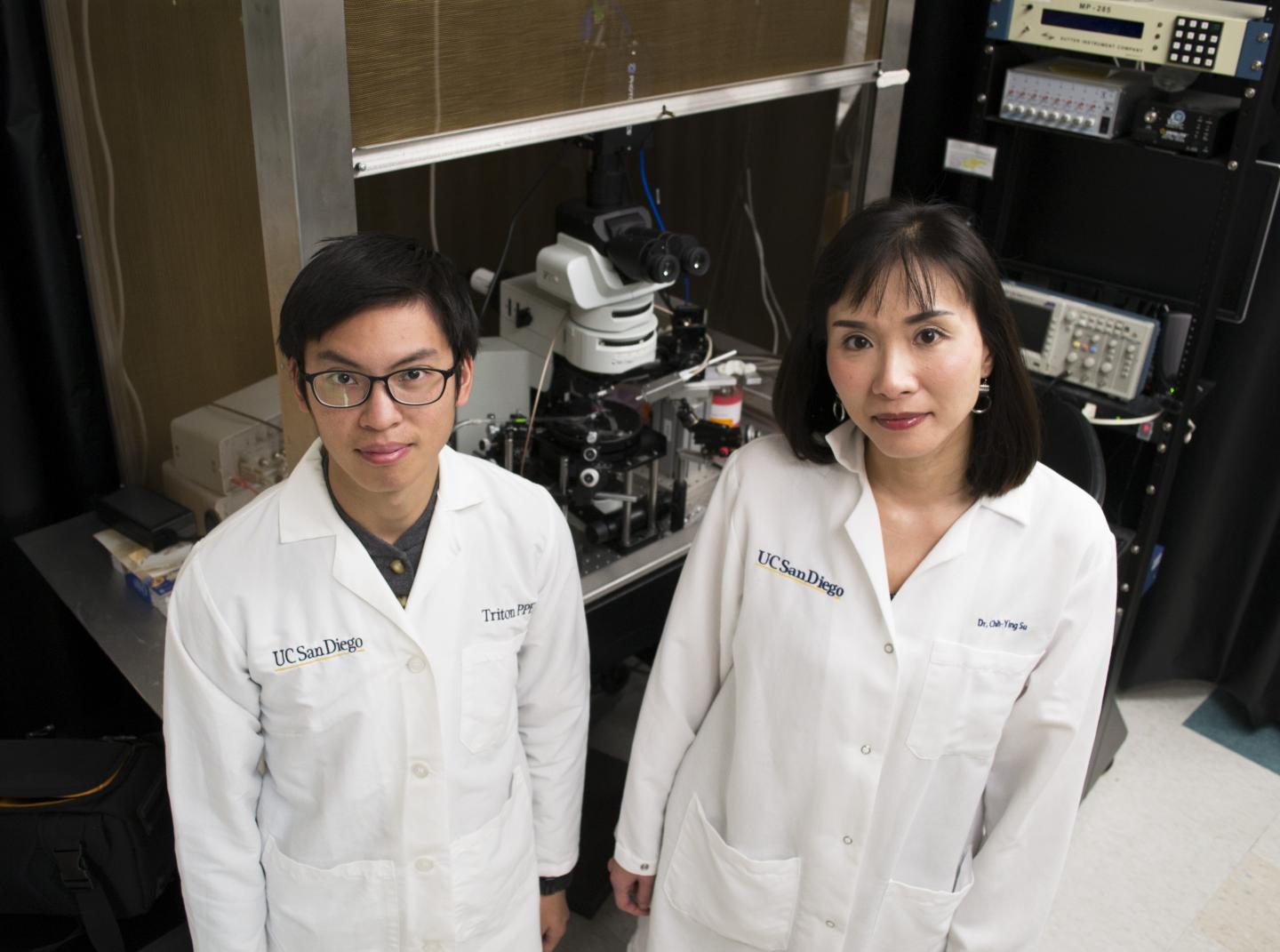
Study in flies links fertility and the response strength of pheromone-sensing neurons
IMAGE

Credit: UC San Diego

Just as humans use their noses for the sense of smell, insects such as fruit flies use their antennae–covered in sensory hairs called sensilla–for olfaction. In flies, the sense of smell plays a fundamental role in courtship.

Nearly 10 years ago, scientists made a significant leap in characterizing insect olfaction when they identified unique properties of the receptor proteins involved. They showed that when odor particles are detected, receptors of the insect “olfactory receptor neurons” (ORNs) function as ion channels; odorant activation directly leads to an influx of positive ions that allows cells to fire, essentially making these channels gateways for ionic flow. But in the past decade little progress has been made in understanding how the strengths of these neuronal responses are regulated.

Now, neurobiologists at the University of California San Diego have made a series of discoveries about fruit fly olfactory processing, including solving a long-standing puzzle of whether and how courtship-promoting signals are amplified by these neurons. Staff Research Associate Renny Ng, Assistant Professor Chih-Ying Su and colleagues published their results on Oct. 16, 2019 in the journal Neuron.

The researchers identified the role of a channel permeable to sodium ions. Known as PPK25, the channel amplifies courtship signals in the ORNs of male flies. Mechanistically, these findings draw further similarities between invertebrate olfactory neurons and vertebrate ORNs, which also undergo signal amplification. Biologically, PPK25 heightens males’ sensitivity to their mates’ odors at the age of peak fertility, thus promoting courtship when flies are most fertile.

“Given its evolutionary importance, courtship behavior is under tight hormonal regulation. We find that PPK25 expression is upregulated in those neurons by a reproductive hormone,” said Su, a faculty member in the Division of Biological Sciences Section of Neurobiology. “The expression level in turn determines the ORN response magnitude to impact courtship behavior. Without such amplification, male courtship is severely compromised.”

The new findings help neuroscientists bridge a knowledge gap in sensory transduction and opens doors to future research on the impact of sexual cues at the level of individual neurons.

PPK25 is a member of a superfamily of ion channels that may also employ the same amplification mechanism. The study therefore carries implications across several species beyond fruit flies, including worms, mosquitoes and even humans. In principle, the amplification mechanism unraveled in the new study could operate in other sensory modalities such as touch, temperature and hearing.

###

The paper was coauthored by Secilia Salem (undergraduate assistant), Shiuan-Tze Wu (graduate student), Hui-Hao Lin (postdoctoral fellow), Andrew Shepherd (research assistant) and Jing Wang (professor) of the Section of Neurobiology; and Meilin Wu (research scientist) and William Joiner (professor) of the Department of Pharmacology.

Media Contact
Mario Aguilera
[email protected]
858-822-5148
Tags: BiochemistryBiologyBiomechanics/BiophysicsBiotechnologyCell BiologyDevelopmental/Reproductive BiologyEntomologyGeneticsMicrobiology
Share14Tweet9Share2ShareShareShare2

Related Posts

Miniature Sensor Uses Light to Detect Touch — Chemistry

Miniature Sensor Uses Light to Detect Touch

May 8, 2026
Iron Minerals Determine Whether Dissolved Organic Matter Fuels Microbes or Becomes Long-Term Carbon Storage — Chemistry

Iron Minerals Determine Whether Dissolved Organic Matter Fuels Microbes or Becomes Long-Term Carbon Storage

May 8, 2026

Kate Evans Appointed Associate Lab Director for Biological and Environmental Systems Science at ORNL

May 8, 2026

Advancing Multiscale Modeling and Overcoming Operational Challenges in Autothermal COâ‚‚-to-Methanol Reactors

May 8, 2026
Please login to join discussion

POPULAR NEWS

  • Research Indicates Potential Connection Between Prenatal Medication Exposure and Elevated Autism Risk

    840 shares
    Share 336 Tweet 210
  • New Study Reveals Plants Can Detect the Sound of Rain

    727 shares
    Share 290 Tweet 181
  • Salmonella Haem Blocks Macrophages, Boosts Infection

    61 shares
    Share 24 Tweet 15
  • Breastmilk Balances E. coli and Beneficial Bacteria in Infant Gut Microbiomes

    57 shares
    Share 23 Tweet 14

About

We bring you the latest biotechnology news from best research centers and universities around the world. Check our website.

Follow us

Recent News

New Post-Hoc Analysis Explores Daily Oral Orforglipron Use in Adults Over 65 with Obesity, Regardless of Diabetes Status

Evaluating Digoxin Use in Patients with Symptomatic Rheumatic Heart Disease

Evaluating the Effectiveness and Safety of Digitalis Glycosides in Treating Heart Failure

Subscribe to Blog via Email

Enter your email address to subscribe to this blog and receive notifications of new posts by email.

Join 82 other subscribers
  • Contact Us

Bioengineer.org © Copyright 2023 All Rights Reserved.

Welcome Back!

Login to your account below

Forgotten Password?

Retrieve your password

Please enter your username or email address to reset your password.

Log In
No Result
View All Result
  • Homepages
    • Home Page 1
    • Home Page 2
  • News
  • National
  • Business
  • Health
  • Lifestyle
  • Science

Bioengineer.org © Copyright 2023 All Rights Reserved.