Selective breeding could help shrink the methane footprint of beef cattle, but only if the emissions data behind the breeding values are trustworthy. A new study of Australian feedlot steers, published in Genetics Selection Evolution, reports that far fewer methane spot-samples per animal are needed for genetic evaluation than earlier recommendations suggested. Requiring animals to have at least five spot-samples of two minutes or longer performed as well as much stricter data thresholds, and better than including animals with only a single visit to the emissions recorder. The finding could substantially enlarge the reference populations available for breeding lower-emitting cattle.
All animals were housed at the Tullimba Feedlot in New South Wales, where feed intake, liveweight, growth and emissions were recorded between October 2022 and May 2024 under approved animal ethics protocols.
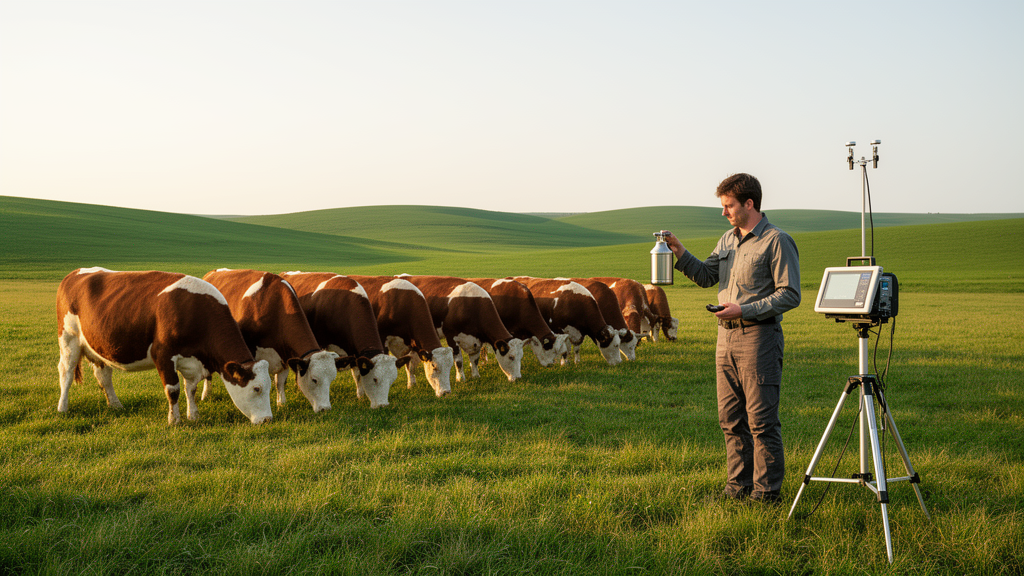
Emissions were measured with GreenFeed Emission Monitor units, automated feeders that bait cattle with small pellet rewards and then capture breath and eructation gas while the animal visits. Because visits are voluntary, each animal accumulates a different number of short gas ‘spot-samples’ over time. The processing protocol of the manufacturer, C-Lock Inc, does not allow emissions from visits shorter than two minutes to be processed at all. Earlier work had suggested that only spot-samples longer than three minutes, and animals with at least 30 such samples, would yield repeatable phenotypic records.
To test whether that strict standard is actually necessary for genetic evaluation, the researchers built 14 datasets that differed in the minimum spot-sample duration (two or three minutes) and the minimum number of spot-samples per animal (one, five, ten, 15, 20, 25 or 30). Before averaging, all spot-samples were corrected for the diurnal pattern of emissions, which rises sharply after feeding and declines slowly afterwards, and for systematic differences between individual GreenFeed machines, using a generalised additive model fitted to time of day. Without this correction, an animal that habitually visits the feeder before the morning meal would appear to be a low emitter simply because of when it likes to visit.
The comparison produced a clear answer. Including animals with at least five spot-samples of two minutes or longer performed as well as datasets demanding more samples per animal, and better than datasets that admitted animals with fewer than five. The required minimum duration of the spot-samples, two versus three minutes, had no systematic impact on variance components or predictive ability. Cross-validation, in which the phenotypes of roughly 200 animals per dataset were masked and predicted, showed no significant differences in bias, dispersion or accuracy of genomic estimated breeding values between scenarios within any trait, and no significant bias or over- or under-dispersion for any scenario.
Under the chosen five-sample, two-minute requirement, the emission traits showed moderate heritabilities ranging from 0.24 for methane yield to 0.43 for carbon dioxide production, with standard errors between 0.06 and 0.08. The methane production traits were more heritable than the methane efficiency traits derived from them. Residual methane, calculated by genetically regressing methane production on feed intake, average daily gain or mid-test weight, retained 66 to 79 percent of the additive genetic variance of raw methane production. Because these residual traits are genetically independent of the trait used in the adjustment, selecting on them would produce no correlated response in feed intake, growth or weight.
The genetic links between emissions and production traits are where the study carries its most consequential message for breeders. Feed intake, liveweight and growth were moderately positively correlated with methane production (0.39 to 0.60), moderately to highly positively correlated with carbon dioxide production (0.54 to 0.88), and only weakly to moderately correlated with the methane efficiency traits, ranging from -0.27 to 0.26. In other words, animals that eat more and grow faster emit more methane in absolute terms, so selecting directly for lower methane production risks dragging down productivity unless the correlation is handled explicitly in a selection index.
Carbon dioxide emerged as an unexpectedly strong player. Its production was more strongly tied to feed intake and body traits than methane was, which the authors suggest may partly explain why carbon dioxide production showed slightly higher heritability than methane production in this population. The highly positive genetic correlation between carbon dioxide production and daily feed intake also supports the idea, flagged in earlier Irish and Australian work, that emissions recording could serve as a proxy for feed intake where direct intake measurement is impractical, particularly in pasture-based systems. The authors caution, however, that the existing evidence comes from housed or feedlot animals, and further research is needed to understand the carbon dioxide-feed intake relationship on pasture.
The study also weighs up which trait definitions make the most practical sense for breeding programs. Ratio traits such as methane intensity (methane per unit of mid-test weight) and methane yield (methane per unit of feed intake) are statistically awkward: direct selection on ratios built from correlated component traits can place disproportionate selection pressure on those components and produce unpredictable responses. Residual traits avoid this problem but require feed intake or weight records and, in this study, offered less direct selection response than methane production itself. The authors note that emission production traits, which come directly from the GreenFeed units without needing weights or intake records, may be the most suitable for genetic evaluation when placed in a balanced selection index that allows simultaneous progress in productivity and emissions.
Practically, relaxing the data requirement from 30 three-minute samples to five two-minute samples meant 35 percent more animals could be evaluated, enlarging the reference population for genomic prediction. The authors stress that their result is a guide for optimising data already recorded, not a recommendation for when to stop collecting samples; how long emissions recording trials should run remains an open question. They also note that the weighting strategy used, which gives more weight to averages built from more spot-samples along an asymptotic curve, may have contributed to the stability seen at low sample thresholds. Within the limits of this feedlot, multibreed dataset, the message is straightforward: modest emissions records, properly corrected for time of day and machine effects, are enough to start breeding for lower-emitting Australian beef cattle.
Subject of Research: Genetic evaluation of methane and carbon dioxide emission traits and their relationships with feed intake, weight and growth in Australian feedlot beef cattle
Article Title: The genetic relationships between different definitions of emissions outputs and feedlot production traits
Article References: Madsen, M. D., Granleese, T., Hergenhan, R., Aliloo, H., Aldridge, M. N., & Clark, S. A. (2026). The genetic relationships between different definitions of emissions outputs and feedlot production traits. Genetics Selection Evolution, 58(1), Article 65. https://doi.org/10.1186/s12711-026-01086-1
Image Credits: AI Generated
DOI: 10.1186/s12711-026-01086-1
Keywords: methane emissions, beef cattle, GreenFeed, genetic evaluation, heritability, feed intake, carbon dioxide, selective breeding, residual methane, feedlot, genomic prediction, Australia
News Source: William Thompson. (October 29, 2026). Fewer Methane Spot-Samples Than Expected Suffice for Breeding Lower-Emitting Cattle. Scienmag.