• HOME
  • NEWS
  • EXPLORE
    • CAREER
      • Companies
      • Jobs
    • EVENTS
    • iGEM
      • News
      • Team
    • PHOTOS
    • VIDEO
    • WIKI
  • BLOG
  • COMMUNITY
    • FACEBOOK
    • INSTAGRAM
    • TWITTER
Saturday, June 27, 2026
BIOENGINEER.ORG
No Result
View All Result
  • Login
  • HOME
  • NEWS
  • EXPLORE
    • CAREER
      • Companies
      • Jobs
        • Lecturer
        • PhD Studentship
        • Postdoc
        • Research Assistant
    • EVENTS
    • iGEM
      • News
      • Team
    • PHOTOS
    • VIDEO
    • WIKI
  • BLOG
  • COMMUNITY
    • FACEBOOK
    • INSTAGRAM
    • TWITTER
  • HOME
  • NEWS
  • EXPLORE
    • CAREER
      • Companies
      • Jobs
        • Lecturer
        • PhD Studentship
        • Postdoc
        • Research Assistant
    • EVENTS
    • iGEM
      • News
      • Team
    • PHOTOS
    • VIDEO
    • WIKI
  • BLOG
  • COMMUNITY
    • FACEBOOK
    • INSTAGRAM
    • TWITTER
No Result
View All Result
Bioengineer.org
No Result
View All Result
Home NEWS Science News Chemistry

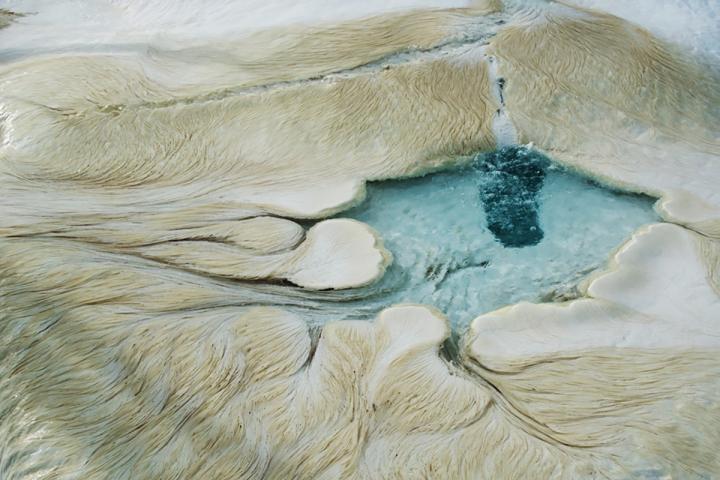
‘Fettuccine’ may be most obvious sign of life on Mars, researchers report

Bioengineer by Bioengineer
May 29, 2019
in Chemistry
Reading Time: 3 mins read
0
IMAGE
Share on FacebookShare on TwitterShare on LinkedinShare on RedditShare on Telegram

IMAGE

Credit: Photo by Tom Murphy

CHAMPAIGN, Ill. — A rover scanning the surface of Mars for evidence of life might want to check for rocks that look like pasta, researchers report in the journal Astrobiology.

The bacterium that controls the formation of such rocks on Earth is ancient and thrives in harsh environments that are similar to conditions on Mars, said University of Illinois geology professor Bruce Fouke, who led the new, NASA-funded study.

“It has an unusual name, Sulfurihydrogenibium yellowstonense,” he said. “We just call it ‘Sulfuri.'”

The bacterium belongs to a lineage that evolved prior to the oxygenation of Earth roughly 2.35 billion years ago, Fouke said. It can survive in extremely hot, fast-flowing water bubbling up from underground hot springs. It can withstand exposure to ultraviolet light and survives only in environments with extremely low oxygen levels, using sulfur and carbon dioxide as energy sources.

“Taken together, these traits make it a prime candidate for colonizing Mars and other planets,” Fouke said.

And because it catalyzes the formation of crystalline rock formations that look like layers of pasta, it would be a relatively easy life form to detect on other planets, he said.

The unique shape and structure of rocks associated with Sulfuri result from its unusual lifestyle, Fouke said. In fast-flowing water, Sulfuri bacteria latch on to one another “and hang on for dear life,” he said.

“They form tightly wound cables that wave like a flag that is fixed on one end,” he said. The waving cables keep other microbes from attaching. Sulfuri also defends itself by oozing a slippery mucus.

“These Sulfuri cables look amazingly like fettuccine pasta, while further downstream they look more like capellini pasta,” Fouke said. The researchers used sterilized pasta forks to collect their samples from Mammoth Hot Springs in Yellowstone National Park.

The team analyzed the microbial genomes, evaluated which genes were being actively translated into proteins and deciphered the organism’s metabolic needs, Fouke said.

The team also looked at Sulfuri’s rock-building capabilities, finding that proteins on the bacterial surface speed up the rate at which calcium carbonate – also called travertine – crystallizes in and around the cables “1 billion times faster than in any other natural environment on Earth,” Fouke said. The result is the deposition of broad swaths of hardened rock with an undulating, filamentous texture.

“This should be an easy form of fossilized life for a rover to detect on other planets,” Fouke said.

“If we see the deposition of this kind of extensive filamentous rock on other planets, we would know it’s a fingerprint of life,” Fouke said. “It’s big and it’s unique. No other rocks look like this. It would be definitive evidence of the presences of alien microbes.”

###

Fouke also is an affiliate professor of microbiology and of the Carl R. Woese Institute for Genomic Biology at the U. of I.

Videos of Sulfuri in hot springs are available here and here.

Editor’s notes:

To reach Bruce Fouke, call 217-244-5431; email [email protected].

The paper “Physiology, metabolism, and fossilization of hot-spring filamentous microbial mats” is available online and from the U. of I. News Bureau.

Media Contact
Diana Yates
[email protected]

Original Source

https://news.illinois.edu/view/6367/792185

Related Journal Article

http://dx.doi.org/10.1089/ast.2018.1965

Tags: BacteriologyBiochemistryCell BiologyEarth ScienceEcology/EnvironmentEvolutionGeneticsGeology/SoilMarine/Freshwater BiologyMicrobiology
Share14Tweet8Share2ShareShareShare2

Related Posts

AI and Physics Collaborate to Design Advanced Hydrogen Storage Materials

June 25, 2026

International Team Including Dresden Scientists Develops Novel Designer Proteins for Advanced Study of Living Tissue

June 25, 2026

New Study Uncovers Key Factors Driving Water Chemistry in Nanoscale Environments

June 25, 2026

Plasma Technology Extends Catalyst Lifespan in Hydrogen Production

June 24, 2026
Please login to join discussion

POPULAR NEWS

  • Saying Goodbye to PGY-6: Pediatric Fellowship Realities

    103 shares
    Share 41 Tweet 26
  • Multi-Hospital Study Reveals Long Covid Burden Is Twice as High as Current Estimates

    92 shares
    Share 36 Tweet 23
  • Detection of EDCs in Breast Milk and Infant Urine Up to Six Months Highlights Early Exposure Risks

    77 shares
    Share 31 Tweet 19
  • New Drug Candidate Developed at McMaster Shows Potential for Treating Brain Cancer

    58 shares
    Share 23 Tweet 15

About

We bring you the latest biotechnology news from best research centers and universities around the world. Check our website.

Follow us

Recent News

Tracking Lanthanide-Labeled Microplastics in Plants

POSTECH Researchers Slash Cost of Reconstituted Cell-Free Systems by 95%

AI and Physics Collaborate to Design Advanced Hydrogen Storage Materials

Subscribe to Blog via Email

Success! An email was just sent to confirm your subscription. Please find the email now and click 'Confirm' to start subscribing.

Join 82 other subscribers
  • Contact Us

Bioengineer.org © Copyright 2023 All Rights Reserved.

Welcome Back!

Login to your account below

Forgotten Password?

Retrieve your password

Please enter your username or email address to reset your password.

Log In
No Result
View All Result
  • Homepages
    • Home Page 1
    • Home Page 2
  • News
  • National
  • Business
  • Health
  • Lifestyle
  • Science

Bioengineer.org © Copyright 2023 All Rights Reserved.