• HOME
  • NEWS
  • EXPLORE
    • CAREER
      • Companies
      • Jobs
    • EVENTS
    • iGEM
      • News
      • Team
    • PHOTOS
    • VIDEO
    • WIKI
  • BLOG
  • COMMUNITY
    • FACEBOOK
    • INSTAGRAM
    • TWITTER
Sunday, August 16, 2026
BIOENGINEER.ORG
No Result
View All Result
  • Login
  • HOME
  • NEWS
  • EXPLORE
    • CAREER
      • Companies
      • Jobs
        • Lecturer
        • PhD Studentship
        • Postdoc
        • Research Assistant
    • EVENTS
    • iGEM
      • News
      • Team
    • PHOTOS
    • VIDEO
    • WIKI
  • BLOG
  • COMMUNITY
    • FACEBOOK
    • INSTAGRAM
    • TWITTER
  • HOME
  • NEWS
  • EXPLORE
    • CAREER
      • Companies
      • Jobs
        • Lecturer
        • PhD Studentship
        • Postdoc
        • Research Assistant
    • EVENTS
    • iGEM
      • News
      • Team
    • PHOTOS
    • VIDEO
    • WIKI
  • BLOG
  • COMMUNITY
    • FACEBOOK
    • INSTAGRAM
    • TWITTER
No Result
View All Result
Bioengineer.org
No Result
View All Result
Home NEWS Science News Health

Fetal-maternal discordance in APOL1 genotype contributes to preeclampsia risk

Bioengineer by Bioengineer
January 12, 2021
in Health
Reading Time: 2 mins read
0
IMAGE
Share on FacebookShare on TwitterShare on LinkedinShare on RedditShare on Telegram

IMAGE

Credit: Hong and Rosenberg, et al, AJKD

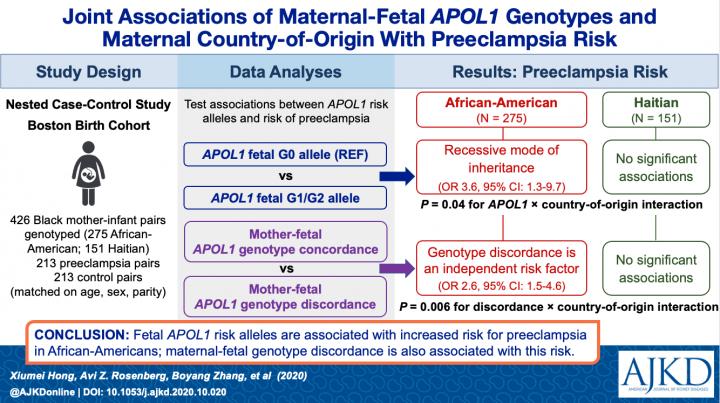
Fetal APOL1 kidney risk alleles are associated with increased risk for preeclampsia in African Americans and maternal fetal genotype discordance is also associated with this risk.

Preeclampsia, characterized by increased blood pressure after 20 weeks of pregnancy, as well as other abnormalities (e.g., protein in the urine), is dangerous to mothers and their infants. Previous studies found that individuals with African ancestry may carry APOL1 genetic variants that increase risk for chronic kidney disease. This study published in the American Journal of Kidney Diseases (AJKD) found that fetal high-risk APOL1 genotypes and maternal-fetal APOL1 genotype discordance independently contribute to preeclampsia risk in African-American mothers. This association was not observed in Haitian mother-infant pairs possibly because of different environmental exposures and cultural milieu. Additional studies are required to understand why APOL1 associations with preeclampsia differ by maternal country of origin and to improve management of mothers at risk for preeclampsia.

###

ARTICLE TITLE: Joint Associations of Maternal-Fetal APOL1 Genotypes and Maternal Country of Origin With Preeclampsia Risk

AUTHORS: Xiumei Hong, MD, PhD, Avi Z. Rosenberg, MD, PhD, Boyang Zhang, BS, Elizabeth Binns-Roemer, Victor David, MS, Yiming Lv, BS, Rebecca C. Hjorten, MD, Kimberly J. Reidy, MD, Teresa K. Chen, MD, MHS, Guoying Wang, MD, PhD, Yuelong Ji, PhD, Claire L. Simpson, PhD, Robert L. Davis, MD, MPH, Jeffrey B. Kopp, MD, Xiaobin Wang, MD, MPH, and Cheryl A. Winkler, PhD

DOI: https://doi.org/10.1053/j.ajkd.2020.10.020

Media Contact
Julie Kimbrough
[email protected]

Related Journal Article

http://dx.doi.org/10.1053/j.ajkd.2020.10.020

Tags: DiagnosticsEpidemiologyGenesGeneticsHealth Care Systems/ServicesHealth ProfessionalsInternal MedicineMedicine/HealthPublic Health
Share12Tweet8Share2ShareShareShare2

Related Posts

PARP1 Drives Neuropathic Pain Through GPX4-Dependent Ferroptosis in Injured Mice’s Sensory Neurons

August 15, 2026

Genome-wide skin pQTL map reveals genetic regulators and mechanisms underlying skin disorders

August 15, 2026

Levistilide A Drives Ferroptosis via RNF40-HSP90α Axis, Suppressing Colorectal Cancer Lung Metastasis

August 15, 2026

Sintilimab, IBI305, and Chemotherapy Show Promise in First-Line Advanced Gastric and GEJ Adenocarcinoma

August 15, 2026
Please login to join discussion

POPULAR NEWS

  • KAIST develops semiconductor neuron that harnesses noise to selectively process signals

    29 shares
    Share 12 Tweet 7
  • Imagining natural and extra robotic thumbs together strengthens kinesthetic sensorimotor networks

    29 shares
    Share 12 Tweet 7
  • PARP1 Drives Neuropathic Pain Through GPX4-Dependent Ferroptosis in Injured Mice’s Sensory Neurons

    29 shares
    Share 12 Tweet 7
  • Strubbelig–NHL3 Receptor Complex Helps Arabidopsis Respond to Cellulose Deficiency

    29 shares
    Share 12 Tweet 7

About

We bring you the latest biotechnology news from best research centers and universities around the world. Check our website.

Follow us

Recent News

KAIST develops semiconductor neuron that harnesses noise to selectively process signals

Imagining natural and extra robotic thumbs together strengthens kinesthetic sensorimotor networks

PARP1 Drives Neuropathic Pain Through GPX4-Dependent Ferroptosis in Injured Mice’s Sensory Neurons

Subscribe to Blog via Email

Success! An email was just sent to confirm your subscription. Please find the email now and click 'Confirm' to start subscribing.

Join 85 other subscribers
  • Contact Us

Bioengineer.org © Copyright 2023 All Rights Reserved.

Welcome Back!

Login to your account below

Forgotten Password?

Retrieve your password

Please enter your username or email address to reset your password.

Log In
No Result
View All Result
  • Homepages
    • Home Page 1
    • Home Page 2
  • News
  • National
  • Business
  • Health
  • Lifestyle
  • Science

Bioengineer.org © Copyright 2023 All Rights Reserved.