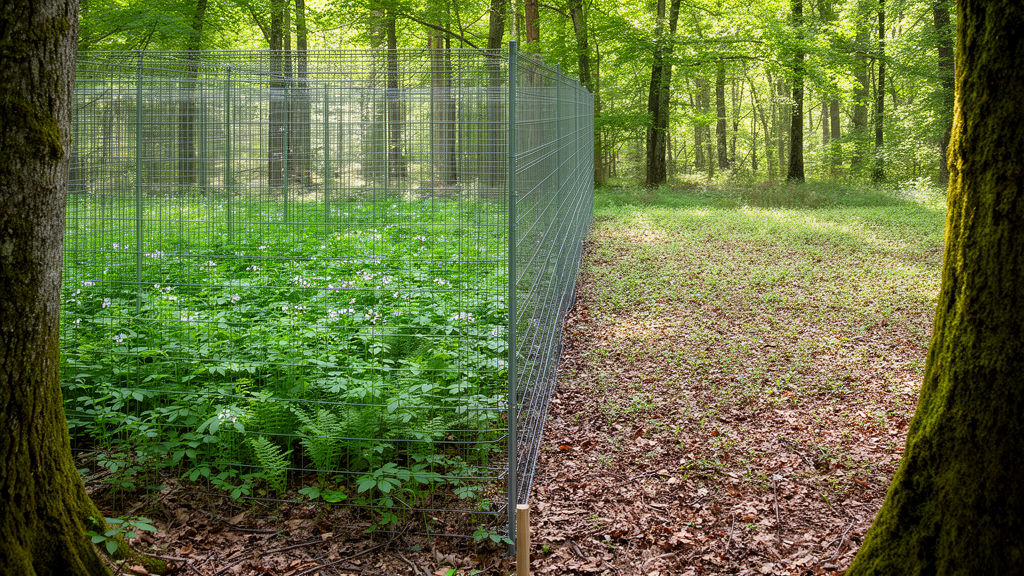
Across hundreds of forest plots in Germany, a simple experiment—fencing wild ungulates out of small patches of woodland and leaving neighbouring patches open—has produced one of the clearest pictures yet of how deer, wild boar and their relatives reshape the plant life of the forest floor. Seven years after the fences went up, researchers report that excluding ungulates shifted the functional makeup of understory communities toward traits associated with herbivory vulnerability and competitive ability, while continued access to ungulates kept communities tilted toward fast-growing, disturbance-tolerant species. The findings come from a comparative trait-based study published in Annals of Forest Science.
The study rested on an unusually large experimental network: 248 paired plots, each consisting of a fenced ungulate exclosure and an unfenced control of identical size, established in 2016 across five German Federal States—Baden-Württemberg, Saxony-Anhalt, North Rhine-Westphalia, Saarland and Thuringia. The sites covered coniferous, broad-leaved and mixed managed forests, with Norway spruce, European beech and Scots pine among the most common overstory trees. Native roe deer and wild boar were ubiquitous throughout the study area, with red deer, introduced fallow deer and introduced mouflon also detected in several regions. Wolves did not maintain a permanent presence during the study period, despite sporadic observations in Saxony-Anhalt in later years.
Each sampling area measured 10 by 10 metres, and the exclosures measured 12 by 12 metres, with a one-metre buffer zone inside the fence to minimise edge effects. Plot pairs shared comparable environmental conditions—light availability, tree species, terrain and the emergence of tree regeneration—and the assignment of fencing treatment within each pair was decided by a random coin toss. The fenced and unfenced plots were set five to twenty metres apart, a spacing chosen because ungulates often prefer to move along fence lines. Monitoring locations had been selected with a statistical model identifying the highest likelihood of successful tree regeneration, and each was associated with a forest area of up to 100 hectares.
Vegetation surveys were carried out in 2016 and again in 2023 by the same team of researchers, following a standardised protocol in both spring and late summer of each year. Two botanists worked together in the field, alternating between fenced and unfenced plots to reduce subjective bias and identification errors. Using a Braun-Blanquet-based approach with direct estimation of percentage cover per species, the team recorded herbaceous and woody vascular plants in distinct layers: the herb layer below half a metre, the shrub layer between half a metre and five metres, and the tree layer above five metres. Total tree-layer cover served as a proxy for light availability, and in every unfenced plot the researchers recorded browsing on individual woody species by checking for browsed terminal shoots within the typical browsing range of up to 130 centimetres.
The analytical core of the study was a comparison of two ways of weighting plant traits in a community. The first, a presence/absence-based mean, gives every species equal weight regardless of how abundant it is. The second, a community-weighted mean based on cover values, lets dominant species pull the average toward their own traits. The researchers calculated the change in both metrics between 2016 and 2023 for each trait and each plot, then tested whether those changes differed between fenced and unfenced plots. The traits spanned the leaf-height-seed functional space—specific leaf area, leaf dry matter content, leaf area, plant height and seed mass—alongside Ellenberg indicator values for light, reaction, nitrogen, temperature and continentality, disturbance indicator values for severity, frequency, grazing pressure and soil disturbance, Raunkiaer life forms, and species affinities to forest habitat.
The results were strikingly method-dependent, and that dependence turned out to be one of the study’s central messages. With presence/absence data, exclosures showed significantly greater declines than unfenced plots in light indicator values, disturbance severity, disturbance frequency, grazing pressure, soil disturbance, specific leaf area, and significantly greater increases in seed mass and plant height. Exclosures also lost more therophytes and open-site species while gaining more forest species. With cover-weighted data, the picture narrowed: differences between treatments remained for disturbance severity, disturbance frequency, grazing pressure, soil disturbance and specific leaf area, but disappeared for seed mass and plant height. The authors attribute this to dominant species—such as wood small-reed, foxglove and bracken, which are little affected by ungulate grazing—masking shifts among less abundant species in the cover-weighted averages. Presence/absence data proved more sensitive to compositional turnover, while cover data captured the influence of abundant species, and the authors argue that only using both methods together gives a full account of functional responses to herbivory.
Within the exclosures themselves, the temporal trends told a story of recovery from browsing, grazing and trampling. Disturbance indicator values fell significantly in fenced plots over the seven years, while in unfenced plots those same values largely rose. Fenced plots also showed declining specific leaf area and leaf area alongside rising leaf dry matter content, seed mass and forest species proportions—shifts the authors interpret as a move away from acquisitive, ruderal strategies toward traits associated with herbivory susceptibility and competitive ability. The accelerated growth of woody species inside the fences, visible in higher shrub-layer cover, most likely intensified competition for light at the forest floor, which helps explain why light indicator values declined in exclosures by the presence/absence measure even as canopy dieback elsewhere increased light availability. The authors note that the observed trait changes most likely reflect species turnover during succession rather than physiological adaptation within individual plants.
Species-level analyses sharpened the picture further. Bilberry, bramble, wood small-reed, wood anemone and bracken showed the greatest increases in mean cover between 2016 and 2023, while wood-sorrel, raspberry, European beech, white wood-rush and broad buckler-fern declined most. Several palatable species—including bilberry, bramble, wood anemone, sweet chestnut fern-relatives such as Teucrium scorodonia, sessile oak and may lily—increased more inside fences than outside, whereas wood small-reed and bracken increased more in the unfenced plots. A Threshold Indicator Taxa Analysis identified 23 species that increased significantly and 29 that decreased significantly along the gradient of ungulate influence, which was approximated as the percentage of browsed tree saplings in unfenced plots. Species favoured at low ungulate impact included heath bedstraw, beech and common nipplewort, while unpalatable or disturbance-tolerant species such as pill sedge, wood small-reed, birch, soft rush, bracken and foxglove benefited further along the gradient. The strongest negative effects fell on palatable and preferred browse species—silver fir, wood anemone, rough meadow-grass relatives such as Dactylis polygama, hawkweed, wild cherry and ash—and notably, all of these declines occurred at low ungulate influence, below 25 percent browsing.
Light availability shaped the same communities along a second gradient. The analysis flagged 43 species that increased and 22 that decreased significantly along the gradient of tree-cover change. Early profiteers of slightly opening canopies included silver fir, hazel and bugle, while further light increases favoured heliophilous plants such as common bent, foxglove, aspen, pedunculate oak and wood small-reed. On the opposite side, increasing canopy cover benefited shade-tolerant species including wood-sorrel, asarabacca, sycamore maple, daphne, wood sedge and wood anemone. Taken together, the authors conclude that ungulate feeding preferences and light availability jointly shape understory dynamics and plant–herbivore interactions, with selective browsing suppressing palatable species and granting competitive advantage to more resistant ones.
For forest management, the study offers trait-based early-warning signals. Potentially unwanted ungulate impacts—such as favouring ruderal plant communities or selectively browsing target tree species—may be mitigated through ungulate population regulation, including targeted hunting strategies that create a landscape of fear and alter ungulate movement patterns, or through non-lethal fencing, which the authors note is resource-intensive. The work also carries a caveat the researchers state plainly: the lack of precise ungulate population density estimates, a key determinant of vegetation responses, may severely limit the ability to contextualise the observed functional changes; browsing percentage, which averaged 13.35 percent across the study area, served only as an approximation. The team underscores the need to continue monitoring these dynamics and to develop integrated frameworks accounting for the interactions between ungulates, vegetation and environmental factors as temperate forests face ongoing environmental change.
Subject of Research: Trait-based functional responses of temperate forest understory vegetation to ungulate exclusion in a paired exclosure experiment
Article Title: Functional responses of understory vegetation to ungulate exclusion in temperate forest ecosystems—a comparative trait-based approach
Article References: Seliger, A., Zäh, J., Heinrichs, S., Ammer, C., & Vor, T. (2026). Functional responses of understory vegetation to ungulate exclusion in temperate forest ecosystems—a comparative trait-based approach. Annals of Forest Science, 83(1), Article 45. https://doi.org/10.1186/s13595-026-01364-4
Image Credits: AI Generated
DOI: 10.1186/s13595-026-01364-4
Keywords: ungulate exclusion, forest understory, plant functional traits, exclosure experiment, browsing pressure, temperate forests, community-weighted mean, indicator species, light availability, deer herbivory, forest management, Germany
News Source: Gavin Prescott. (October 29, 2026). Fenced-off deer reveal how browsing reshapes forest floor plant traits. Scienmag.