Credit: Takashi Yamamoto
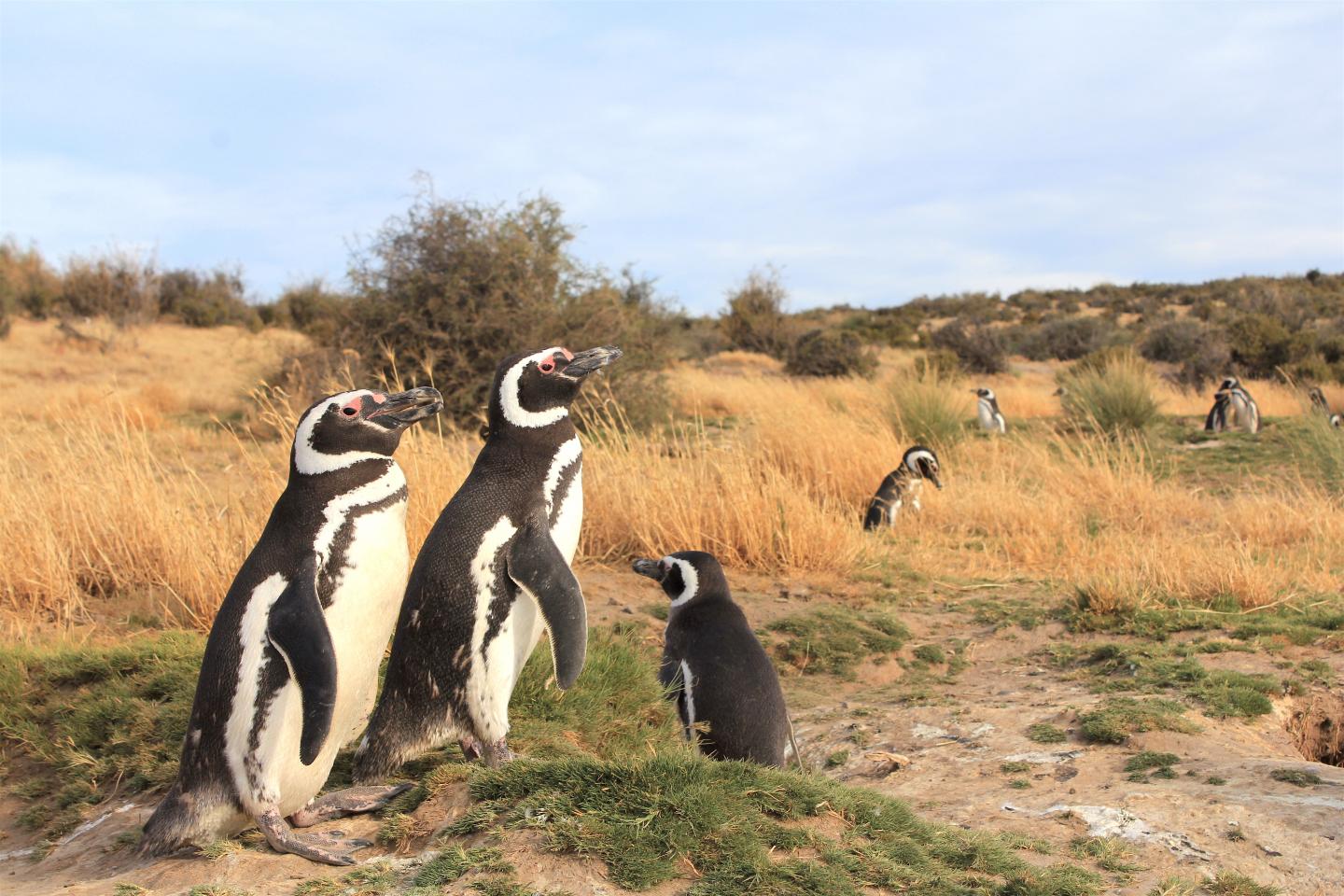
Every year, thousands of Magellanic penguins are stranded along the South American coast–from northern Argentina to southern Brazil–1,000 kilometers away from their breeding ground in northern Patagonia. Now researchers reporting in Current Biology on January 7 have new evidence to explain the observation that the stranded birds are most often female: female penguins venture farther north than males do, where they are apparently more likely to run into trouble.
“Anthropogenic threats have been considered to threaten wintering Magellanic penguins along the coasts of northern Argentina, Uruguay, and southern Brazil; these include water pollution caused by oil development and marine transport as well as fishery-associated hazards, such as bycatch and depletion of prey species,” says Takashi Yamamoto of the Institute of Statistical Mathematics in Tokyo. “Our results suggest that the northward spatial expansion likely increases the probability to suffer these risks, and particularly so in females.”
Researchers knew that penguins stranded along the South American coast were three times as likely to be females. The question was: why?
While data were lacking, there wasn’t any evidence to suggest that males and females split up for the winter. Now, Yamamoto and his colleagues find that in fact they do. The researchers recorded the migratory and diving behavior of 14 Magellanic penguins (eight males and six females) during the non-breeding period in 2017 using LAT 2500 geolocators (Lotek Wireless, Inc.).
The Magellanic penguins finished breeding in late February. Afterward, they began their migration through April, returning to the breeding grounds in September or October. During the wintering period, the tracking data show that females reached more northern areas than males did. Females showed other differences too. For example, they didn’t dive as deep under the water.
The researchers suggest that these behavioral differences between sexes in winter might be related to competition for food resources or other factors related to differences in size (males are larger and heavier than females). They also suggest that penguins traveling farther to the north may be at greater risk to a wide range of threats, leading them to become stranded more often.
Whatever the reasons, the greater loss of females from the breeding population could have serious consequences for the viability of the population. So, Yamamoto says, the new findings highlight “the necessity of gaining a better understanding of the long-term spatial utilizations of species throughout their annual cycle, including any differences within a population, in order to facilitate dynamic and adaptive conservation practices.”
Yamamoto also notes that juvenile penguins are stranded more often than adults are. To further explore, they’d like to track movements of juveniles from the time they leave the place of their birth until they return to breed for the first time. “Information during this period is totally missing,” he says.
###
This work was supported by JSPS KAKENHI.
Current Biology, Yamamoto et al.: “Female-biased stranding in Magellanic penguins” https://www.cell.com/current-biology/fulltext/S0960-9822(18)31489-1
Current Biology (@CurrentBiology), published by Cell Press, is a bimonthly journal that features papers across all areas of biology. Current Biology strives to foster communication across fields of biology, both by publishing important findings of general interest and through highly accessible front matter for non-specialists. Visit: http://www.
Media Contact
Carly Britton
[email protected]
617-417-7053
Related Journal Article
http://dx.