Credit: Image by Janet Sinn-Hanlon, University of Illinois
CHAMPAIGN, Ill. — Growing muscle tissue on grooved platforms helps neurons more effectively integrate with the muscle, a requirement for engineering muscle in the lab that responds and functions like muscle in the body, University of Illinois researchers found in a new study.
Such engineered muscle with integrated nerves has applications in reconstructive and rehabilitative medicine, as well as for engineered biological machines or robots.
“With this approach, we can engineer muscle outside of the body so it can respond like muscle in the body,” said study leader Hyunjoon Kong, a professor of chemical and biomolecular engineering. “Usually people just culture muscle cells without neurons. It’s quite straightforward to do that. But it’s very difficult for neurons to integrate and communicate with the muscle so that it’s functional and responsive.”
Kong co-led the study with Rashid Bashir, a professor of bioengineering and dean of the College of Engineering. Bashir and Kong also are affiliated with the Carle Illinois College of Medicine.
The researchers’ goal is to create muscle that responds to neurotransmitters as it responds in the body, rather than relying on added electrical or chemical stimulation. While other groups have demonstrated engineered muscle with some nerve integration, called innervation, the function and response of the muscle has been limited, the researchers say.
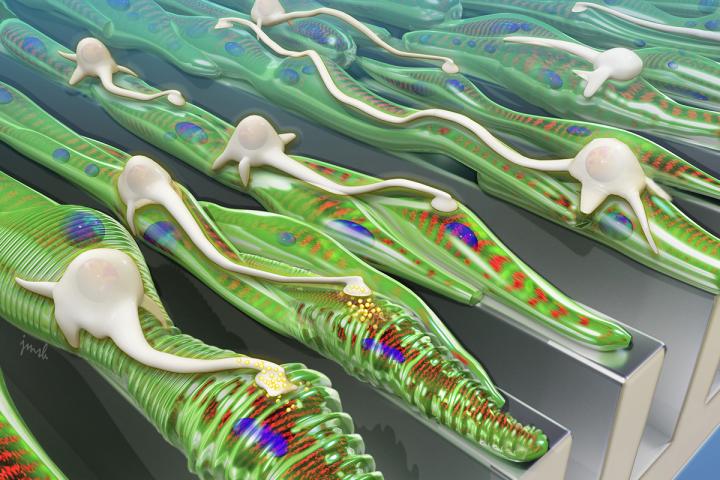
The Illinois group altered the surface on which they incubated the muscle to see if topology affected muscle growth, function or innervation. The researchers grew mouse muscle tissue on increasingly grooved surfaces, then seeded the muscle with stem cells primed to become neurons and watched how the nerves formed and integrated with the muscle.
They found that on a flat surface, the muscle tissue lacked organization and nerves did not penetrate efficiently. However, the more grooved the surface, the more ordered the muscle fibers grew and the more successfully the neurons integrated with the muscle, said graduate student Clare (Eunkyung) Ko, the first author of the study.
“If you think about the physiological properties of muscle, it’s very aligned. There are a lot of fibers bundled together. The grooved substrate provides a similar environment to our natural skeletal muscle, so it can help the cells to align and form bundles like a real muscle,” Ko said. “These aligned bundles also guide the neurons as they extend along and into the muscle tissue. It gives them a path to grow.”
The researchers then tested the innervated muscle’s response to two neurotransmitters, natural chemicals that signal nerve cells – one that stimulates activity and one that inhibits it. The tissues grown on the grooved surfaces were the most responsive.
“If the muscle and neurons are functioning together, the muscles should contract when exposed to the chemical that stimulates neurons, and stop when exposed to the inhibitors. Ours did that,” Kong said. “We are the first ones to demonstrate that our muscle is functional and responding to these chemicals much better than others.”
The researchers plan to refine their grooved substrates in experiments with human muscle and nerve cells. They hope to develop their approach as a platform for drug screening and for tissue engineering for patients with muscle damage or injury.
“When there is damage to the muscle, there often is a gap in the nerves as well. This can cause the muscle to become weaker and smaller. So for injury treatment, it’s important to let the neurons re-innervate the muscle,” Kong said. “We could use a patient’s own cells to engineer muscle samples to screen which drugs could enhance the reintroduction of neurons to the muscle. We could test a variety of growth factors or proteins and see which would be good for regeneration of the muscle with the neurons together.”
The researchers also plan to use the innervated muscle to power miniature biological machines, or bio-bots. Bashir’s group has developed bio-bots powered by muscle tissue that responds to electricity and light, and integration with neurons would provide the machines with sensing capability that could provide direction – for example, moving toward an environmental toxin to neutralize it, Bashir said.
“Our goal is to build a little neuronal circuit that could sense chemical concentration and translate that to motion,” Bashir said.
###
The National Science Foundation, the National Institutes of Health and the National Research Foundation of Korea supported this work.
Editor’s notes: To reach Hyunjoon Kong, call (217) 333-1178; email: [email protected].
The paper “Matrix topography regulates synaptic transmission at the neuromuscular junction” is available online or from the News Bureau.
Media Contact
Liz Ahlberg Touchstone
[email protected]
217-244-1073
Original Source
https:/
Related Journal Article
http://dx.