

• HOME
  • NEWS
  • EXPLORE
    • CAREER
      • Companies
      • Jobs
    • EVENTS
    • iGEM
      • News
      • Team
    • PHOTOS
    • VIDEO
    • WIKI
  • BLOG
  • COMMUNITY
    • FACEBOOK
    • INSTAGRAM
    • TWITTER
Sunday, July 5, 2026
BIOENGINEER.ORG
No Result
View All Result
  • Login
  • HOME
  • NEWS
  • EXPLORE
    • CAREER
      • Companies
      • Jobs
        • Lecturer
        • PhD Studentship
        • Postdoc
        • Research Assistant
    • EVENTS
    • iGEM
      • News
      • Team
    • PHOTOS
    • VIDEO
    • WIKI
  • BLOG
  • COMMUNITY
    • FACEBOOK
    • INSTAGRAM
    • TWITTER
  • HOME
  • NEWS
  • EXPLORE
    • CAREER
      • Companies
      • Jobs
        • Lecturer
        • PhD Studentship
        • Postdoc
        • Research Assistant
    • EVENTS
    • iGEM
      • News
      • Team
    • PHOTOS
    • VIDEO
    • WIKI
  • BLOG
  • COMMUNITY
    • FACEBOOK
    • INSTAGRAM
    • TWITTER
No Result
View All Result
Bioengineer.org
No Result
View All Result
Home NEWS Science News Chemistry

Feeding behavior traits may be an indicator of feed efficiency in Holstein cows

Bioengineer by Bioengineer
September 28, 2022
in Chemistry
Reading Time: 3 mins read
0
Feeding behavior traits may be an indicator of feed efficiency in Holstein cows
Share on FacebookShare on TwitterShare on LinkedinShare on RedditShare on Telegram

Philadelphia, September 28, 2022 – Genetic selection is a powerful tool to improve livestock production, given that genetic gains are cumulative and permanent, and feeding behavior in cows may be used as an indicated trait for feed efficiency. In a new report in the Journal of Dairy Science®, published by FASS Inc. and Elsevier, eight researchers from the University of Wisconsin (Madison, WI), Council on Dairy Cattle Breeding (Bowie, MD), and Michigan State University (East Lansing, MI) concluded that measures of feeding behavior could be useful indicators of dairy cow feed efficiency, and individual cows that eat at a slower rate may be more feed efficient.
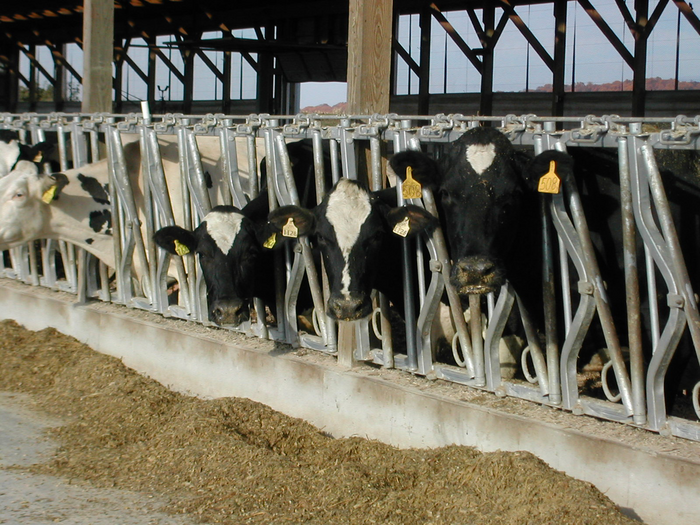
Feeding behavior traits may be an indicator of feed efficiency in Holstein cows

Credit: Ken Olson, PhD, PAS

Philadelphia, September 28, 2022 – Genetic selection is a powerful tool to improve livestock production, given that genetic gains are cumulative and permanent, and feeding behavior in cows may be used as an indicated trait for feed efficiency. In a new report in the Journal of Dairy Science®, published by FASS Inc. and Elsevier, eight researchers from the University of Wisconsin (Madison, WI), Council on Dairy Cattle Breeding (Bowie, MD), and Michigan State University (East Lansing, MI) concluded that measures of feeding behavior could be useful indicators of dairy cow feed efficiency, and individual cows that eat at a slower rate may be more feed efficient.

Due to the lack of feeding behavior genetic studies in lactating dairy cattle and the potential for using these traits as indicators of feed efficiency, the objective of this study was to investigate different feeding behavior traits and their genetic associations with feed efficiency traits in lactating US Holstein cows. Researchers estimated genetic parameters for feeding behavior traits using daily records.

“Interestingly, some feeding behavior traits were strongly genetically correlated with feed efficiency,” said lead researcher Ligia Cavani, PhD, Department of Animal and Dairy Sciences, University of Wisconsin. The research team found that feeding rate showed a strong positive genetic correlation with dry matter intake, metabolic body weight, and residual feed intake in particular.

The researchers used data from daily feeding behavior records of 1,328 Holstein cows in 31 experiments conducted from 2009 to 2020 in a facility at the University of Wisconsin-Madison Emmons Blaine Dairy Cattle Research Center (Arlington, WI). The facility used an automated intake recording system, which permits one animal to access the feeder at a given time. The feeding behavior traits considered included number of feeder visits per day, number of meals per day, duration of each feeder visit, duration of each meal, total duration of feeder visits, intake per visit, intake per meal, feeding rate per visit, and feeding rate per meal.

Overall, our results suggest that measures of feeding behavior could be useful indicators of dairy cow feed efficiency and that individual cows that eat at a slower rate may be more feed efficient,” said Cavani.


Journal

Journal of Dairy Science

DOI

10.3168/jds.2022-22066

Method of Research

Observational study

Subject of Research

Animals

Article Title

Estimates of genetic parameters for feeding behavior traits and their associations with feed efficiency in Holstein cows


Share12Tweet8Share2ShareShareShare2

Related Posts

Intelligent Microgrid Management Promises Lower Household Energy Bills and Reduced Diesel Emissions — Chemistry

Intelligent Microgrid Management Promises Lower Household Energy Bills and Reduced Diesel Emissions

July 4, 2026
Graz University of Technology Deciphers the Structural Secrets of MOF Thin Films — Chemistry

Graz University of Technology Deciphers the Structural Secrets of MOF Thin Films

July 2, 2026

Breaking Thermodynamic Limits: Wavelength-Driven Catalysis Advances Ammonia Synthesis

July 2, 2026

From Quantum Mechanics to AI-Powered Materials Discovery: MARVEL Marks 12 Years of Transforming Computational Science

July 2, 2026

POPULAR NEWS

  • Detection of EDCs in Breast Milk and Infant Urine Up to Six Months Highlights Early Exposure Risks

    77 shares
    Share 31 Tweet 19
  • Saying Goodbye to PGY-6: Pediatric Fellowship Realities

    103 shares
    Share 41 Tweet 26
  • New Drug Candidate Developed at McMaster Shows Potential for Treating Brain Cancer

    58 shares
    Share 23 Tweet 15
  • KTU Researchers Explore Ultrasound’s Role in Enhancing Blood Flow Beyond Diagnostics

    53 shares
    Share 21 Tweet 13

About

We bring you the latest biotechnology news from best research centers and universities around the world. Check our website.

Follow us

Recent News

Quasi-Bound States Boost Quantum Well Photoresponse

Lysine Pyruvylation Links Glycolysis to Epigenetics

Multiphysics Coupling: Single vs. Multiple DeepONet Branches

Subscribe to Blog via Email

Success! An email was just sent to confirm your subscription. Please find the email now and click 'Confirm' to start subscribing.

Join 83 other subscribers
  • Contact Us

Bioengineer.org © Copyright 2023 All Rights Reserved.

Welcome Back!

Login to your account below

Forgotten Password?

Retrieve your password

Please enter your username or email address to reset your password.

Log In
No Result
View All Result
  • Homepages
    • Home Page 1
    • Home Page 2
  • News
  • National
  • Business
  • Health
  • Lifestyle
  • Science

Bioengineer.org © Copyright 2023 All Rights Reserved.
