Geologist Melodie French wins National Science Foundation CAREER Award
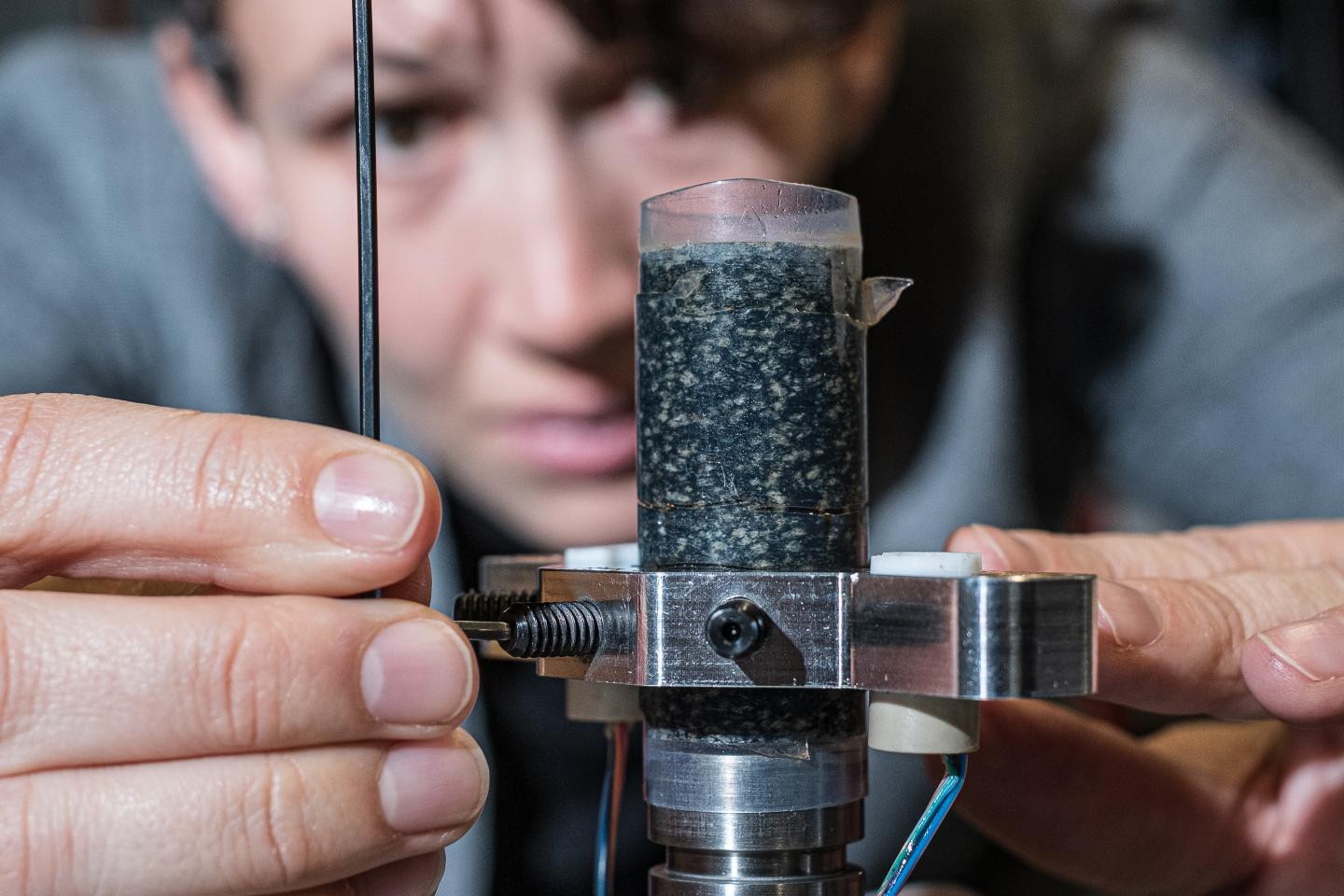
Credit: Jeff Fitlow/Rice University
HOUSTON – (Jan. 31, 2020) – Rice University geologist Melodie French is crushing it in her quest to understand the physics responsible for earthquakes.
The assistant professor of Earth, environmental and planetary science has earned a prestigious CAREER Award, a five-year National Science Foundation (NSF) grant for $600,000 to support her investigation of the tectonic roots of earthquakes and tsunamis.
CAREER awards support the research and educational development of young scholars likely to become leaders in their fields. The grants, among the most competitive awarded by the NSF, go to fewer than 400 scholars each year across all disciplines.
For French, the award gives her Rice lab the opportunity to study rocks exhumed from subduction zones at plate boundaries that are often the source of megathrust earthquakes and tsunamis. Her lab squeezes rock samples to characterize the strength of the rocks deep underground where the plates meet.
“Fundamentally, we hope to learn how the material properties of the rocks themselves control where earthquakes happen, how big one might become, what causes an earthquake to sometimes arrest after only a small amount of slip or what allows some to grow quite large,” French said.
“A lot of geophysics involves putting out instruments to see signals that propagate to the Earth’s surface,” she said. “But we try to understand the properties of the rocks that allow these different phenomena to happen.”
That generally involves putting rocks under extreme stress. “We squish rocks at different temperatures and pressures and at different rates while measuring force and strain in as many dimensions as we can,” French said. “That gives us a full picture of how the rocks deform under different conditions.”
The lab conducts experiments on both exposed surface rocks that were once deep within subduction zones and rock acquired by drilling for core samples.
“I’m working with (Rice Professor) Juli Morgan on a subduction zone off of New Zealand where they drilled through part of the fault zone and brought rock up from about 500 meters deep,” French said. “But many big earthquakes happen much deeper than we could ever drill. So we need to go into the field to find ancient subduction rocks that have somehow managed to come to the surface.”
French is not sure if it will ever be possible to accurately predict earthquakes. “But one thing we can do is create better hazard maps to help us understand what regions should be prepared for quakes,” she said.
###
French is a native of Maine who earned her bachelor’s degree at Oberlin College, a master’s at the University of Wisconsin-Madison and a Ph.D. at Texas A&M University.
The award, co-funded by the NSF’s Geophysics, Tectonics and Marine Geology and Geophysics programs, will also provide inquiry-based educational opportunities in scientific instrument design and use to K-12 students as well as undergraduate and graduate-level students.
Read the award abstract at https:/
This news release can be found online at https:/
Follow Rice News and Media Relations via Twitter @RiceUNews.
Related materials:
Rheology and Deformation (French Lab): https:/
An interview with Melodie French: http://earthscience.
Earth, Environmental and Planetary Sciences: https:/
Wiess School of Natural Sciences: https:/
Images for download:
https:/
Rice University geologist Melodie French has earned a National Science Foundation CAREER Award to support her investigation of the tectonic roots of earthquakes and tsunamis. (Credit: Jeff Fitlow/Rice University)
https:/
Rice University geologist Melodie French and graduate student Ben Belzer work with a rock sample. French has been granted a National Science Foundation CAREER Award to study the tectonic roots of earthquakes and tsunamis. (Credit: Jeff Fitlow/Rice University)
https:/
Geologist Melodie French sets up an experiment in her Rice University lab. She has won a National Science Foundation CAREER Award, a prestigious grant given to young scholars likely to become leaders in their fields. (Credit: Jeff Fitlow/Rice University)
Located on a 300-acre forested campus in Houston, Rice University is consistently ranked among the nation’s top 20 universities by U.S. News & World Report. Rice has highly respected schools of Architecture, Business, Continuing Studies, Engineering, Humanities, Music, Natural Sciences and Social Sciences and is home to the Baker Institute for Public Policy. With 3,962 undergraduates and 3,027 graduate students, Rice’s undergraduate student-to-faculty ratio is just under 6-to-1. Its residential college system builds close-knit communities and lifelong friendships, just one reason why Rice is ranked No. 1 for lots of race/class interaction and No. 4 for quality of life by the Princeton Review. Rice is also rated as a best value among private universities by Kiplinger’s Personal Finance.
Jeff Falk
713-348-6775
[email protected]
Mike Williams
713-348-6728
[email protected]
Media Contact
Mike Williams
[email protected]
713-348-6728
Original Source
https:/