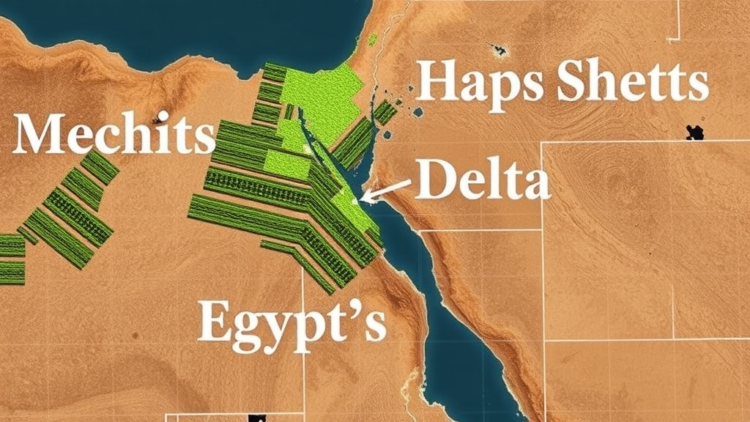
In the intensively irrigated farmland of Egypt’s Nile Delta, knowing exactly when crops begin to suffer from water stress can mean the difference between a viable harvest and devastating losses. A new study published in Smart Agricultural Technology presents a feature-optimized artificial intelligence framework that estimates agricultural vegetation water stress from satellite data with remarkable precision, offering a practical tool for water managers in one of the world’s most water-constrained agricultural regions. The research, led by Ahmed Elbeltagi with Aman Srivastava and Abdullah A. Alsumaiei, focuses on Dakahliyah Governorate, a highly productive but water-stressed agroecosystem in the northern Delta.
The challenge the researchers set out to address is deceptively complex. Vegetation water stress expresses itself through coupled changes in canopy greenness, leaf area, surface temperature, and evaporative behavior, all of which can be observed from space. Satellite-derived indicators such as the Normalized Difference Vegetation Index (NDVI), the Enhanced Vegetation Index (EVI), Leaf Area Index (LAI), Fraction of Photosynthetically Active Radiation (Fpar), the Evaporative Stress Index (ESI), and Land Surface Temperature (LST) provide temporally consistent, spatially exhaustive information on crop condition. Yet translating these multiple, partly redundant signals into a reliable single estimate of vegetation stress has remained difficult, particularly in irrigated deltas where human water-management decisions strongly modulate how plants respond to climate forcing.
The study uses MODIS satellite products covering 2018 to 2025, with NDVI and EVI drawn from the MOD13Q1 product at 250-meter resolution, LAI and Fpar from MOD15A2H, LST from MOD11A2, and actual and potential evapotranspiration from MOD16A2, from which ESI was calculated as the ratio of actual to potential evapotranspiration. Quality-assurance layers were used to exclude pixels contaminated by clouds, shadows, aerosols, or low-confidence retrievals, and the data were aggregated into monthly governorate-level values. Observations from 2018 to 2023 served for model training, while 2024 and 2025 were reserved as an independent testing period, supplemented by 5-fold cross-validation to assess temporal robustness.
A central methodological innovation lies in the coupling of Best Subset Regression (BSR) with machine learning. Rather than feeding every available indicator into the models, BSR systematically evaluated all possible combinations of LAI, Fpar, ESI, NDVI, and LST, selecting the subset that best balanced explanatory power and parsimony using criteria such as adjusted R², the Akaike and Bayesian Information Criteria, and Mallows’ Cp. The Variance Inflation Factor was used to screen out multicollinearity. This physically grounded variable reduction was then paired with four machine-learning architectures: a multilayer perceptron (MLP) neural network, a Random Subspace (RS) ensemble, Regression by Discretization (RD), and Random Forest (RF).
The feature-selection analysis produced a strikingly clear hierarchy of controls. NDVI emerged as the overwhelmingly dominant predictor of EVI, with a correlation of 0.934 and a standardized regression coefficient of 0.935, supported by an extraordinarily large t-statistic of nearly 199 and a narrow, strictly positive confidence interval. LAI contributed a smaller but statistically significant refinement, capturing canopy structural attributes such as layering and leaf clumping that a two-band greenness index cannot fully represent. By contrast, Fpar, ESI, and LST showed no detectable linear contribution once NDVI and LAI were accounted for, suggesting that in this irrigated setting their influence is either mediated through greenness signals or expressed through nonlinear interactions, and that managed water supply buffers canopy condition from short-lived thermal or evaporative stress.
The consequences of feature optimization for model performance were substantial, though architecture-dependent. Before selection, Regression by Discretization led the independent testing period, while Random Forest lagged with a correlation of only 0.9571. After BSR, Random Forest transformed into the clear best performer, achieving a correlation of 0.9943, a mean absolute error of just 0.0063, and a root mean square error of 0.0161 during the 2024–2025 testing period, with relative absolute error falling to under 5 percent. Random Subspace also improved markedly, its testing correlation rising from 0.9414 to 0.9738 and its slope moving from 0.4768 to 0.9666, while the multilayer perceptron failed to benefit and deteriorated slightly across all metrics.
Cross-validation reinforced these findings. Across five folds, the optimized Random Forest achieved a correlation of 0.9793 with relative errors dropping to roughly 9.6 and 20.2 percent, demonstrating low bias and low variance across resampled data partitions. The authors attribute this behavior to the underlying data structure: because EVI is governed by a near one-dimensional NDVI–EVI relationship with a modest incremental contribution from LAI, tree-based ensembles can exploit repeated splits on these dominant predictors to form many shallow, low-bias trees, while bagging averages out noise. The neural network, with its larger parameterization relative to the effective information content, remained more sensitive to sample variation.
To confirm that the optimized Random Forest was not simply outperforming weak baselines, the team benchmarked it against univariate and multiple linear regression, XGBoost, and CatBoost. The linear baselines produced testing RMSE values of approximately 0.053, while the boosting algorithms reduced this to around 0.045 and 0.046. The feature-optimized Random Forest, however, retained a substantially lower RMSE of 0.0161, roughly a third of the boosting models’ error, confirming a genuine methodological advantage rather than an artifact of comparison. Time-series analysis further showed that after feature selection the model reproduced the timing and amplitude of seasonal greening and senescence cycles with markedly tighter agreement.
The practical implications extend to operational water management in semi-arid regions. Because NDVI and LAI are routinely available from satellite platforms at frequent intervals, the framework could be updated as new observations arrive, supporting governorate-scale vegetation-condition monitoring. Estimated EVI could then be converted into crop- and season-specific anomalies and combined with crop-water requirements and irrigation schedules to inform allocation decisions. The authors are careful to note limits: the framework estimates contemporaneous vegetation condition rather than forecasting future stress, and its findings are specific to Dakahliyah Governorate and the 2018–2025 period. Validation across longer records, contrasting irrigation regimes, and additional regions, along with the incorporation of microwave soil moisture and field-scale data, remains a priority before broader transferability or early-warning use can be claimed.
Nevertheless, the study offers a compelling demonstration that less can be more in agricultural machine learning. By systematically identifying which satellite indicators genuinely carry information about crop water stress, and by discarding the rest, the researchers built a model that is simultaneously more accurate, more interpretable, and cheaper to operate, requiring only a small set of widely available inputs. As water scarcity intensifies across semi-arid agricultural regions worldwide, such parsimonious, physically grounded AI frameworks may become essential instruments for safeguarding food production under increasingly uncertain climatic conditions.
Subject of Research: Estimation of agricultural vegetation water stress using feature-optimized remote sensing and ensemble machine learning in the Nile Delta
Article Title: Estimation of agricultural vegetation water stress using feature-optimized remote sensing and ensemble machine learning
Article References: Elbeltagi, A., Srivastava, A., & Alsumaiei, A. A. (2026). Estimation of agricultural vegetation water stress using feature-optimized remote sensing and ensemble machine learning. Smart Agricultural Technology, 15, Article 102536. https://doi.org/10.1016/j.atech.2026.102536
Image Credits: AI Generated
DOI: 10.1016/j.atech.2026.102536
Keywords: vegetation water stress, remote sensing, machine learning, random forest, Nile Delta, MODIS, EVI, NDVI, best subset regression, agricultural drought, irrigation management, Egypt
Cite Scienmag News
APA MLA Chicago
Alan Morgan. (September 13, 2026). Feature-Optimized AI Tracks Crop Water Stress in Egypt’s Nile Delta. Scienmag. https://scienmag.com/feature-optimized-ai-tracks-crop-water-stress-in-egypts-nile-delta/
Alan Morgan. “Feature-Optimized AI Tracks Crop Water Stress in Egypt’s Nile Delta.” Scienmag, 13 September 2026, https://scienmag.com/feature-optimized-ai-tracks-crop-water-stress-in-egypts-nile-delta/. Accessed 13 September 2026.
Alan Morgan. “Feature-Optimized AI Tracks Crop Water Stress in Egypt’s Nile Delta.” Scienmag. September 13, 2026. https://scienmag.com/feature-optimized-ai-tracks-crop-water-stress-in-egypts-nile-delta/
Copy citation Download RIS
Tags: agricultural droughtagricultural water stress indicesAI-driven crop water stress detectionbest subset regressiondrought stress prediction in EgyptEgyptevapotranspiration and crop healthEVIfeature-optimized artificial intelligence in agricultureirrigation managementLand Surface Temperature (LST) in crop monitoringMachine learningMODISNDVINDVI and EVI for water stress estimationNile Deltaprecision agriculture for water-scarce regionsRandom Forestremote sensingremote sensing data analysis for irrigation managementsatellite-based agricultural monitoringvegetation health assessment using remote sensingvegetation water stresswater management in Nile Delta