

• HOME
  • NEWS
  • EXPLORE
    • CAREER
      • Companies
      • Jobs
    • EVENTS
    • iGEM
      • News
      • Team
    • PHOTOS
    • VIDEO
    • WIKI
  • BLOG
  • COMMUNITY
    • FACEBOOK
    • INSTAGRAM
    • TWITTER
Friday, December 26, 2025
BIOENGINEER.ORG
No Result
View All Result
  • Login
  • HOME
  • NEWS
  • EXPLORE
    • CAREER
      • Companies
      • Jobs
        • Lecturer
        • PhD Studentship
        • Postdoc
        • Research Assistant
    • EVENTS
    • iGEM
      • News
      • Team
    • PHOTOS
    • VIDEO
    • WIKI
  • BLOG
  • COMMUNITY
    • FACEBOOK
    • INSTAGRAM
    • TWITTER
  • HOME
  • NEWS
  • EXPLORE
    • CAREER
      • Companies
      • Jobs
        • Lecturer
        • PhD Studentship
        • Postdoc
        • Research Assistant
    • EVENTS
    • iGEM
      • News
      • Team
    • PHOTOS
    • VIDEO
    • WIKI
  • BLOG
  • COMMUNITY
    • FACEBOOK
    • INSTAGRAM
    • TWITTER
No Result
View All Result
Bioengineer.org
No Result
View All Result
Home NEWS Science News Health

Fatty acid receptor involved in temperature-induced sex reversal of Japanese medaka fish

Bioengineer by Bioengineer
September 4, 2020
in Health
Reading Time: 2 mins read
0
IMAGE
Share on FacebookShare on TwitterShare on LinkedinShare on RedditShare on Telegram

The newly discovered sex determination mechanism may lead to improved fish farming techniques
IMAGE

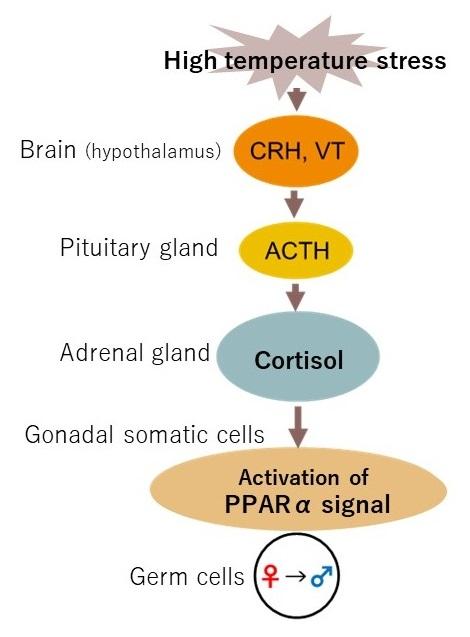
Heat stress activates the PPARα signal in gonadal somatic cells through cortisol in the adrenal gland to differentiate medaka into males.

A research collaboration based at Kumamoto University (Japan) has found that activation of PPARα, a fatty acid receptor that detects fatty acids in cells and regulates physiological functions, causes masculinization of Japanese rice fish (medaka). The discovery of this molecular mechanism is expected to advance the development of new sex control technologies.

The sex of mammals is determined in their genes, specifically the XX/XY combination of sex chromosomes. On the other hand, the sex-determination of fish, amphibians, and reptiles is greatly affected by ambient temperature. The medaka (Oryzias latipes), however, is a bony fish that uniquely uses the XX/XY sex determination system. The sex-determining gene, DMY, was recently identified on their Y chromosome. Normally, XY individuals with the DMY gene will differentiate into males and XX individuals (without DMY) will differentiate into females. However, if medaka are bred in water with temperatures of 32 to 34°C during their period of sexual differentiation, XX individuals will differentiate into males. In other words, their genetic sex-determination is affected by temperature. Previous research from Kumamoto University demonstrated that cortisol, a high-temperature-induced stress hormone, directly acts on the gonads and causes masculinization of XX medaka (Hayashi et al., 2010; Yamaguchi et al., 2010; Kitano et al., 2012). However, the molecular mechanism of cortisol masculinization was not determined.

In this study, researchers conducted an RNA sequencing analysis to search for genes activated by high temperature or cortisol. Many genes related to the fatty acid receptor “peroxisome proliferator-activated receptor alpha” (PPARα) were detected, and when a PPARα activator was administered to medaka larvae, XX medaka became male. Furthermore, when knockout medaka with inhibited PPARα function were produced, differentiation into males was completely suppressed, even after the administration of cortisol or a PPARα activator. To the researchers’ knowledge, this is the first time that PPARα activation has been shown to be so involved with medaka sex-differentiation by cortisol or an activator.

“In fish farming for food production, such as flounder or eel, technology that produces only females is sought after because they grow faster than males,” said study leader, Professor Takeshi Kitano. “Here, we have revealed the molecular mechanism that induces differentiation into males and we hope that new sexual control technologies using this mechanism will be developed in the future.”

###

This research was posted online in “Scientific Reports” on 15 July 2020.

Source:

Hara, S., Furukawa, F., Mukai, K., Yazawa, T., & Kitano, T. (2020). Peroxisome proliferator-activated receptor alpha is involved in the temperature-induced sex differentiation of a vertebrate. Scientific Reports, 10(1). doi:10.1038/s41598-020-68594-y

Media Contact
J. Sanderson, N. Fukuda
[email protected]

Related Journal Article

http://dx.doi.org/10.1038/s41598-020-68594-y

Tags: BiologyBiotechnologyCell BiologyDevelopmental/Reproductive BiologyFisheries/AquacultureGeneticsMarine/Freshwater BiologyPopulation Biology
Share12Tweet8Share2ShareShareShare2

Related Posts

Active Teaching Boosts Nursing Students’ Prescription Skills

December 25, 2025

Loneliness and Its Impact on Older Pneumonia Patients

December 25, 2025

Vitamin D Boosts Muscle Function in Intestinal Failure Patients

December 25, 2025

Italian NHS Insights on Breast Cancer Patient Safety

December 25, 2025
Please login to join discussion

POPULAR NEWS

  • Nurses’ Views on Online Learning: Effects on Performance

    Nurses’ Views on Online Learning: Effects on Performance

    70 shares
    Share 28 Tweet 18
  • NSF funds machine-learning research at UNO and UNL to study energy requirements of walking in older adults

    71 shares
    Share 28 Tweet 18
  • Unraveling Levofloxacin’s Impact on Brain Function

    54 shares
    Share 22 Tweet 14
  • Exploring Audiology Accessibility in Johannesburg, South Africa

    51 shares
    Share 20 Tweet 13

About

We bring you the latest biotechnology news from best research centers and universities around the world. Check our website.

Follow us

Recent News

AI-Driven ESL Materials Tailored to CEFR Levels

Active Teaching Boosts Nursing Students’ Prescription Skills

Loneliness and Its Impact on Older Pneumonia Patients

Subscribe to Blog via Email

Enter your email address to subscribe to this blog and receive notifications of new posts by email.

Join 70 other subscribers
  • Contact Us

Bioengineer.org © Copyright 2023 All Rights Reserved.

Welcome Back!

Login to your account below

Forgotten Password?

Retrieve your password

Please enter your username or email address to reset your password.

Log In
No Result
View All Result
  • Homepages
    • Home Page 1
    • Home Page 2
  • News
  • National
  • Business
  • Health
  • Lifestyle
  • Science

Bioengineer.org © Copyright 2023 All Rights Reserved.


