Short-term starvation, a form of fasting that has drawn attention for its apparent safety, feasibility and cost-effectiveness in cancer care, may suppress colorectal tumours through a specific molecular pathway, according to a new study published in Cellular Oncology. The research identifies the interferon regulatory factor IRF7 as a central mediator of the tumour-suppressive effects of fasting in colorectal cancer, linking the practice to both a slowdown of tumour cell proliferation and an increase in tumour cell death.
The team, led by Zhenyu Zhang, Yang Shen, Caihong Sun and colleagues with senior author Changhong Miao, combined bioinformatic analysis with laboratory experiments in which colorectal cancer cells were exposed to short-term starvation. This approach pinpointed IRF7 as a factor that is notably upregulated in colorectal cancer cells following starvation treatment. The finding was not limited to cell culture: the researchers also validated IRF7 expression in clinical samples from patients, corroborating the laboratory observations in human tumour tissue.
To probe what IRF7 actually does, the researchers performed knockdown experiments, reducing the factor’s activity and then running a series of in vitro assays. The results showed that when IRF7 was knocked down, colorectal cancer cells proliferated more vigorously and were less likely to die under starvation treatment. In other words, IRF7 appears to be a necessary part of the anti-tumour response that fasting provokes: without it, the cancer cells fare considerably better.
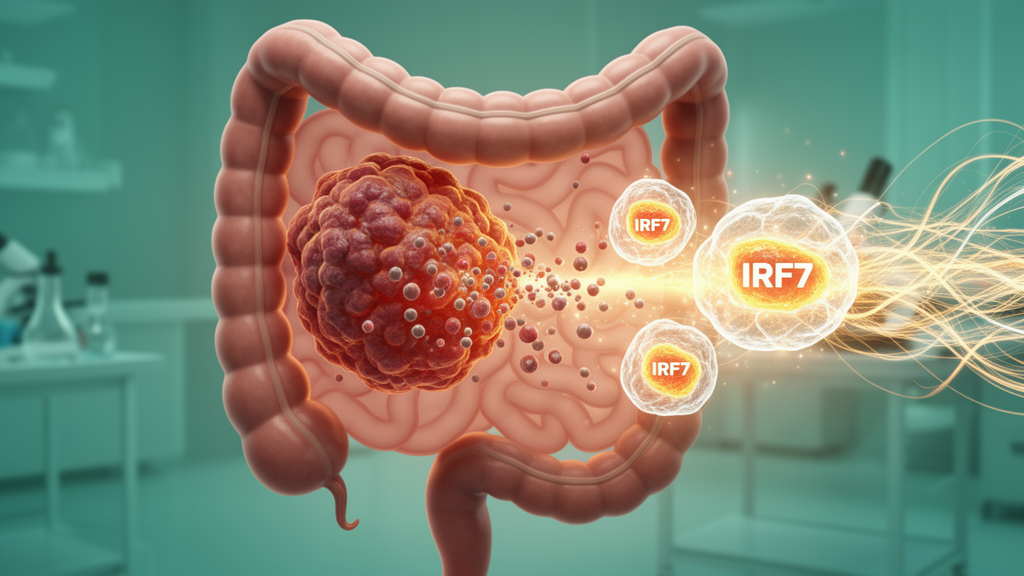
The mechanistic picture that emerged has two distinct arms. First, IRF7 inhibits the proliferation of colorectal cancer cells by downregulating PFKFB3, a regulator of glucose metabolism. This connects fasting’s effect to metabolic reprogramming, since altering PFKFB3 changes how the cancer cells process sugar. Second, IRF7 facilitates the apoptosis of colorectal cancer cells through the induction of type I interferon production, recruiting an immune signalling pathway to push the cells toward programmed cell death. Together, these two actions suggest that fasting acts on colorectal cancer cells along both a metabolic and an immunological axis, with IRF7 sitting at the junction.
The study also uncovered a feedback relationship involving STAT1. Correlation analysis and in vitro experiments indicated that IRF7 acts as a downstream effector of STAT1 and can, in turn, reciprocally upregulate STAT1 under starvation treatment. The authors describe this as a potential positive feedback loop that exerts tumour-suppressive effects on colorectal cancer in the context of short-term starvation, meaning that the two factors may reinforce each other’s activity once the starvation response is under way.
To test whether the cell-culture findings held up in a living system, the researchers employed orthotopic transplantation mouse models, in which tumours are implanted in the anatomical location where the cancer normally arises. According to the paper, these models were used to validate the results, supporting the conclusion that the IRF7-mediated effects observed in dishes are relevant to tumour growth in vivo.
The authors conclude that the study uncovered the elevation and function of IRF7 in colorectal cancer after short-term starvation and explored its interaction with glucose metabolism and type I interferon signalling.
Several caveats are worth noting. The work is a preclinical study combining cell-line experiments, clinical sample analysis and mouse models; it has not yet been tested in a clinical trial of fasting in colorectal cancer patients. The article itself is being shared early as a peer-reviewed, accepted manuscript that is citable and carries a permanent DOI, but the publisher notes that this version is subject to further edits and will be replaced by the final Version of Record. The abstract also states that the specific mechanism of fasting-induced tumour suppression had remained largely uncovered, which is the gap this study set out to address. Readers should therefore interpret the findings as mechanistic evidence from laboratory and animal research rather than as demonstrated clinical benefit, and any consideration of fasting as part of cancer care should involve qualified medical professionals.
Nevertheless, the study adds a concrete molecular link between an increasingly studied dietary intervention and cancer biology. By showing that starvation raises IRF7, that IRF7 restrains proliferation through PFKFB3, that it promotes apoptosis through type I interferon production, and that it participates in a reciprocal loop with STAT1, the research offers a testable framework for future work aimed at translating fasting biology into colorectal cancer therapy.
Subject of Research: Mechanism by which short-term starvation suppresses colorectal cancer through IRF7-mediated metabolic reprogramming and type I interferon expression
Article Title: Fasting inhibits colorectal cancer via enhancing IRF7-mediated metabolic reprogramming and promoting type I interferon expression
Article References: Zhang, Z., Shen, Y., Sun, C., Gu, J., Yue, Y., Nan, K., Zhong, Z., Zhang, J., & Miao, C. (2026). Fasting inhibits colorectal cancer via enhancing IRF7-mediated metabolic reprogramming and promoting type I interferon expression. Cellular Oncology. https://doi.org/10.1007/s13402-026-01304-4
Image Credits: AI Generated
DOI: 10.1007/s13402-026-01304-4
Keywords: colorectal cancer, fasting, short-term starvation, IRF7, PFKFB3, type I interferon, STAT1, metabolic reprogramming, apoptosis, orthotopic mouse model, Cellular Oncology, preclinical study
News Source: Nathaniel Bowman. (October 29, 2026). Fasting slows colorectal cancer growth in mice by triggering IRF7-driven metabolic and immune changes. Scienmag.