• HOME
  • NEWS
  • EXPLORE
    • CAREER
      • Companies
      • Jobs
    • EVENTS
    • iGEM
      • News
      • Team
    • PHOTOS
    • VIDEO
    • WIKI
  • BLOG
  • COMMUNITY
    • FACEBOOK
    • INSTAGRAM
    • TWITTER
Thursday, May 21, 2026
BIOENGINEER.ORG
No Result
View All Result
  • Login
  • HOME
  • NEWS
  • EXPLORE
    • CAREER
      • Companies
      • Jobs
        • Lecturer
        • PhD Studentship
        • Postdoc
        • Research Assistant
    • EVENTS
    • iGEM
      • News
      • Team
    • PHOTOS
    • VIDEO
    • WIKI
  • BLOG
  • COMMUNITY
    • FACEBOOK
    • INSTAGRAM
    • TWITTER
  • HOME
  • NEWS
  • EXPLORE
    • CAREER
      • Companies
      • Jobs
        • Lecturer
        • PhD Studentship
        • Postdoc
        • Research Assistant
    • EVENTS
    • iGEM
      • News
      • Team
    • PHOTOS
    • VIDEO
    • WIKI
  • BLOG
  • COMMUNITY
    • FACEBOOK
    • INSTAGRAM
    • TWITTER
No Result
View All Result
Bioengineer.org
No Result
View All Result
Home NEWS Science News Chemistry

faster imaging in rubber x-ray CT imaging helps tires become smarter and more efficient

Bioengineer by Bioengineer
March 30, 2021
in Chemistry
Reading Time: 2 mins read
0
IMAGE
Share on FacebookShare on TwitterShare on LinkedinShare on RedditShare on Telegram

IMAGE

Credit: Sumitomo Rubber Industries, Ltd.

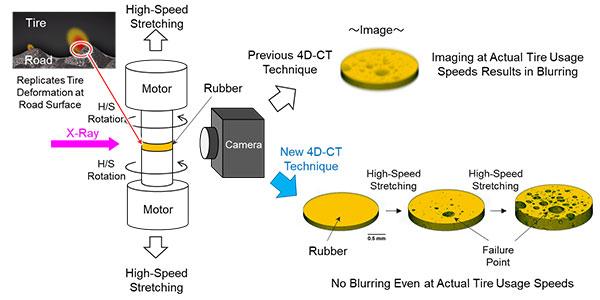
Sumitomo Rubber Industries, Ltd (SRI) and Tohoku University teamed up to increase the speed of 4-Dimensional Computed Tomography (4D-CT) a thousand-fold, making it possible to observe rubber failure in tires in real-time.

This breakthrough will accelerate the development of new tire materials to provide super wear resistance, greater environmental friendliness, and longer service life. It will also aid significantly in the advancement of smart tires.

SRI initially developed 4D-CT as part of the ADVANCED 4D NANO DESIGN, a new materials development technology unveiled in 2015 that enables highly accurate analysis and simulation of the rubber’s internal structure from the micro to nanoscale. This analysis ultimately leads to enhanced rubber wear performance in terms of fuel efficiency, wet grip, and wear resistance.

Since the birth of ADVANCED 4D NANO DESIGN, SRI has undertaken new materials development using the technology available at the SPring-8 synchrotron radiation research facility. However, the existing 4D-CT technique still took several seconds to capture a single 3D image.

Wataru Yashiro, associate professor at Tohoku University, had previously developed a new method to produce higher quality CT images within milliseconds. The technology, which used intense synchrotron radiation, made the breakthrough feasible. It became possible to observe rubber failure as it occurs at varying speeds, allowing a better approximation of a tire’s rubber wear.

“As a result of this research, we have increased the speed of imaging by approximately a thousand-fold, meaning that a 3D image can now be captured in around 1/100 of a second,” said Yashiro.

Looking ahead, SRI hopes to use this technology in conjunction with machine learning and other advanced data processing techniques to analyze the enormous amounts of data that this imaging technique will generate. On the collaborative side, SRI and Tohoku University will continue to serve as participants in the Japan Science and Technological Agency’s Core Research for Evolutionary Science and Technology Program (CREST).

###

Media Contact
Wataru Yasshiro
[email protected]

Original Source

https://www.tohoku.ac.jp/en/press/faster_imaging_rubber_tire.html

Related Journal Article

http://dx.doi.org/10.1107/S1600577520014666

Tags: MaterialsTechnology/Engineering/Computer Science
Share12Tweet8Share2ShareShareShare2

Related Posts

Scientists Achieve Breakthrough in Molecular ‘Sandwich’ Assembly — Chemistry

Scientists Achieve Breakthrough in Molecular ‘Sandwich’ Assembly

May 21, 2026
Advancing In Vivo and In Situ Monitoring: Science Bulletin Highlights Host-Based Antifouling Gold Nanotube Sensor for Selective Detection of Mechanically Sensitive Serotonin Release in Intestinal Mucosa — Chemistry

Advancing In Vivo and In Situ Monitoring: Science Bulletin Highlights Host-Based Antifouling Gold Nanotube Sensor for Selective Detection of Mechanically Sensitive Serotonin Release in Intestinal Mucosa

May 20, 2026

How Magnetic Orientation Could Influence the Building Blocks of Life

May 20, 2026

Breaking a 200-Year-Old Belief: Novel Surface Design Achieves Two Distinct Wetting States on One Substrate

May 20, 2026
Please login to join discussion

POPULAR NEWS

  • blank

    New Study Reveals Plants Can Detect the Sound of Rain

    733 shares
    Share 292 Tweet 183
  • ESMO 2025: mRNA COVID Vaccines Enhance Efficacy of Cancer Immunotherapy

    303 shares
    Share 121 Tweet 76
  • Research Indicates Potential Connection Between Prenatal Medication Exposure and Elevated Autism Risk

    846 shares
    Share 338 Tweet 212
  • Breastmilk Balances E. coli and Beneficial Bacteria in Infant Gut Microbiomes

    58 shares
    Share 23 Tweet 15

About

We bring you the latest biotechnology news from best research centers and universities around the world. Check our website.

Follow us

Recent News

Rural Siblings of Individuals with Neurodevelopmental Conditions Face Unique Challenges Without Adequate Support

Stretch-Resistant Spoof Plasmonic Fabric via Fiber Buckling

MedZero by The Lancet: A Unified Platform for Carbon Data Across All Healthcare Products

Subscribe to Blog via Email

Enter your email address to subscribe to this blog and receive notifications of new posts by email.

Join 82 other subscribers
  • Contact Us

Bioengineer.org © Copyright 2023 All Rights Reserved.

Welcome Back!

Login to your account below

Forgotten Password?

Retrieve your password

Please enter your username or email address to reset your password.

Log In
No Result
View All Result
  • Homepages
    • Home Page 1
    • Home Page 2
  • News
  • National
  • Business
  • Health
  • Lifestyle
  • Science

Bioengineer.org © Copyright 2023 All Rights Reserved.