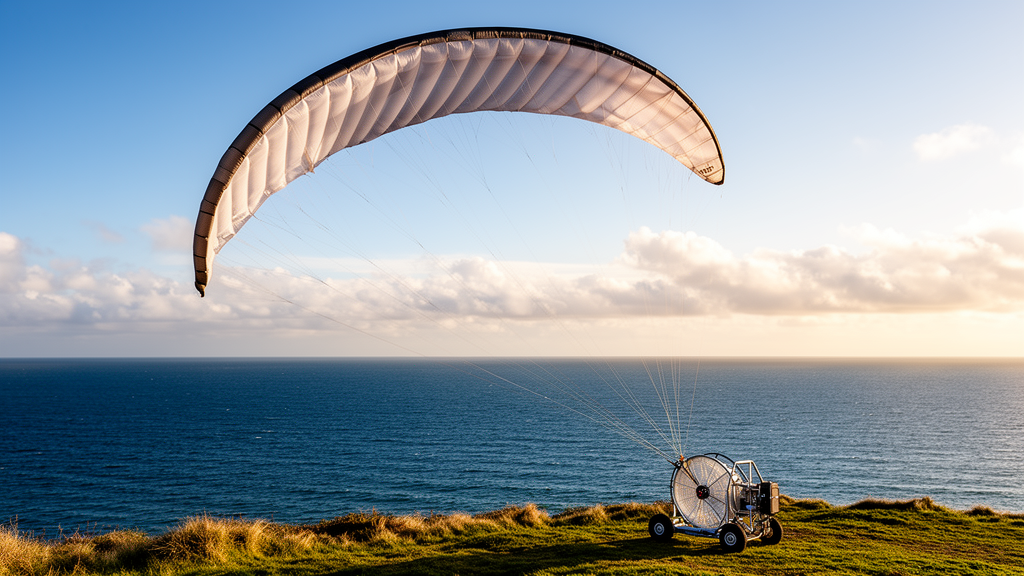
A research team at Delft University of Technology has developed a computationally efficient aerodynamic framework that accelerates leading-edge inflatable kite simulations by roughly six orders of magnitude while preserving high predictive fidelity. Inflatable kites serve as tethered wings for airborne wind energy and wind-assisted ship propulsion, yet their complex geometry has long hindered rapid numerical design. To resolve this bottleneck, the investigators coupled an extended three-dimensional vortex step method with machine learning surrogates trained on a vast database of two-dimensional viscous flow simulations. Evaluated against wind tunnel data from a rigidized subscale model of the reference TU Delft V3 kite across its operational incidence range of negative one to ten degrees, the hybrid model predicted lift and drag within average errors of nine percent and thirteen percent, respectively. Evaluating a full wing in twenty-five milliseconds on a standard laptop processor, the framework eliminates reliance on costly high-fidelity computations during conceptual design.
In airborne wind energy applications, these membrane wings operate at higher angles of attack during reel-out and lower angles during reel-in. However, the pre-inflated tubular spar running along the leading edge imposes severe aerodynamic challenges that deviate fundamentally from classical streamlined aircraft wings. The presence of this thick cylindrical tube causes immediate and persistent flow separation on the pressure side, followed downstream by complex recirculation zones across nearly the entire flight envelope. Classical potential-flow solvers, panel methods, and standard vortex-lattice formulations fail under these operating conditions because their governing equations presume attached flow with thin boundary layers, making higher-fidelity viscous inputs indispensable for resolving sectional performance.
Historically, kite designers have relied either on empirical prototype testing or on full three-dimensional Reynolds-averaged Navier-Stokes computational fluid dynamics. While experimental campaigns in wind tunnels or open-air sites deliver authentic physical observations, constructing and testing physical prototypes at commercial scales becomes prohibitively expensive and slows iterative development cycles. Conversely, solving the full three-dimensional Navier-Stokes equations with advanced turbulence closures captures complex crossflow effects and separation bubbles, but at an immense computational penalty. A single steady three-dimensional viscous simulation of a reference kite wing requires nearly twenty thousand seconds of central processing unit time, rendering direct numerical optimization and two-way fluid-structure interaction modeling intractable. Simplified aerodynamic surrogates like NeuralFoil, which rely on viscous-inviscid interaction codes developed for attached boundary layers, systematically break down when confronting leading-edge inflatable profiles, overpredicting maximum lift and delaying the onset of aerodynamic stall. Consequently, developing an intermediate model capable of bridging low-fidelity computational speed and high-fidelity accuracy became an urgent priority.
To supply the vortex step framework with rigorous sectional aerodynamics, the researchers engineered an automated pipeline to construct, mesh, and simulate thousands of parameterized leading-edge inflatable airfoil sections. Profile geometries were generated using Bézier curves defined by six primary parameters: leading-edge tube diameter, maximum camber height, chordwise position of maximum camber, trailing-edge reflex angle, camber tension, and leading-edge curvature. Automated scripts generated structured O-grid meshes comprising approximately one hundred and fifteen thousand cells for each distinct geometric configuration. The computational grids featured wall-normal resolution with a non-dimensional wall distance below one to ensure fully resolved viscous sublayers. Numerical flow solutions were executed in OpenFOAM using the semi-implicit method for pressure-linked equations and Menter’s shear stress transport turbulence model. By leveraging the university high-performance computing cluster, the team completed more than forty-five thousand individual two-dimensional simulations per evaluated Reynolds number, consuming one hundred and forty thousand core hours while enforcing strict convergence criteria of ten to the negative sixth on initial flow residuals.
Because running live two-dimensional Navier-Stokes solves within a three-dimensional wing solver remains computationally burdensome, the investigators deployed the resulting simulation database to train fast machine learning surrogate models. Data filtering protocols removed statistical outliers exhibiting z-scores greater than three alongside non-converged post-stall solutions, leaving more than forty-two thousand training instances and five thousand testing cases. After benchmarking multiple regression algorithms using ten-fold cross-validation, the team selected extremely randomized trees, which consistently demonstrated superior performance with coefficients of determination exceeding 0.98 across all Reynolds numbers. Separate surrogate models were established at Reynolds numbers of one million, five million, and twenty million, reflecting representative flight regimes from small testing wings to utility-scale harvesting systems. To eliminate the piecewise-constant stepping inherent in raw tree-based predictions, the model queries were fitted with shape-preserving piecewise cubic Hermite interpolating polynomial splines, providing continuous aerodynamic polar curves without introducing unphysical mathematical oscillations.
The global wing aerodynamics were computed using an extended vortex step method rooted in classic lifting-line theory and discrete horseshoe vortex systems. In this framework, the physical wing is discretized into spanwise panels, with each panel housing a bound vortex filament placed along its quarter-chord line connected to trailing filaments and semi-infinite wake filaments aligned with the undisturbed freestream. Induced velocity vectors at every three-quarter-chord control point were calculated using the Biot-Savart law supplemented by regularized viscous vortex core models to prevent numerical singularities. Crucially, the formulation precomputes an aerodynamic influence coefficient matrix and explicitly subtracts each panel’s two-dimensional self-induced velocity, preventing double-counting of sectional induction already captured within the machine-learned airfoil polars. Spanwise circulation was iteratively solved through circulation matching governed by the Kutta-Joukowski theorem under numerical under-relaxation. Methodological testing revealed that while classical cosine panel clustering suffered from numerical instability and failed to converge above fifty panels, uniform spanwise spacing converged robustly up to one hundred and fifty panels.
Comprehensive validation demonstrated that the coupled framework accurately captures the three-dimensional aerodynamic behavior of the TU Delft V3 reference kite across its primary operating conditions. Within the critical operational incidence window of negative one to ten degrees, encompassing reel-in at approximately one degree and reel-out at eight degrees, the model predicted lift forces within nine percent and drag forces within thirteen percent of wind tunnel balance measurements. Remarkably, the vortex step method utilizing the machine-learned two-dimensional viscous inputs reproduced experimental force trends more consistently than full three-dimensional computational fluid dynamics, which suffered from geometric discrepancies associated with strut modeling and artificial grid smoothing. In terms of execution performance, the new tool evaluated a one-hundred-and-fifty-panel wing configuration in approximately twenty-five milliseconds, compared to over nineteen thousand seconds required by the reference three-dimensional Navier-Stokes simulation. This computational efficiency facilitates design optimization, aero-structural coupling, and real-time control applications.
Beyond steady load predictions, the researchers utilized the framework to establish a baseline set of rigid-body stability derivatives for the reference inflatable kite. By introducing central finite-difference perturbations in flow angles and body rotation rates around a trimmed equilibrium of 7.469 degrees angle of attack, the team extracted non-dimensional static and rate derivatives in the aircraft reference frame. The resulting static derivatives confirmed that the trimmed kite possesses intrinsic static stability across roll, pitch, and yaw axes, exhibiting a restoring pitch-moment slope of negative 2.708 per radian. Furthermore, the calculated rate derivatives revealed positive aerodynamic damping across all three rotational axes, though yaw damping was an order of magnitude weaker due to the absence of a vertical stabilizer. Although these rigid-body calculations omit unsteady aeroelastic deformations of the flexible canopy, they provide an invaluable benchmark for the aerospace community, shedding light on the fundamental flight dynamics of tethered swept wings.
Parametric explorations conducted with the validated model exposed complex aerodynamic design trade-offs between energy extraction efficiency and passive flight stability. In airborne wind energy applications, the primary figure of merit governing mechanical power output is the system performance ratio, defined as the cube of the lift coefficient divided by the square of the drag coefficient. Examining global planform geometry demonstrated that increasing the wing aspect ratio enhances the lift-to-drag ratio and bolsters directional yaw stability, matching classical aeronautical principles. Conversely, increasing the wing anhedral angle degraded aerodynamic efficiency while significantly amplifying lateral side forces under sideslip conditions. This trade-off confirms that wing anhedral, while slightly diminishing raw energy extraction, provides the vital lateral-directional control authority necessary for executing aggressive crosswind trajectories.
Finally, investigating tow-point placement revealed critical insights into the unique balance mechanisms governing bridled kites compared to free-flying aircraft. Because tethered kites naturally rotate about their converging bridle confluence point rather than their internal center of gravity, aerodynamic stability margins are exceptionally sensitive to tow-point coordinates. Shifting the tow point aft increases the operational trim angle and elevates the energy harvesting metric, but positioning it too close to the trailing edge induces severe static pitch and yaw instabilities. Strikingly, the analysis demonstrated that raising the bridle attachment point upward toward the wing eliminates restoring roll moments, rendering the kite statically unstable in roll. This behavior establishes that tethered kites rotating about a low tow point strictly require wing anhedral to maintain positive roll stability, directly reversing the conventional aeronautical rule where unconstrained aircraft depend on wing dihedral. These findings provide an indispensable foundation for sizing bridle geometries and guiding the future multi-objective optimization of commercial airborne wind systems.
Subject of Research: Computational aerodynamics and machine learning modeling for leading-edge inflatable kites
Article Title: Computational aerodynamics for leading-edge inflatable kite design
Article References: Poland, J. A. W., Masure, K. R. G., Cayon, O., & Schmehl, R. (2026). Computational aerodynamics for leading-edge inflatable kite design. Wind Energy Science, 11(11), 4147-4178. https://doi.org/10.5194/wes-11-4147-2026
Image Credits: AI Generated
Keywords: airborne wind energy, leading-edge inflatable kites, vortex step method, computational fluid dynamics, machine learning surrogate, wind tunnel testing, aerodynamic stability, flight dynamics, Computational, aerodynamics, leading-edge, inflatable
News Source: Audrey Campbell. (November 10, 2026). Fast Aerodynamic Framework Predicts Inflatable Kite Loads Within Thirteen Percent. Scienmag.