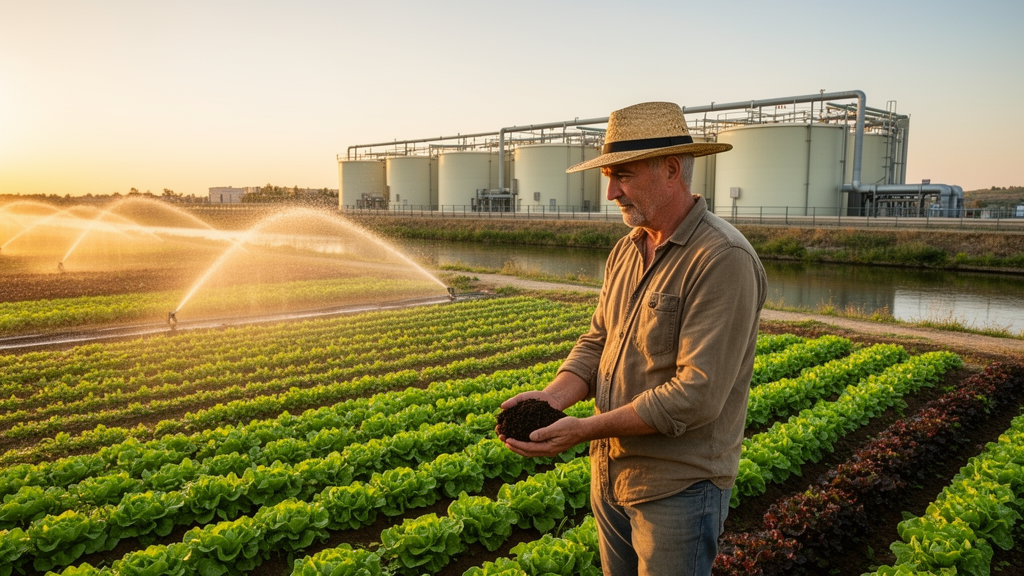
Treated urban wastewater could be one of the most valuable tools agriculture has against drought, yet the farmers who would actually use it often see it as a threat rather than a resource. A new field survey of 200 irrigated farms in Basilicata, a drought-exposed region of Southern Italy, maps out exactly how growers perceive the risks of irrigating with reclaimed water, and the results reveal five sharply different farmer profiles whose attitudes toward the practice diverge dramatically. The study, published in Agricultural and Food Economics, was conducted by Antonella Tassinari and Adele Coppola between July and December 2024 in the Metapontino area, the centre of the region’s intensive irrigated agriculture.
The stakes are considerable. In recent years drought has become an increasingly significant issue in Italy, particularly affecting the Southern regions, and climate change is expected to intensify reduced water availability and irregular rainfall. Agriculture is among the sectors most affected, having suffered economic losses from reduced yields across most irrigated crops, and agricultural water demand often exceeds supply. Farmers have responded with wells, storage basins and micro-irrigation, but the study’s authors argue these measures, while effective in the short term, do not guarantee systemic resilience in the medium to long term. Reuse of treated urban wastewater, an approach already tested in various agricultural contexts in Europe and developing countries, is an emerging alternative whose large-scale adoption remains limited by multiple factors, including regulatory variation and, critically, farmers’ own perceptions of risk.
The survey area itself illustrates the pressure. Since 2022, the frequency and intensity of extreme drought events in Basilicata have increased significantly, with substantial repercussions on agricultural production; according to ISTAT data, in 2022 the region’s agricultural sector suffered a 0.7% decrease in production volume. The 200 surveyed farms cover 7,308 hectares of utilised agricultural area, 80% of it irrigated, and their irrigated area of 5,857 hectares represents almost 20% of the regional irrigated total. Average farm size is 36.5 hectares, ranging from 2 to 350 hectares, and 98% of farms specialise in fruit and vegetable production. Alarm about water is widespread: 83% of respondents say they are alarmed by the effects of climate change and the increasing frequency of droughts, and 87% have adopted drip irrigation systems to optimise water use. Yet 83% of farmers using irrigation consortia reported problems with limited water availability and distribution inefficiencies.
Against that backdrop, 61% of the sample, 122 farmers, declared themselves in favour of using wastewater for irrigation, mainly because it provides access to greater volumes of water than conventional sources and offers potential agronomic benefits linked to reduced fertiliser use. But the remaining farmers were not persuaded, and the questionnaire dug into why. Farmers were asked about concerns including accumulation of contaminants in soils, equipment clogging, potential compromise of product quality, and impacts on human and environmental health. A higher percentage of farmers perceived the accumulation of undesirable substances and market difficulties for products irrigated with wastewater as relevant risks, while just over a third feared damage to irrigation systems. The least perceived risks were groundwater pollution, cited by 18% of farmers, and increased soil salinity, cited by 21%.
To make sense of these responses, the researchers applied a principal component analysis based on a tetrachoric correlation matrix, extracting three components that together explain 76.7% of the total variance. The first component captures perceived risk related to the accumulation of undesirable substances and the quality of the final products, a dimension that spans technical effects on irrigation systems and effects on marketability. The second represents perceived environmental risk related to contamination of soil and natural ecosystems, and the third concerns risk to the health of agricultural workers and consumers. The authors note that the prominence of worsening product quality across two components suggests farmers see this risk as connected both to product market characteristics and to systemic soil effects.
The statistical associations that emerged are strikingly consistent. Risk perception increases with age, with farmers aged 55 or older reporting higher perceived risks across all three dimensions. In all three risk areas, farmers who are not informed about wastewater regulations report significantly higher risk perceptions than those with some or full knowledge, and similar results emerged regarding levels of education and participation in professional agricultural training courses, suggesting that access to information and formal education are associated with lower risk perceptions. Farmers who describe themselves as more innovative, self-classified innovators and early adopters, tend to perceive risks less than those with less innovative attitudes, although pairwise comparisons show the differences are most pronounced for accumulation risk and, for environmental and health risks, significant mainly between the extreme innovativeness groups. Most directly, farmers in favour of using wastewater reported a significantly lower perception of risk than those unwilling to use it.
Cluster analysis of the risk-perception factor scores then identified five distinct farmer profiles, with a silhouette score of 0.54 indicating reasonable cluster quality. The largest group, the Experimenters at 44.5% of respondents, shows below-average risk perception on all dimensions, high regulatory knowledge, higher education, lower average age, more than 70% self-identifying as innovators or early adopters, and 93% willing to use treated wastewater. The Product Concerned group, 19.0% of the sample, mirrors the Experimenters on environmental and health risk but shows the highest accumulation risk of any cluster; these farmers are strongly market-oriented, on average selling 37% of production through direct sales and associations, and appear to be protecting product quality and commercial competitiveness. The Health Concerned cluster, 12.5% of cases, shows the highest health-risk perception, with about 60% unaware of wastewater regulations, 72% having low education, 64% over age 65, and 68% unwilling to use wastewater; notably, 76% of them say they would need adequate training to use it safely.
The two remaining profiles complete the picture. The Environment Concerned cluster, the smallest at 8.5% of respondents, is defined by high environmental risk perception paired with low health-risk perception, and an information gap in which 56% are unaware of the regulations; despite this, 53% are willing to use wastewater, and the cluster sits predominantly between the early and late majority in innovation attitude, suggesting adoption only after observing success among others. The Cautious cluster, 15.5% of the sample, combines high environmental and health risk perception with an average age of 64, 77% with only primary education, 78% unaware of the governing legislation, and 81% not inclined to use wastewater. Across clusters, the relationships are statistically significant: cluster membership is associated with innovation attitude (χ² = 96.689, P < .001; Cramer’s V = 0.348) and with willingness to use wastewater (χ² = 75.980, P < .001; Cramer’s V = 0.616).
The authors are careful about what these numbers mean. The study adopted an exploratory design with a convenience-based, non-probabilistic sample recruited mainly through local Producer Organisations, so the findings do not statistically represent the whole population of farmers and cannot be generalised; such sampling may also have preferentially selected more active farmers. The data are self-reported, which is appropriate for studying subjective perceptions but may be influenced by respondents’ interpretations and, to some extent, social desirability, and risk perceptions were collected as binary variables because a pre-test showed farmers positioning themselves at the extremes of Likert scales, a limitation the authors acknowledge and flag for future research using more gradual scales. The analysis identifies associations, not causal links, and the authors note that future work could address more robust analysis of relationships, the relationship between actual and perceived risks, and patterns related to information channels and adoption.
Even with those caveats, the practical implications are clear. The authors argue that a single strategy will not suffice to incentivise wastewater use, and they propose a multi-faceted approach: training and information campaigns, including outreach on regulations and safety protocols, aimed at mitigating knowledge gaps prevalent among older and less educated farmers; evidence-based demonstrations through pilot projects and case studies, with networks of pioneering farmers acting as credible testimonials; and specific economic incentives designed to reassure farmers, such as the Product Concerned, who worry about impacts on crop quality and market valuation. They place this within the Agricultural Knowledge and Innovation System of the Common Agricultural Policy, which links research institutes, authorities, extension services and farmer organisations. The broader message is that adoption of treated wastewater seems constrained by heterogeneous risk perceptions, uneven access to information and structural differences in human capital, and that translating technical data into comprehensible, tailored messages, whether emphasising economic advantages and microbiological safety for market-focused farmers or environmental sustainability for ecologically minded ones, will determine whether this practice, still perceived as risky by many, becomes a collective opportunity for more resilient and sustainable agriculture.
Subject of Research: Farmers' perceptions of risk associated with reusing treated wastewater for irrigation in Southern Italy
Article Title: From risk to resource: understanding farmers’ perceptions of wastewater reuse
Article References: Tassinari, A., & Coppola, A. (2026). From risk to resource: understanding farmers’ perceptions of wastewater reuse. Agricultural and Food Economics, 14(1), Article 67. https://doi.org/10.1186/s40100-026-00508-4
Image Credits: AI Generated
DOI: 10.1186/s40100-026-00508-4
Keywords: wastewater reuse, irrigation, risk perception, farmers, Basilicata, water scarcity, cluster analysis, principal component analysis, innovation adoption, agricultural training, drought, Southern Italy
News Source: Alan Morgan. (October 29, 2026). Farmers’ risk perceptions shape willingness to reuse treated wastewater in Italy. Scienmag.