A warming climate threatens crop diversity; the ‘Seeds for Needs’ approach combines farmers’ knowledge of resilient crops with ‘elite’ varieties identified by scientists
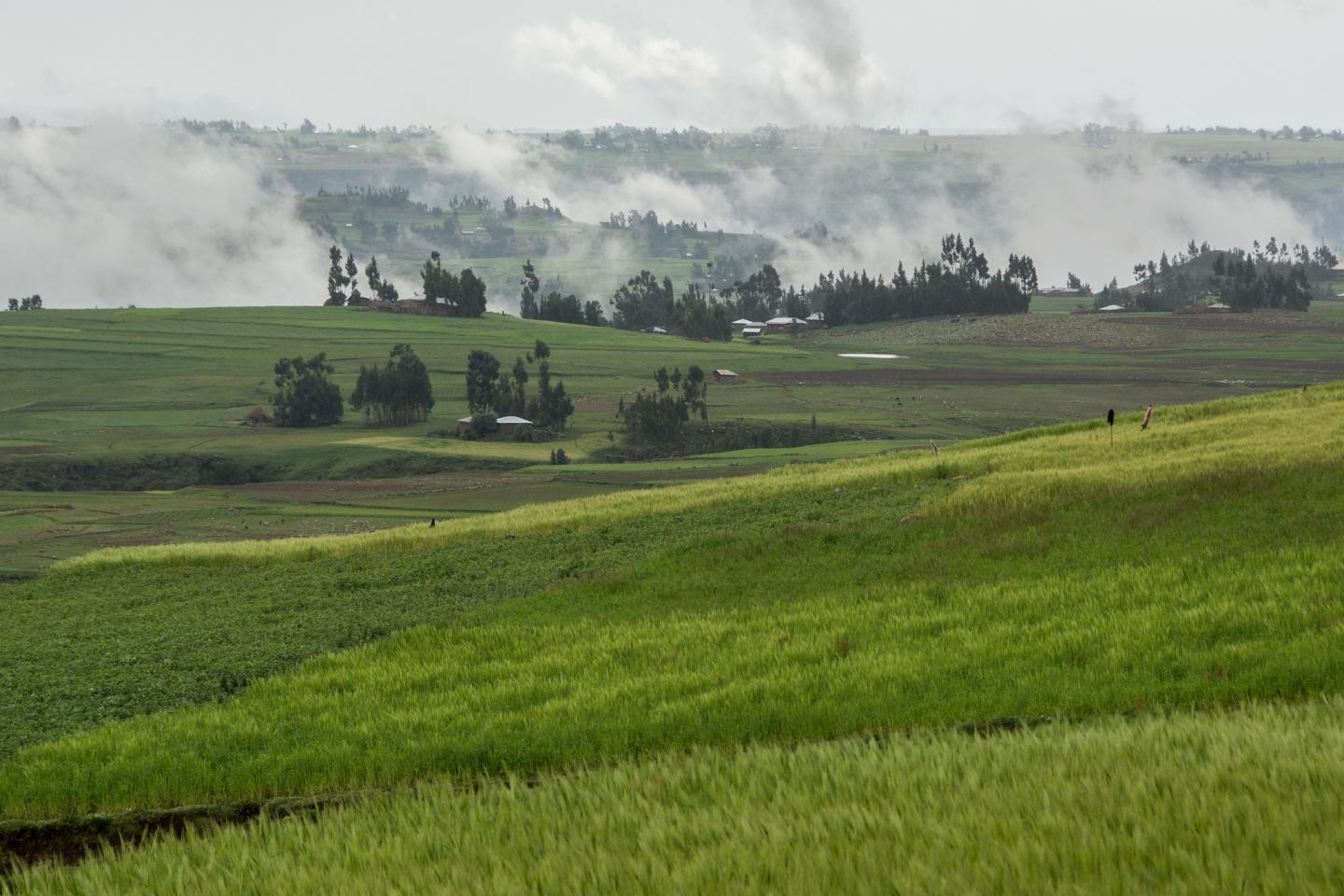
Credit: Georgina Smith / International Center for Tropical Agriculture
In a review paper published in Frontiers in Plant Science, scientists urge the importance of combining the knowledge harbored by farmers of diverse crop varieties – which is often overlooked by scientists – with high-tech breeding done in laboratories.
Authors argue that farmers’ knowledge and high-tech breeding to improve crops can be effectively combined to unlock more resilient and nutritious food supplies in the face of climate threats. They say that involving farmers in crop improvement enhances the chance that new varieties will be adopted, making crop improvement more efficient.
“Modern breeding under a microscope in the lab can speed up breeding of ‘elite’ varieties able to provide significant yield increase,” says Carlo Fadda, a co-author from the Alliance of Bioversity and International Center for Tropical Agriculture. “But are those varieties and traits most important to farmers? Do they plant them? On the other hand, traditional varieties can better withstand changing climatic conditions, but are these varieties high-yielding enough?”
This Seeds for Needs approach, first trialed in Ethiopia to speed up durum wheat breeding, has already yielded surprising results. When scientists took a selection of elite and traditional durum wheat varieties obtained from Ethiopia Biodiversity Institute (EBI) to farmers to get their feedback, traditional varieties outperformed elite ones, producing double the average national durum wheat yield while also resistant to major diseases.
“Rather than mass-producing seed to cope in a broad range of conditions, we need to find varieties for local contexts in order to maximize yields at each site,” says Fadda. “Traditionally, farmers grow a portfolio of crops to withstand different conditions and make different products. Some will plant wheat for bread, for local-brewed beer, for injera – the local flatbread – to minimize their risk.”
The ‘Seeds for Needs’ approach further integrates scientific rigor and cutting-edge breeding to fast-track climate-resilient traits and crop varieties. Combined with farmer selection of varieties, which can cope in field conditions, the result is a better-adapted food supply, more resilient to the impacts of the impending climate crisis, say authors.
“Climate change is a shifting target, and to address it we need a dynamic process,” says Fadda. “This approach provides a constant injection of new material adapted to a broader set of conditions within one locality. With this approach, as climate change advances, there will always be well-adapted crop varieties for local conditions, bringing together high tech approaches and traditional knowledge.”
Matteo Dell’Acqua, a co-author and geneticist at the Institute of Life Sciences, Scuola Superiore Sant’Anna, in Pisa in Italy, adds: “This approach shows the value of combining the most advanced genomics approaches with traditional knowledge of farmer communities. In this framework, modern breeding and crowd-sourcing methods can complement each other in supporting local adaptation of farming systems to the impacts of climate change.”
With the advent of digital tools, the researchers say farmer ‘citizen scientists’ can provide adequate, reliable information identifying varieties with superior traits tolerant to climate-induced stress. Research conducted with farmers in Ethiopia, Honduras and India shows they are keen to be part of trials, to contribute to research or in exchange for advice.
In Ethiopia, two wheat varieties bred using the ‘Seeds for Needs’ approach have already been released four years faster than the average time required to release new varieties. Now, the approach is being used across Africa, Asia and Latin American and the Caribbean.
###
Media Contact
Sean Mattson
[email protected]
Related Journal Article
http://dx.