• HOME
  • NEWS
  • EXPLORE
    • CAREER
      • Companies
      • Jobs
    • EVENTS
    • iGEM
      • News
      • Team
    • PHOTOS
    • VIDEO
    • WIKI
  • BLOG
  • COMMUNITY
    • FACEBOOK
    • INSTAGRAM
    • TWITTER
Sunday, June 28, 2026
BIOENGINEER.ORG
No Result
View All Result
  • Login
  • HOME
  • NEWS
  • EXPLORE
    • CAREER
      • Companies
      • Jobs
        • Lecturer
        • PhD Studentship
        • Postdoc
        • Research Assistant
    • EVENTS
    • iGEM
      • News
      • Team
    • PHOTOS
    • VIDEO
    • WIKI
  • BLOG
  • COMMUNITY
    • FACEBOOK
    • INSTAGRAM
    • TWITTER
  • HOME
  • NEWS
  • EXPLORE
    • CAREER
      • Companies
      • Jobs
        • Lecturer
        • PhD Studentship
        • Postdoc
        • Research Assistant
    • EVENTS
    • iGEM
      • News
      • Team
    • PHOTOS
    • VIDEO
    • WIKI
  • BLOG
  • COMMUNITY
    • FACEBOOK
    • INSTAGRAM
    • TWITTER
No Result
View All Result
Bioengineer.org
No Result
View All Result
Home NEWS Science News Health

Farm-like indoor microbiota may protect children from asthma also in urban homes

Bioengineer by Bioengineer
June 17, 2019
in Health
Reading Time: 2 mins read
0
IMAGE
Share on FacebookShare on TwitterShare on LinkedinShare on RedditShare on Telegram

IMAGE

Credit: National Institute for Health and Welfare

Earlier research has shown that growing up on a farm with animals may as much as half the risk of asthma and allergies. The protective effect is thought to be attributable to the diverse microbial exposures encountered on farms.

“We now discovered that the presence of farm-like microbiota in an early-life home seemed to protect from asthma also in urban homes. The effect was not based on the presence of large number of different microbial species but rather differences in the relative abundance of certain bacterial groups,” says Pirkka Kirjavainen, Senior Researcher at the Finnish National Institute for Health and Welfare.

Wearing outdoor shoes indoors, the number of siblings and the age of the house played a role

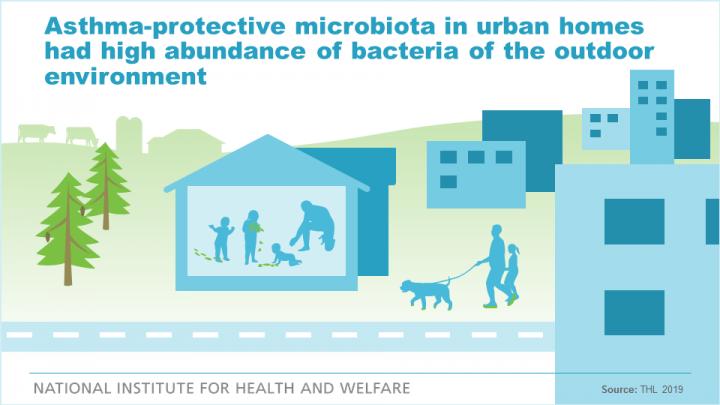
The study found that the microbiota in homes protecting from asthma contained a wealth of bacteria typical of the outdoor environment, including bacteria in soil. On the other hand, the proportion of microbes normally occurring in the human respiratory tract and associated with respiratory tract infections was small.

“The key characteristic of microbiota in homes protecting from asthma appears to be large abundance of bacteria which originate from the outdoor environment and are beneficial or harmless to health, relative to bacteria that are a potential threat to health,” Kirjavainen comments.

In urban homes, factors that increased the farm-like features in the microbiota included wearing outdoor shoes indoors, the number of siblings and the age of the house; all factors that may increase transport of outdoor microbes into the home.

Asthma is the most common chronic disease in children in Finland – can new cases be prevented in the future?

“It is interesting to see how clear of a protective effect indoor microbiota can have against the development of asthma. In contrast, it has been considerably more difficult to identify microbiota that would explain the detrimental effect of moisture damage on asthma,” says Professor Juha Pekkanen.

Asthma is the most common chronic disease in children in Finland as well as in many other countries, and its prevalence is increasing with urbanisation. The new study supports the view that children’s early exposure to ‘right cocktail’ of microbes may help their bodies to develop mechanisms protecting from asthma.

“The results suggest that asthma could be prevented in the future by modifying children’s early microbial exposures,” says Pekkanen.

###

Media Contact
Pirkka Kirjavainen
[email protected]

Original Source

https://thl.fi/en/web/thlfi-en/-/study-farm-like-indoor-microbiota-may-protect-children-from-asthma-also-in-urban-homes

Related Journal Article

http://dx.doi.org/10.1038/s41591-019-0469-4

Tags: Ecology/EnvironmentEnvironmental HealthImmunology/Allergies/AsthmaMedicine/HealthMicrobiologyPediatricsPublic Health
Share19Tweet8Share2ShareShareShare2

Related Posts

Tracking Lanthanide-Labeled Microplastics in Plants

June 25, 2026

Neural Design Enables Zero-Shot Drug-Binding Proteins

June 25, 2026

Genomic Insights into Human Skin Fungi Diversity

June 25, 2026

Chiral Laser Gyroscopes Surpass Lock-In Limit

June 25, 2026
Please login to join discussion

POPULAR NEWS

  • Saying Goodbye to PGY-6: Pediatric Fellowship Realities

    103 shares
    Share 41 Tweet 26
  • Multi-Hospital Study Reveals Long Covid Burden Is Twice as High as Current Estimates

    92 shares
    Share 36 Tweet 23
  • Detection of EDCs in Breast Milk and Infant Urine Up to Six Months Highlights Early Exposure Risks

    77 shares
    Share 31 Tweet 19
  • New Drug Candidate Developed at McMaster Shows Potential for Treating Brain Cancer

    58 shares
    Share 23 Tweet 15

About

We bring you the latest biotechnology news from best research centers and universities around the world. Check our website.

Follow us

Recent News

Tracking Lanthanide-Labeled Microplastics in Plants

POSTECH Researchers Slash Cost of Reconstituted Cell-Free Systems by 95%

AI and Physics Collaborate to Design Advanced Hydrogen Storage Materials

Subscribe to Blog via Email

Success! An email was just sent to confirm your subscription. Please find the email now and click 'Confirm' to start subscribing.

Join 82 other subscribers
  • Contact Us

Bioengineer.org © Copyright 2023 All Rights Reserved.

Welcome Back!

Login to your account below

Forgotten Password?

Retrieve your password

Please enter your username or email address to reset your password.

Log In
No Result
View All Result
  • Homepages
    • Home Page 1
    • Home Page 2
  • News
  • National
  • Business
  • Health
  • Lifestyle
  • Science

Bioengineer.org © Copyright 2023 All Rights Reserved.