Facemasks do not impair indicators of cognitive performance when performing moderate physical work in hot environments
Credit: Andreas Flouris
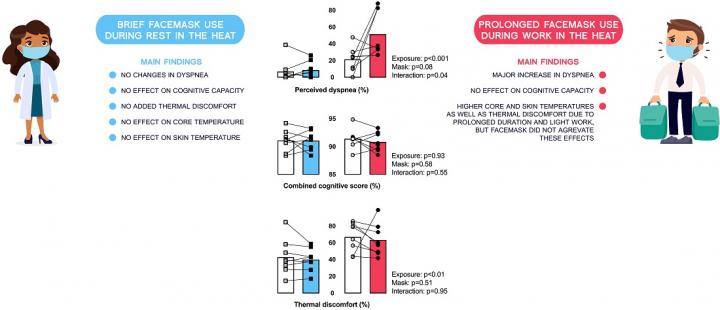
A novel study shows that facemask use does not affect indicators of cognitive performance when the wearers are resting or performing moderate physical work in hot environments. However, wearing a facemask does make it more difficult to breathe when performing moderate physical work in a hot environment. The study is conducted by researchers at the Department of Nutrition, Exercise and Sports, University of Copenhagen in collaboration with the European research consortium ‘HEAT-SHIELD’.
Facemasks are mandatory by law in many countries and recommended by the World Health Organization (WHO) to prevent spreading of the COVID-19 virus. However, experts and lay people alike have raised concerns that working with a facemask may aggravate heat stress, thermal discomfort and increase perceived breathlessness (dyspnea) – which eventually could impair cognitive function, concentration and jeopardize occupational safety.
The only measure worsened by wearing a mask was feelings of breathlessness
Now a study shows that facemask usage has lesser consequences on indicators of cognitive performance than expected, when the wearers are resting or performing moderate physical work in normal work-wear in hot environments. This cognitive testing battery consisted of four different math and fine motor skill tasks that were performed in a random order on a computer.
During testing, body temperature and thermal discomfort did increase in both trials, but not to a greater degree while wearing a mask. However, the study also showed that wearing a facemask does make it more difficult to breathe when performing moderate physical work in a hot environment.
Professor in human physiology at University of Copenhagen and coordinator for the HEAT-SHIELD project, Lars Nybo explains:
“We utilized an experimental set-up that mimics tasks completed in many occupations and a protocol previously used to explore how heat-stress and dehydration markedly impair performance in tasks relying on the ability to concentrate and conduct complex motor-cognitive tasks. Although prolonged exposure with facemasks while wearing normal work-wear in a thermal stressing environment elevated thermal discomfort in both trials, it did not lower scores in any of the motor-cognitive tasks that the participants completed. Indeed, the only measure worsened by wearing a mask was feelings of breathlessness.”
The researchers therefore conclude that facemasks do not directly impair concentration or indicators of cognitive performance – but they may restrict physically demanding work when the restraint on respiration becomes an issue.
Facts about the study
Eight healthy, active males, aged 27 – 41, participated in the study. On two different occasions, one with a facemask and one with a bare face, participants sat in a climatic chamber regulated at 40°C and 20% humidity for 30 min to become accustomed to the testing conditions. After which they exercised for 45 minutes at an intensity that simulates occupations with manual work.
Physiological, perceptual (thermal comfort and breathlessness) and motor-cognitive measurements (consisting of four different computer tasks relying on math ability and fine motor precision) were taken immediately before and after the bout of exercise.
###
About HEAT-SHIELD
HEAT-SHIELD is dedicated to address the negative impact of increased workplace heat stress on the health and productivity of five strategic European industries: manufacturing, construction, transportation, tourism and agriculture.
The consortium consists of a group of twelve research institutions, two policy-making organizations, four industrial entities and two civil society organization from across the EU.
Read more about HEAT-SHIELD.
Media Contact
Nathan B Morris
[email protected]
Original Source
https:/
Related Journal Article
http://dx.