Credit: VTT
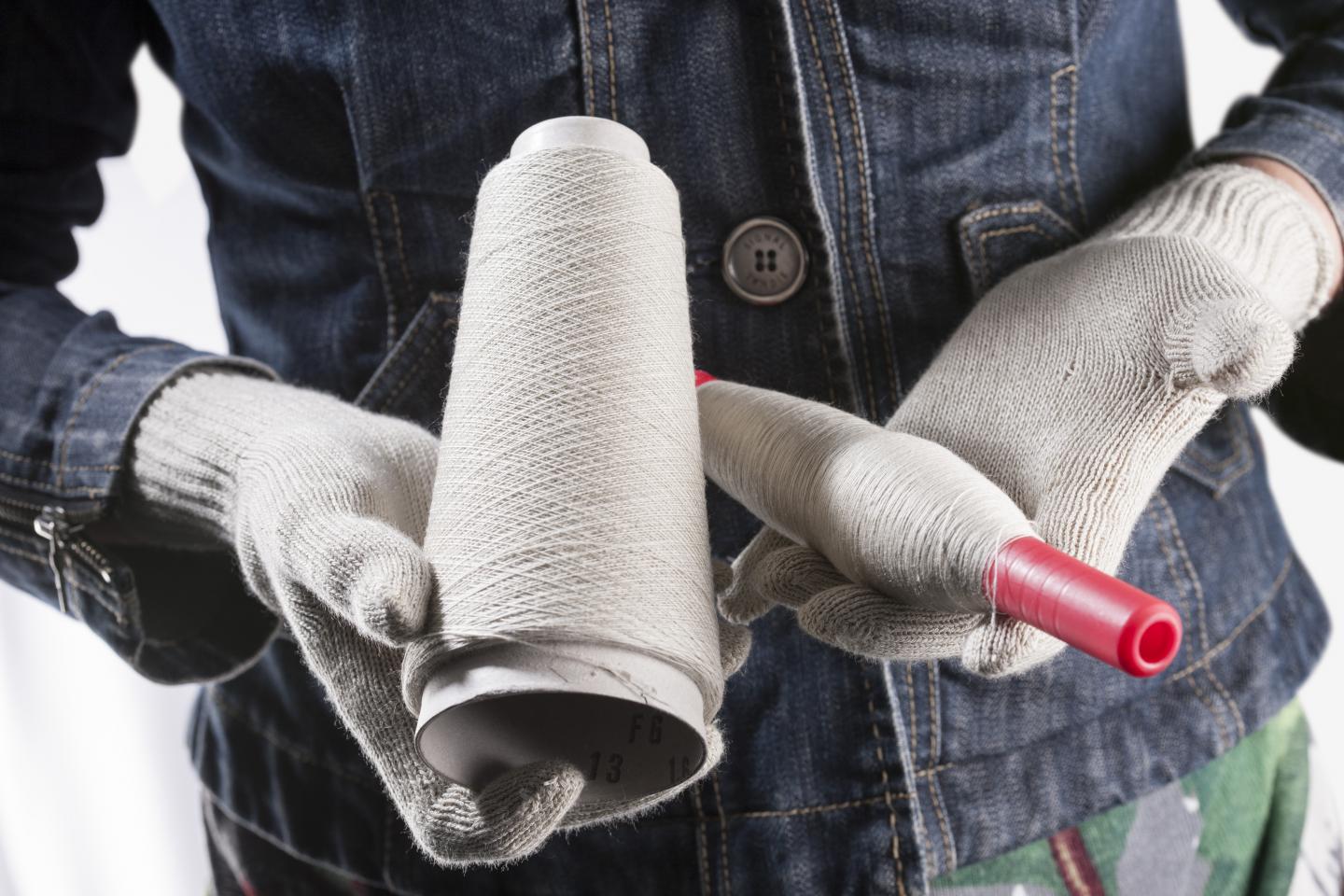
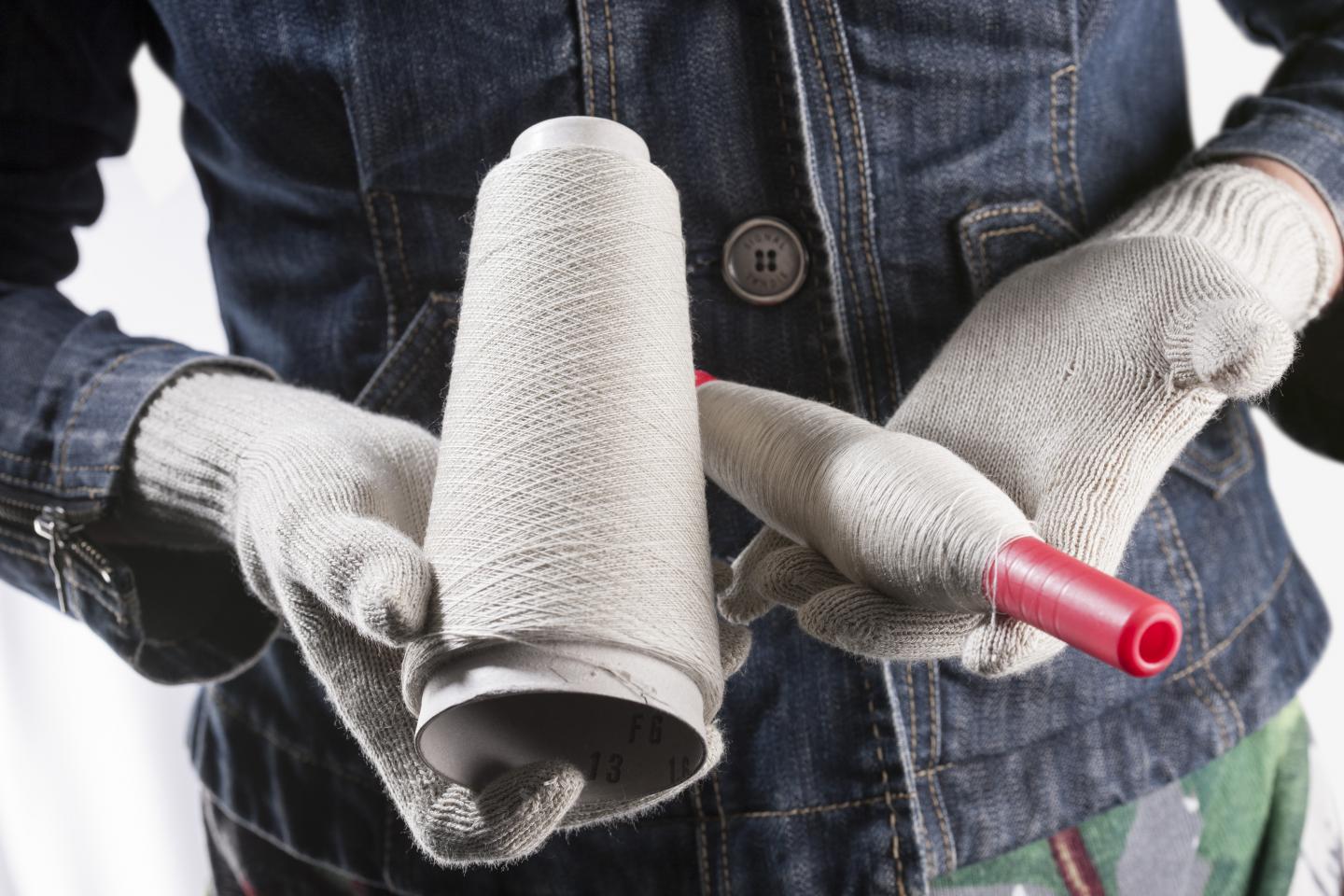
The method develop at VTT Technical Research Centre of Finland involves dissolving worn and discarded cotton and using it as a raw material for new fibre. The first product models demonstrate that recycled fibre can be transformed into a yarn and pleasant fabric. Based on a carbamate dissolution process, the technology has been used to produce the first batch of recycled fibre in a pilot facility.
The fabric made from the recycled fibre met the researcher's expectations: it is smooth with a subdued matt finish and drapes nicely. Ali Harlin and Pirjo Heikkilä of VTT say that the fibre feels natural.
Carbon disulphide-free
The method is much friendlier to the environment than the viscose process, in which carbon disulphide is needed for dissolution. In addition, polyester residues are removed from the cotton material using methods familiar from the pulp industry.
According to calculations during the technology commercialisation project, the carbon footprint of recycled fibre produced using carbamate technology is about a third smaller than for cotton and in the same category and as the most environmentally friendly viscose. The water footprint of the recycled fibre is around 2% of that of virgin cotton and 10% of viscose.
Yarn was spun at Tampere University of Technology from discarded cotton turned into fibre in VTT's laboratory. The fibre's characteristics rivalled those of commercial yarns when being spun. Following this stage, the first model products, gloves and flat-knitted fabrics, were made by knitwear company Agtuvi.
R&D will continue at the Infinited Fiber Company
R&D is still required in order to achieve process reliability. The Infinited Fiber Company startup has been established to advance the process design and licensing of the technology.
The spinning process is being developed towards industrial production through collaboration between VTT and the Infinited Fiber Company at VTT's Bioruukki pilot centre. A range of cellulose fibres may be developed at a spinning unit built at Bioruukki this summer.
Towards a closed loop: the Relooping Fashion Initiative and Telaketju
VTT's method forms part of the TEKI project, which was launched internationally with the title of The Relooping Fashion Initiative. The project involves piloting and modelling a closed-loop ecosystem in line with circular economy principles; the ecosystem will enable new industrial applications of previously unusable textile waste. VTT, Ethica, the Helsinki Metropolitan Area Reuse Centre, Seppälä, Remeo, Pure Waste Textiles, RePack, Touchpoint and Lindström are involved in the project. The project is funded by Tekes and the participating businesses.
###
The collection and sorting of discarded textiles is also being developed via the Telaketju project jointly funded by Tekes and the Ministry of the Environment. This involves the creation of an ecosystem of companies and other actors, with the aim of taking Finland's textile circular economy to the next level.
MEDIA MATERIAL: https://www.flickr.com/photos/149240221@N02/albums/72157686807777824
Further information:
Relooping Fashion Initiative: http://www.reloopingfashion.org
Telaketju: http://www.telaketju.fi
VTT Technical Research Centre of Finland Ltd
Ali Harlin
Research Professor
[email protected]
tel. 358-40-5332179
VTT Technical Research Centre of Finland Ltd
Pirjo Heikkilä, Senior Scientist
[email protected]
tel. 358-40-6891443
Further information on VTT:
Milka Lahnalammi-Vesivalo
Communications Manager
358-40-545- 828
[email protected]
http://www.vtt.fi
VTT Technical Research Centre of Finland Ltd is the leading research and technology company in the Nordic countries. We use our research and knowledge to provide expert services for our domestic and international customers and partners, and for both private and public sectors. We use 4,000,000 hours of brainpower a year to develop new technological solutions. VTT in social media: Twitter @VTTFinland, Facebook, LinkedIn, YouTube and Instagram.
Media Contact
Ali Harlin
[email protected]
358-405-332-179
@VTTFinland
http://www.vtt.fi/?lang=en
Original Source
http://www.vttresearch.com/media/news/fabric-made-from-vtts-recycled-fibre-feels-half-way-between-cotton-and-viscose