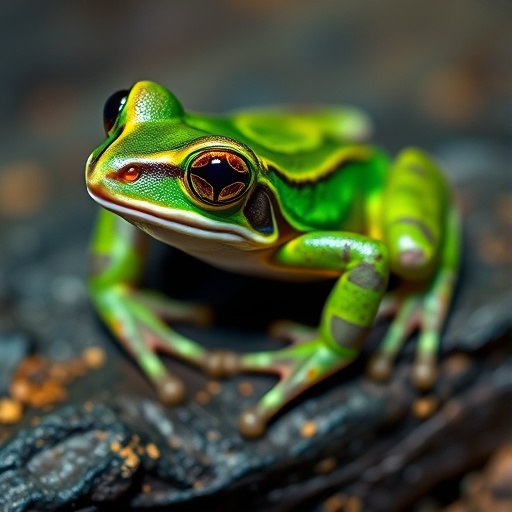
Scientists Sequence the Full Genome of a Critically Endangered Caribbean Frog Without Killing It — Entirely on the Island It Calls Home
In the mist-draped rainforests of Grenada, researchers have quietly achieved something that until recently would have demanded a killing jar, a liquid-nitrogen shipper, and a multimillion-dollar sequencing center. Scientists led from St. George’s University on the Caribbean island report the first-ever reference genome of the Grenada Frog (Pristimantis euphronides), a critically endangered amphibian found nowhere else on Earth — and they built it without euthanizing the animal, without exporting a single biological sample, and without ever entering a conventional sequencing facility. Every wet-laboratory step, from DNA extraction to sequencing on Oxford Nanopore Technologies’ pocket-sized MinION device, took place in Grenada on portable equipment, while the computational analyses ran on laptop-class hardware and a remote server accessed from the island. The resulting genome, described in the open-access journal BMC Genomics, spans roughly 1.75 billion base pairs and is the first whole-genome assembly not only for this species but for its entire genus — a lineage of more than 600 frog species that, until now, had no reference genome of any kind.
The achievement resonates far beyond one Caribbean mountaintop. Pristimantis ranks among the most species-rich vertebrate genera on the planet, with more than 600 described species spread across the Neotropics, and most of its members are direct developers: females lay terrestrial eggs that hatch straight into miniature frogs, bypassing the aquatic tadpole stage entirely, a life history that ties their survival tightly to intact forest habitat. Before this study, no whole-genome assembly existed for any member of the genus, nor for the closely related families Strabomantidae or Craugastoridae. The gap mattered because reference genomes are foundational tools of modern conservation: they underpin analyses of population structure, genetic diversity and inbreeding, disease vulnerability, and the phylogenomic comparisons needed to place little-known species on the tree of life. Yet producing such a genome has traditionally required destructive sampling to obtain high-quality tissue, large institutional infrastructure, and the shipment of biomaterials to distant laboratories — barriers that have effectively excluded many biodiversity-rich countries from sequencing their own wildlife.
For P. euphronides, the stakes are unusually high. The species is endemic to the montane rainforest of Grenada in the Lesser Antilles and is classified as critically endangered. Working from a single wild female, the team sampled the animal non-lethally using three complementary methods: a small toe clip, a blood swab, and a buccal swab. The protocol was designed and directly supervised by a veterinarian board-certified by the American College of Zoological Medicine and the European College of Zoological Medicine in Zoo Health Management. The two toe-clip sites were disinfected with diluted povidone-iodine before and after the procedure, hemostasis was confirmed, and the frog was verified to be responsive before being released at the exact location of its capture. Animal ethics approval came from the Institutional Animal Care and Use Committee of St. George’s University’s School of Veterinary Medicine under protocol IACUC-24010-R, approved on 18 September 2024, and field sampling was conducted under permission from Grenada’s Ministry of Agriculture, Forestry, and Fisheries with oversight by the Office of the Chief Veterinary Officer. No animal was euthanized, sacrificed, or anesthetized at any stage of the study.
Turning milligram-scale samples into genome-grade DNA posed the first technical test. Nanopore sequencing threads individual DNA molecules through nanoscale protein pores and reads the disruptions they cause in an electrical current, yielding very long reads that are ideal for navigating the repetitive, repeat-rich sequence that dominates vertebrate genomes. That property matters here, because amphibian genomes are riddled with transposable elements and tandem repeats that shred into unusable fragments when read in short pieces. The team prepared its sequencing libraries on-site, ran them on the MinION in Grenada, and basecalled the raw signal data with the Dorado software in high-accuracy mode, then screened every read with the taxonomic classifier Kraken2 to filter out bacterial, fungal, and other contaminating sequences before assembly. The work was funded through a material grant from ORG.one in collaboration with Oxford Nanopore Technologies, with additional support from New England Biolabs GmbH, and the authors report that the funders had no role in study design, analysis, or publication. Logistical support came from St. George’s University and from the local community in the sampling area.
The computational pipeline paired redundancy with rigor. The team assembled the genome twice with two independent long-read assemblers, Flye and Wtdbg2, whose mutual agreement served as an internal quality check, then polished the Flye reconstruction with Medaka, a nanopore-specific tool that corrects base-level errors by aligning reads back onto the draft. Because no chromosomal map of P. euphronides existed, the researchers scaffolded their contigs with RagTag, a tool that orders and orients sequences by aligning them to a reference genome — in this case the Puerto Rican coqui, Eleutherodactylus coqui, the closest available chromosome-scale genome within the same superfamily. The reference was itself chosen computationally: pairwise Mash distances computed against 21 Hyloidea genome assemblies identified E. coqui as the nearest match. The final assembly comprised 13 pseudochromosomes with a scaffold N50 of 117.8 megabases, meaning half of the genome’s sequence sits in scaffolds of at least that length, and reached 91.4% completeness against the tetrapod BUSCO benchmark of universal single-copy genes. Gene prediction and annotation with the HANNO pipeline yielded 28,071 protein-coding genes, and repeat annotation further characterized the assembly’s repeat landscape, including long terminal repeat retrotransposons — the repetitive raw material that makes frog genomes notoriously hard to piece together.
The choice of scaffolding strategy was forced by a hard constraint. Chromosome-scale assemblies today typically rely on Hi-C, a chromatin conformation capture method that chemically cross-links DNA inside intact cells and uses the resulting contact patterns to stitch together sequences that belong on the same chromosome. Hi-C demands fresh, structurally preserved tissue — a requirement fundamentally incompatible with minimally invasive sampling of a protected wild frog. The team instead leaned on reference-guided scaffolding against E. coqui despite roughly 52 million years of evolutionary separation between the two species, a gap long enough to raise legitimate doubts about whether conserved synteny would hold. The bet rested on synteny — the conservation of gene order along chromosomes — surviving between lineages that last shared a common ancestor tens of millions of years ago. To validate the approach, the researchers built a haplotype-resolved diploid assembly as an independent cross-check, phasing the genome with HapDup, calling variants with PEPPER, refining phase sets with Margin, polishing in a haplotype-aware manner, and scaffolding both haplotypes separately before measuring their agreement.
Comparative analysis then delivered both a caution and a discovery. By aligning the new genome against three additional Hyloidea genomes, the team computationally predicted an underlying karyotype of n = 16 — sixteen chromosomes per gamete — consistent with prior cytogenetic counts. That result carries a warning for the genome community: the 13 pseudochromosomes produced by reference-guided scaffolding do not correspond to the species’ true haploid chromosome number, a reminder that reference-based assemblies inherit the chromosome architecture of whatever organism they are scaffolded against. On the discovery side, coverage analysis — which exploits the expectation that Z-linked sequence appears at roughly half the depth of autosomal sequence in a ZW female — flagged candidate Z-linked regions on two scaffolds, while a set of unplaced contigs carried sequence features consistent with the heterochromatic W chromosome previously described in this frog through C-banding microscopy. Together, these findings give researchers their first sequence-level framework for dissecting sex chromosomes across the entire genus.
The genome also dissolves a long-standing bottleneck for evolutionary biology. Because earlier comparative work on this hyperdiverse, direct-developing clade had relied on a small handful of classical marker genes, relationships within and around the group remained poorly resolved. With a whole genome finally available, the team reconstructed the frog’s phylogenetic position from 19 genes and built twelve maximum-likelihood single-gene trees from nuclear orthologs long favored by herpetologists — including BDNF, BMP2, CXCR4, MC1R, POMC, RAG2, RHO, and TYR — using the European common frog, Rana temporaria, as an outgroup, with all trees and supporting datasets archived on Zenodo. To put the achievement in perspective, the authors also audited the public record of frog genomics: retrieving all 214 publicly available anuran genome assemblies, covering 148 species, from the NCBI Genome database on 18 April 2026, and classifying each by sequencing technology, assembly level, taxonomic family, and the tissue source recorded in its BioSample metadata. The audit showed how heavily the field still leans on destructive sampling: most published amphibian genomes trace back to euthanized animals, assemblies built exclusively from nanopore data are rare, and genomic coverage of the Terrarana — the broad radiation that includes Pristimantis — remains sparse. Against that backdrop, the Grenada Frog assembly stands as proof that a scaffold-level reference genome for a repeat-rich vertebrate can emerge from a living animal, a portable sequencer, and laptop-scale computing.
The implications travel fast. For conservation authorities in small island states and tropical nations, the study supplies a template: reference-quality genomes of their own endangered species can now be generated locally, under national permits, by local veterinarians and scientists, with results feeding directly into domestic conservation planning rather than passing through foreign laboratories. For genome scientists, it demonstrates that a 52-million-year divergence gap can be bridged by carefully validated cross-species scaffolding when chromatin-conformation methods are off the table. And for the more than 600 species of Pristimantis — many of them narrow endemics slipping toward extinction on fragmented Andean slopes and Caribbean islands — the Grenada Frog’s genome is the first proof that none of them has to die to be read. In a field where most reference genomes still begin inside a freezer in a wealthy country, that chain of custody — one frog, one island, one sequencer — may prove as consequential as the sequence itself. The open-access article, received on 24 May 2026, accepted on 20 August 2026, and published on 29 August 2026, was written by Katharina Kopp, Shelley Lownds, Billie Harrison, Heiner Kuhl, and Sophie Moittié, with affiliations spanning Grenada, the United States, and Germany.
Subject of Research: Non-lethal, on-site whole-genome assembly of the critically endangered Grenada Frog (Pristimantis euphronides) using portable Oxford Nanopore sequencing performed entirely in Grenada
Subject of Research: Biology
Article Title: From field to genome: non-lethal, on-site nanopore-only assembly of the endangered Grenada Frog (Pristimantis euphronides)
Article References: Kopp, K., Lownds, S., Harrison, B., Kuhl, H., & Moittié, S. (2026). From field to genome: non-lethal, on-site nanopore-only assembly of the endangered Grenada Frog (Pristimantis euphronides). BMC Genomics. https://doi.org/10.1186/s12864-026-13291-9
Image Credits: AI Generated
DOI: 10.1186/s12864-026-13291-9
Keywords: Pristimantis euphronides, Grenada Frog, whole-genome assembly, Oxford Nanopore Technologies, non-lethal sampling, field genomics, conservation genomics, anuran genome
Cite Scienmag News
APA MLA Chicago
Juliet Wilcox. (August 30, 2026). Field nanopore sequencing yields non-lethal genome assembly of endangered Grenada Frog. Scienmag. https://scienmag.com/field-nanopore-sequencing-yields-non-lethal-genome-assembly-of-endangered-grenada-frog/
Juliet Wilcox. “Field nanopore sequencing yields non-lethal genome assembly of endangered Grenada Frog.” Scienmag, 30 August 2026, https://scienmag.com/field-nanopore-sequencing-yields-non-lethal-genome-assembly-of-endangered-grenada-frog/. Accessed 30 August 2026.
Juliet Wilcox. “Field nanopore sequencing yields non-lethal genome assembly of endangered Grenada Frog.” Scienmag. August 30, 2026. https://scienmag.com/field-nanopore-sequencing-yields-non-lethal-genome-assembly-of-endangered-grenada-frog/
Copy citation Download RIS
Tags: biodiversity preservation in GrenadaCaribbean biodiversity preservationconservation genetics of Caribbean amphibianscritical amphibian conservationendangered amphibian genome sequencingEndangered frog genome sequencinggenome assembly of Pristimantis euphronidesGrenada Frog conservationisland-based DNA sequencingisland-based genome assemblynon-invasive species researchnon-invasive wildlife researchnon-lethal genome assemblynon-lethal wildlife genomicsopen-access genome dataopen-access genomic dataOxford Nanopore MinION applicationOxford Nanopore MinION applicationsportable nanopore sequencingrainforest amphibian genomicsremote genomic analysisremote in-field DNA sequencingspecies-specific genome project