Fish are changing how they search for and consume prey in warmer waters, with models suggesting extinctions become more likely due to this behaviour change, according to a new study published in Nature Climate Change.
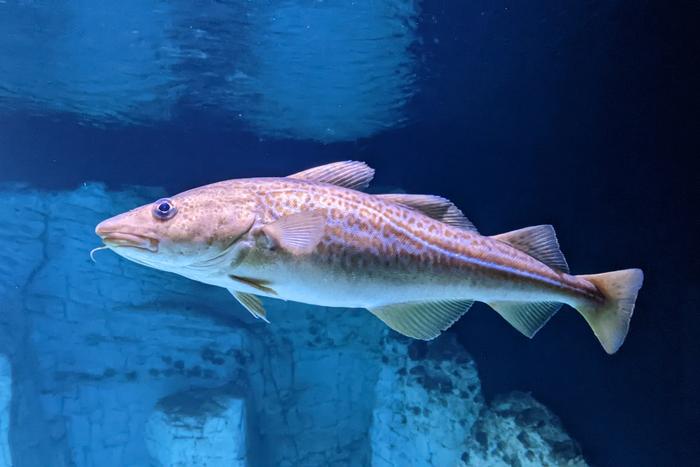
Credit: WT Fiege, Wikimedia Commons
Fish are changing how they search for and consume prey in warmer waters, with models suggesting extinctions become more likely due to this behaviour change, according to a new study published in Nature Climate Change.
Led by researchers at the German Centre for Integrative Biodiversity Research (iDiv) and the Friedrich Schiller University Jena, the researchers found that fish in the Baltic Sea respond to temperature increases by consuming the first prey they encounter. This change in foraging behaviour led to the fish selecting prey that tends to be more abundant and smaller. Small prey present in their environment at all temperatures included brittle stars, small crustaceans, worms, and molluscs.
Fish, like many other consumer species, need more food when temperatures increase because their metabolism also increases. Although more abundant prey provides an immediate energy source, this so-called flexible foraging behaviour means fish are missing out on opportunities to satisfy their long-term energy needs by consuming larger prey that provide more calories.
Model food web calculations show that this mismatch between a fish’s energetic requirements and their actual food intake could lead to more extinctions under warmer conditions, with fish ultimately starving because they are not eating enough to meet their energetic needs. The model, which can also be applied to other consumer species, suggests this is especially true for species higher up in food chains. The authors suggest that overall, this flexible foraging behaviour may make communities more vulnerable to climate change.
“It is usually assumed that species will adapt their foraging to maximise the amount of energy they consume”, explains first author Benoit Gauzens of iDiv and the University of Jena. “But these findings suggest fish – and other animals, too – may respond to the stress of climate change in unexpected and inefficient ways.”
Data from fish stomachs
The researchers analysed ten years of data about the stomach contents of six commercially important fish species with different feeding strategies in the Bay of Kiel. For example, flatfish, like the European flounder (Platichthys flesus), tend to be sit-and-wait predators, whereas Atlantic Cod (Gadus morhua) are more actively foraging feeders.
Collected year-round from 1968 to 1978, this data provided insight into the fish’s diets – what was in their stomachs – and which prey was present in their environment at different temperatures. The stomach contents indicated that fish gradually shifted their focus from less abundant prey to more abundant prey as waters became warmer.
“Fish species in the Baltic Sea and elsewhere are facing a multitude of man-made pressures, like overfishing or pollution”, adds co-author Gregor Kalinkat of the Leibniz Institute of Freshwater Ecology and Inland Fisheries (IGB). “The effect of more inefficient prey searching behaviour under warming might be another, so far overlooked factor leading to fish stocks that cannot recover even when fisheries pressure is significantly reduced.”
Using these insights, the researchers then calculated how this change in foraging behaviour at different temperatures impacts other species and the ecosystem overall using mathematical food web models based on theoretical communities. The results suggest that this change in foraging behaviour when temperature increases lead to more extinctions for consumer species, like fish. These extinctions, in turn, come with knock-on effects for other species in the community.
“Adaptation of foraging behaviour to local environmental conditions is usually a key to maintaining high levels of biodiversity in ecosystems”, Gauzens adds. “It is therefore puzzling to see that this might not be entirely true in the context of temperature increase.”
Though striking, the implications of the findings are estimated as they are currently based on theoretical models. In future, the researchers hope to test the mechanism in a natural environment and study different organisms to see whether they exhibit similar or different changes in their foraging behaviour.
Journal
Nature Climate Change
DOI
10.1038/s41558-024-01946-y
Article Title
Flexible foraging behaviour increases predator vulnerability to climate change
Article Publication Date
27-Feb-2024