[Jerusalem, Israel] – Professor Amri Wandel, from Hebrew University of Jerusalem, has unveiled research that promises to redefine our comprehension of habitable exoplanets. In a recent study published in the Astronomical Journal, Professor Wandel introduces the concept of subglacial liquid water as a pivotal element in broadening the boundaries of the conventional Habitable Zone.
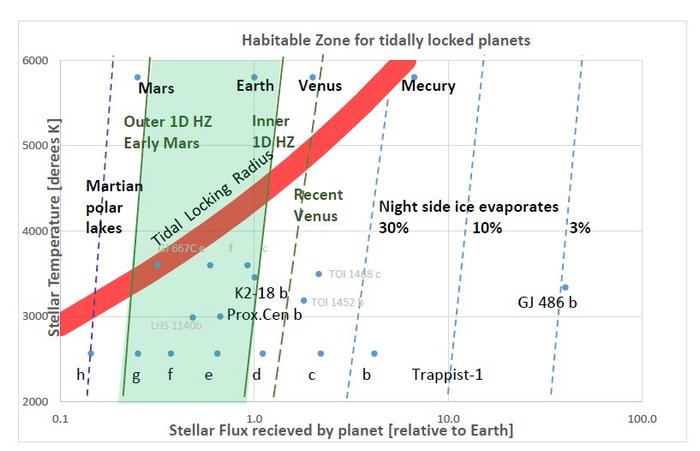
Credit: Amri Wandel
[Jerusalem, Israel] – Professor Amri Wandel, from Hebrew University of Jerusalem, has unveiled research that promises to redefine our comprehension of habitable exoplanets. In a recent study published in the Astronomical Journal, Professor Wandel introduces the concept of subglacial liquid water as a pivotal element in broadening the boundaries of the conventional Habitable Zone.
The classical Habitable Zone, often colloquially referred to as the “Goldilocks Zone,” typically defines the region around a star where conditions allow the presence of surface liquid water and, by extension, life as we understand it. However, Professor Wandel’s research offers a fresh perspective by illustrating that the existence of subglacial liquid water can considerably extend this zone.
One of the primary discoveries of this research is the potential to expand the Habitable Zone inwards for tidally locked planets closely orbiting M-dwarf stars, which are frequently regarded as candidates for detecting spectral evidence for life (so called biosignatures) in exoplanets. The study delineates how an atmosphere and liquid water could coexist on these planets, pushing the limits of the Habitable Zone further than previously assumed.
Moreover, the research postulates that subglacial liquid water can also broaden the Habitable Zone beyond the outer limits of the conservative Habitable Zone. These findings unlock the possibility of liquid water on a more diverse range of exoplanets than previously envisioned, presenting tantalizing opportunities for the search for extraterrestrial life.
A noteworthy implication of this research is its connection to recent observations made by the James Webb Space Telescope (JWST). The potential identification of atmospheric water vapor on GJ 486 b, a rocky Earth-sized exoplanet, and the evidence for an ocean on K2-18b, a Super Earth exoplanet, hint at the existence of liquid water, possibly organic chemistry, and the potential for life on such celestial bodies. This discovery provides empirical substantiation to address the long-standing question of whether exoplanets orbiting M-dwarf stars can sustain habitable conditions.
Professor Wandel remarked, “This work demonstrates that the Habitable Zone of red dwarfs is likely significantly broader than previously assumed, and planets within it have the capacity to maintain water and an atmosphere. The latter conclusion is empirically supported by recent findings of water on such exoplanets by the Webb Telescope, particularly in K2-18 b, as predicted in the article submitted two months prior. In particular, it may optimize the target allocation and priority for biosignature research by JWST.”
Professor Wandel’s research elucidates how water on terrestrial planets closely orbiting M-dwarf stars may endure within a subglacial melting layer, presenting a unique perspective on the sustainability of liquid water. The study further explores how the detection of water on various exoplanets can aid in constraining their atmospheric characteristics.
In conclusion, Professor Amri Wandel’s research spotlights the transformative potential of subglacial liquid water in expanding the Habitable Zone of exoplanets. This discovery not only advances our comprehension of habitable environments in the cosmos but also illuminates the prospect of life beyond our planet.
Journal
The Astronomical Journal
DOI
10.3847/1538-3881/ad0045
Method of Research
Computational simulation/modeling
Subject of Research
Not applicable
Article Title
Extended habitability of exoplanets due to subglacial water
Article Publication Date
3-Nov-2023