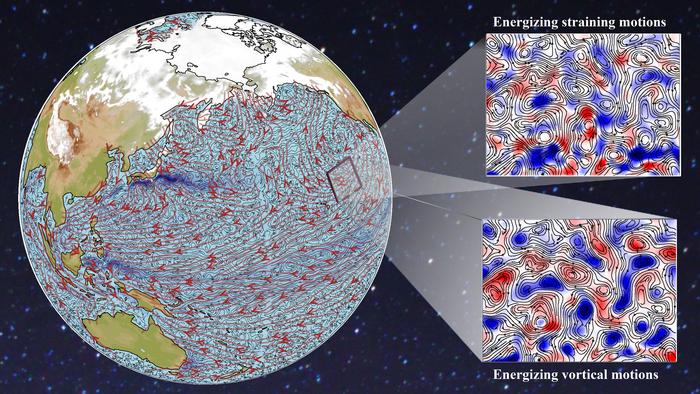

Recent research from the University of Rochester has shed new light on the complex interactions between Earth’s atmospheric winds and oceanic eddies, fundamentally altering our understanding of ocean weather patterns. Scientists have long held that prevailing winds acted as a barrier to the movement of these circular water currents, effectively dampening their energy. However, this new study highlights that the relationship is not as straightforward as previously thought. Instead, the prevailing winds can actually enhance the energy of ocean eddies if their rotational motion aligns appropriately, presenting a significant paradigm shift in oceanographic studies.
Eddies are sizable spiral currents in the ocean, often extending approximately 100 kilometers in diameter. They are crucial components of ocean circulation, playing key roles in heat distribution and nutrient transport in marine ecosystems. Understanding how these eddies interact with atmospheric conditions is vital for enhancing climate models and predicting weather phenomena, which could have far-reaching implications for both environmental science and commercial endeavors.
The research team leveraged high-resolution climate model data alongside extensive satellite imagery to delve into the mechanics governing eddy motion. Findings indicate that while atmospheric winds can slow down ocean currents that spin in the opposite direction, they can simultaneously provide an energizing force to those that rotate in the same direction. This asymmetrical effect opens the door to new modeling methods that can better predict how these ocean currents will behave in varying atmospheric conditions.
Professor Hussein Aluie, a leading scientist involved in this research, articulates the significance of this discovery, suggesting that the traditional viewpoint underestimated the impact of atmospheric forces on ocean dynamics. His insights emphasize the importance of exploring the directionality of both wind and current spins to fully understand the mechanics at play. This provides a richer context for how energy flows between the atmosphere and the ocean, which remains a largely overlooked aspect of meteorological and oceanographic science.
Furthermore, the study investigates the existence of strain patterns within these ocean currents. Though less visible than eddies, strain patterns represent approximately half of the ocean’s kinetic energy. They play a critical role in the dynamics of ocean circulation, creating minor currents within the broader eddy structure. Interestingly, the influence of winds on these strains mirrors the behaviors observed in larger eddy systems, demonstrating the interconnectedness of various oceanic phenomena.
The outcomes of this research extend beyond academic curiosity; they bear practical ramifications as well. Improved understanding of ocean weather patterns, fueled by this study, holds the promise of enhancing the effectiveness of global fisheries and optimizing shipping routes for commercial vessels. These applications underscore the importance of real-time ecological data, which can ultimately lead to more sustainable practices in marine resource management.
With the investigation funded by reputable agencies such as the National Science Foundation and NASA, among others, the implications of these findings could catalyze further research into ocean and atmospheric sciences, pushing boundaries toward novel observational technologies. Aluie has laid out future research aims that include a thorough examination of how eddies might act as conduits for energy exchange between the atmosphere and ocean. This could open up a new frontier in climate dynamics, offering the potential to refine climate projections and enhance our preparedness for climate-related challenges.
Moreover, as climate change continues to reshape weather patterns globally, understanding these interactions becomes exceedingly urgent. It’s not merely a matter of academic inquiry; the need for accurate predictions of marine and atmospheric interactions could influence policy decisions related to climate action and resource management. The information gleaned from studying eddy behavior under various wind conditions may serve as a crucial resource for international efforts aiming to combat the impacts of climate change.
The research publication, which appeared in the esteemed journal Nature Communications, elevates the discourse surrounding ocean-atmosphere interactions, signaling a new chapter in environmental science. With its implications resonating through various disciplines, from mechanical engineering to marine biology, this study serves as a testament to the intricacies of our planet’s systems.
Ultimately, the dynamics between ocean eddies and atmospheric winds illustrate a complex web of interactions that new studies are now beginning to unravel. By continuing to probe this relationship, scientists will not only increase our understanding of oceanic processes but also equip society with the tools necessary for navigating the uncertainties of a changing globe.
This groundbreaking research reminds us that nature is filled with intricacies waiting to be discovered. Each finding contributes to the larger narrative of Earth’s systems, challenging preconceived notions and steering science into new territories. Interdisciplinary collaboration, as demonstrated by the diverse expertise involved in this study, will be essential as we move forward in unearthing the secrets held by our oceans and atmosphere.
In conclusion, the shifting perspectives on the interactions between atmospheric winds and ocean eddies underscore the dynamic nature of scientific inquiry, where established theories can be transformed by new evidence. As this field progresses, continued exploration into these phenomena will be crucial for both enriching academic knowledge and fostering sustainable practices in marine science.
Subject of Research: Interactions between atmospheric winds and oceanic eddies
Article Title: Atmospheric wind energization of ocean weather
News Publication Date: 30-Jan-2025
Web References: University of Rochester
References: Nature Communications
Image Credits: University of Rochester illustration / Shikhar Rai
Keywords
Ocean physics, Weather, Atmosphere, Climate modeling, Kinetic energy, Climate data, Observational data, Earth surface, Mechanical engineering, Planet Earth, Ocean currents.
Tags: advancements in climate scienceclimate models and ocean circulationenergy dynamics of ocean eddiesimpact of atmosphere on ocean currentsinteractions between atmospheric winds and ocean eddiesoceanic weather patternsparadigm shift in oceanographic studiespredicting weather phenomena through ocean studiesrole of ocean eddies in nutrient transportsatellite imagery in oceanographic researchsignificance of ocean eddies in marine ecosystemsUniversity of Rochester research on ocean dynamics