


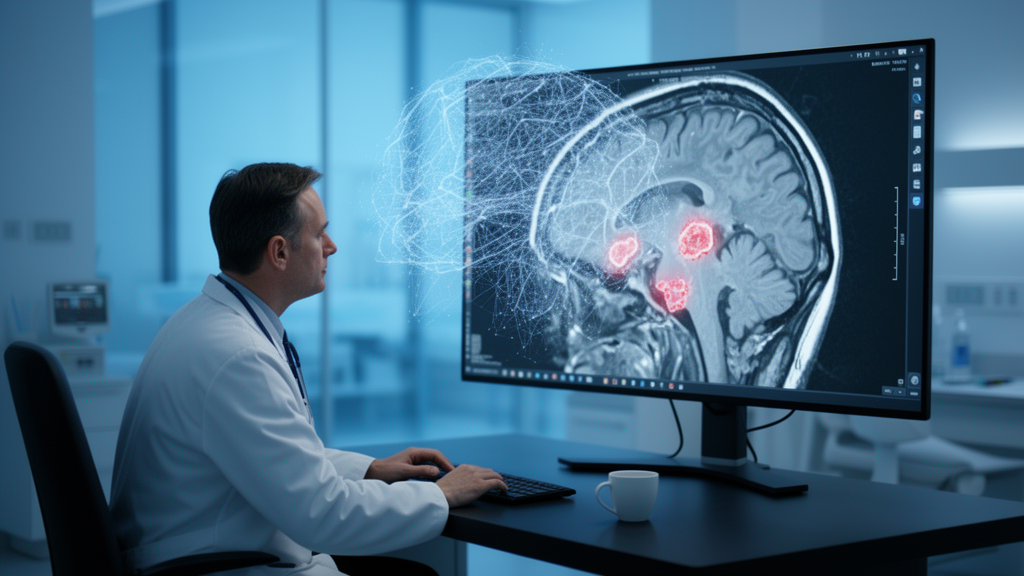
Deep learning models can detect and outline stroke lesions on brain scans with impressive accuracy, but very few of these systems can explain their decisions, according to a systematic review published in BMC Medical Imaging. The review, covering studies published between 1 January 2015 and 15 January 2026, found that explainable artificial intelligence methods appeared in only 11 percent of the included research, even as model architectures grew increasingly sophisticated.
The motivation is substantial. Stroke is the second leading cause of death and the third leading cause of disability worldwide, affecting roughly 15 million people each year and imposing an economic burden exceeding US$890 billion. Interpreting brain CT and MRI images remains time-consuming, subject to inter-observer variability, and constrained by a shortage of neuroradiology experts, particularly in low-resource settings. Automated lesion analysis could ease that burden, which is why the rapid proliferation of convolutional neural networks, transformers, and hybrid architectures demanded systematic evaluation.
The reviewers searched IEEE Xplore, PubMed, Scopus, and SpringerLink and assessed study quality with the Stroke AI Quality Assessment tool, rating 48 studies, or 64.0 percent, as high quality, with a Cohen’s kappa of 0.80. Because of heterogeneity in datasets, methods, and evaluation metrics, no meta-analysis was performed. CNN-based models were the most commonly used architecture at 56 percent of studies, with U-Net variants achieving Dice scores of 0.59 to 0.94 for lesion segmentation.
Transformer-based models accounted for 24 percent of the reviewed work and achieved classification accuracies up to 99.6 percent and Dice scores above 0.90, a performance the authors attribute to their ability to capture long-range dependencies in imaging data. Hybrid CNN-transformer models, at 16 percent, generally outperformed individual architectures by combining local feature extraction with global context understanding. In the review’s assessment, these hybrids currently offer the best balance between accuracy and robustness for stroke lesion analysis.
Yet the explainability picture is stark. Standard techniques such as Grad-CAM, SHAP, and LIME were reported in just 11 percent of studies, and no standardized evaluation framework exists for judging how well these explanations reflect model reasoning.
The review also catalogued recurring technical obstacles. Class imbalance affected 24 percent of studies, limited annotated data 20 percent, poor generalization across institutions 16 percent, and computational complexity 11 percent.
Emerging approaches may address some of these limitations. Federated learning appeared in 4 percent of studies, self-supervised learning in 5 percent, and few-shot learning in 3 percent.
The authors caution that limited external validation, poor explainability, and high computational cost remain key barriers to real-world clinical use, despite the strong potential of hybrid CNN-transformer models for stroke diagnosis. Their recommended priorities for future research include multi-center validation, standardized benchmarking, uncertainty-aware explainable AI, federated learning, and equitable deployment in low-resource settings.
As a systematic review, the work synthesizes published findings rather than testing new models itself, and the absence of meta-analysis reflects genuine diversity in how prior studies were conducted. Even so, the message is clear: accuracy alone will not carry stroke imaging AI into the clinic. Without standardized evaluation and explanations clinicians can interrogate, even the best-performing architectures remain research tools rather than diagnostic aids.
Subject of Research: Explainable deep learning architectures for stroke lesion segmentation and classification on brain CT and MRI
Article Title: Explainable deep learning for stroke lesion analysis: CNN, transformer, hybrid models, and future directions: a systematic review
Article References: Chekol, Y. B., Gebremeskel, G. B., Asfaw, T. T., Munaye, Y. Y., & Tai, L.-C. (2026). Explainable deep learning for stroke lesion analysis: CNN, transformer, hybrid models, and future directions: a systematic review. BMC Medical Imaging. https://doi.org/10.1186/s12880-026-02908-w
Image Credits: AI Generated
DOI: 10.1186/s12880-026-02908-w
Keywords: stroke, deep learning, CNN, transformer, explainable AI, medical imaging, systematic review, segmentation, federated learning, MRI, CT, Explainable
News Source: Cassandra Pierce. (October 29, 2026). Explainable AI lags in stroke lesion deep learning, review finds. Scienmag.



