• HOME
  • NEWS
  • EXPLORE
    • CAREER
      • Companies
      • Jobs
    • EVENTS
    • iGEM
      • News
      • Team
    • PHOTOS
    • VIDEO
    • WIKI
  • BLOG
  • COMMUNITY
    • FACEBOOK
    • INSTAGRAM
    • TWITTER
Saturday, May 23, 2026
BIOENGINEER.ORG
No Result
View All Result
  • Login
  • HOME
  • NEWS
  • EXPLORE
    • CAREER
      • Companies
      • Jobs
        • Lecturer
        • PhD Studentship
        • Postdoc
        • Research Assistant
    • EVENTS
    • iGEM
      • News
      • Team
    • PHOTOS
    • VIDEO
    • WIKI
  • BLOG
  • COMMUNITY
    • FACEBOOK
    • INSTAGRAM
    • TWITTER
  • HOME
  • NEWS
  • EXPLORE
    • CAREER
      • Companies
      • Jobs
        • Lecturer
        • PhD Studentship
        • Postdoc
        • Research Assistant
    • EVENTS
    • iGEM
      • News
      • Team
    • PHOTOS
    • VIDEO
    • WIKI
  • BLOG
  • COMMUNITY
    • FACEBOOK
    • INSTAGRAM
    • TWITTER
No Result
View All Result
Bioengineer.org
No Result
View All Result
Home NEWS Science News Chemistry

Experiment unveils Berry curvature mechanism for linear positive magnetoresistance

Bioengineer by Bioengineer
November 8, 2022
in Chemistry
Reading Time: 2 mins read
0
The schematic illustration of Berry curvature induced LPMR and the fitting of experimental data to theoretical equations
Share on FacebookShare on TwitterShare on LinkedinShare on RedditShare on Telegram

A research group lead by Prof. LIU Enke from the Institute of Physics of the Chinese Academy of Sciences (CAS) has established a physical model of Berry-curvature-dominated linear positive magnetoresistance (LPMR), providing experimental evidence for this mechanism. 
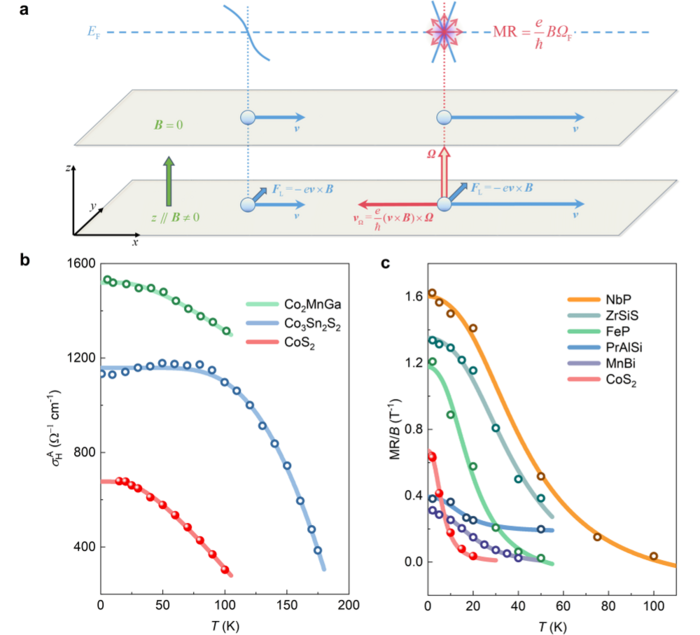
The schematic illustration of Berry curvature induced LPMR and the fitting of experimental data to theoretical equations

Credit: Institute of Physics

A research group lead by Prof. LIU Enke from the Institute of Physics of the Chinese Academy of Sciences (CAS) has established a physical model of Berry-curvature-dominated linear positive magnetoresistance (LPMR), providing experimental evidence for this mechanism. 

Relevant results were published on PNAS on Nov. 2. 

Berry curvature, the pseudomagnetic field in momentum space, is the origin of many transport phenomena including chiral anomaly and intrinsic anomalous transverse transport properties. In topological materials, Berry curvature is extremely large because of special band structures, e.g., Dirac nodes, Weyl nodes, and nodal lines. 

LPMR is a transport phenomenon whereby longitudinal resistance of a material varies linearly and positively with magnetic field. Although large LPMR has been widely reported in topological materials, the explanations for it in topological materials are ambiguous. 

In view of this, researchers in LIU’s group and their collaborators investigated the relation between Berry curvature and LPMR based on a topological material candidate, cobalt disulfide (CoS2). 

Their study showed that, in theory, the slope of LPMR is proportional to the average of the Berry curvature around the Fermi surface. 

They proposed temperature-dependent anomalous Hall conductivity and LPMR equations based on a 3D-Weyl-node model. The experimental data of CoS2 and other topological materials reported previously can be fitted to the theoretical temperature-dependent equations, which is evidence for Berry-curvature-dominated LPMR. 

This study unveils the relationship between Berry curvature and LPMR, thus facilitating the understanding and functional design of LPMR materials for magnetic sensing or information storage. 

This work was supported by the National Science Foundation of China, the Ministry of Science and Technology of China, and CAS. 


Journal

Proceedings of the National Academy of Sciences

DOI

10.1073/pnas.220850511

Method of Research

Experimental study

Subject of Research

Not applicable

Article Title

Scaling of Berry-curvature monopole dominated large linear positive magnetoresistance

Article Publication Date

2-Nov-2022

Share12Tweet8Share2ShareShareShare2

Related Posts

Study Reveals How Valproate Affects Early Brain Development: Insights into the Antiepileptic Drug’s Impact — Chemistry

Study Reveals How Valproate Affects Early Brain Development: Insights into the Antiepileptic Drug’s Impact

May 22, 2026
Sustainable Chemistry: Iron Replaces Noble Metals in Catalytic Reactions — Chemistry

Sustainable Chemistry: Iron Replaces Noble Metals in Catalytic Reactions

May 22, 2026

Advancing Thin-Film Device Manufacturing with Imaging Ellipsometry for Enhanced Process Control

May 22, 2026

Simple Adjustment in 3D Printing Enhances Fit of Dental Crowns

May 22, 2026

POPULAR NEWS

  • blank

    New Study Reveals Plants Can Detect the Sound of Rain

    734 shares
    Share 293 Tweet 183
  • ESMO 2025: mRNA COVID Vaccines Enhance Efficacy of Cancer Immunotherapy

    312 shares
    Share 125 Tweet 78
  • Research Indicates Potential Connection Between Prenatal Medication Exposure and Elevated Autism Risk

    847 shares
    Share 339 Tweet 212
  • Common Food Preservatives Associated with Elevated Blood Pressure and Increased Heart Disease Risk

    55 shares
    Share 22 Tweet 14

About

We bring you the latest biotechnology news from best research centers and universities around the world. Check our website.

Follow us

Recent News

Music and Motion Shape Emotion in Chinese Performance

N-acetylcysteine Trials for Preterm Birth Prevention

Nomogram Predicts Early Outcomes in Childhood Aplastic Anemia

Subscribe to Blog via Email

Enter your email address to subscribe to this blog and receive notifications of new posts by email.

Join 83 other subscribers
  • Contact Us

Bioengineer.org © Copyright 2023 All Rights Reserved.

Welcome Back!

Login to your account below

Forgotten Password?

Retrieve your password

Please enter your username or email address to reset your password.

Log In
No Result
View All Result
  • Homepages
    • Home Page 1
    • Home Page 2
  • News
  • National
  • Business
  • Health
  • Lifestyle
  • Science

Bioengineer.org © Copyright 2023 All Rights Reserved.