The race to build a practical quantum computer is well underway. Researchers around the world are working on a huge variety of qubit technologies. So far, there is no consensus on what type of qubit is most suitable for maximizing the potential of quantum information science.
Credit: NCCR SPIN
The race to build a practical quantum computer is well underway. Researchers around the world are working on a huge variety of qubit technologies. So far, there is no consensus on what type of qubit is most suitable for maximizing the potential of quantum information science.
Qubits are the foundation of a quantum computer: they handle the processing, transfer and storage of data. To work correctly, they have to both reliably store and rapidly process information. The basis for rapid information processing is stable and fast interactions between a large number of qubits whose states can be reliably controlled from the outside.
For a quantum computer to be practical, millions of qubits must be accommodated on a single chip. The most advanced quantum computers today have only a few hundred qubits, meaning they can only perform calculations that are already possible (and often more efficient) on conventional computers..
Electrons and holes
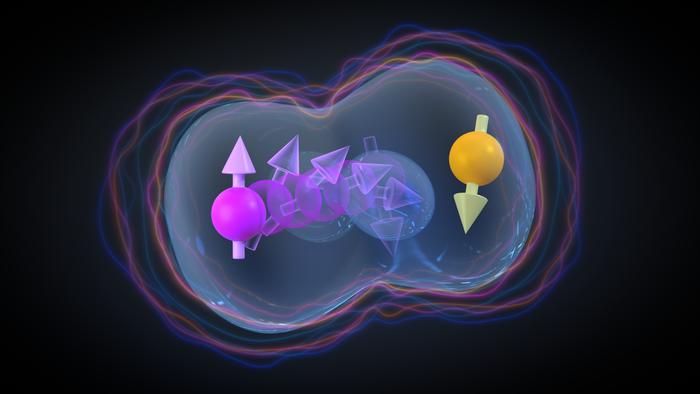
To solve the problem of arranging and linking thousands of qubits, researchers at the University of Basel and the NCCR SPIN rely on a type of qubit that uses the spin (intrinsic angular momentum) of an electron or a hole. A hole is essentially a missing electron in a semiconductor. Both holes and electrons possess spin, which can adopt one of two states: up or down, analogous to 0 and 1 in classical bits. Compared to an electron spin, a hole spin has the advantage that it can be entirely electrically controlled without needing additional components like micromagnets on the chip.
As early as 2022, Basel physicists were able to show that the hole spins in an existing electronic device can be trapped and used as qubits. These “FinFETs” (fin field-effect transistors) are built into modern smartphones and are produced in widespread industrial processes. Now, a team led by Dr. Andreas Kuhlmann has succeeded for the first time in achieving a controllable interaction between two qubits within this setup.
Fast and precise controlled spin-flip
A quantum computer needs “quantum gates” to perform calculations. These represent operations that manipulate the qubits and couple them to each other. As the researchers report in the journal Nature Physics, they were able to couple two qubits and bring about a controlled flip of one of their spins, depending on the state of the other’s spin – known as a controlled spin-flip. “Hole spins allow us to create two-qubit gates that are both fast and high-fidelity. This principle now also makes it possible to couple a larger number of qubit pairs,” says Kuhlmann.
The coupling of two spin qubits is based on their exchange interaction, which occurs between two indistinguishable particles that interact with each other electrostatically. Surprisingly, the exchange energy of holes is not only electrically controllable, but strongly anisotropic. This is a consequence of spin-orbit coupling, which means that the spin state of a hole is influenced by its motion through space.
To describe this observation in a model, experimental and theoretical physicists at the University of Basel and the NCCR SPIN combined forces. “The anisotropy makes two-qubit gates possible without the usual trade-off between speed and fidelity,” Dr. Kuhlmann says in summary.
“Qubits based on hole spins not only leverage the tried-and-tested fabrication of silicon chips, they are also highly scalable and have proven to be fast and robust in experiments.” The study underscores that this approach has a strong chance in the race to develop a large-scale quantum computer.
Journal
Nature Physics
DOI
10.1038/s41567-024-02481-5
Article Title
Anisotropic exchange interaction of two hole-spin qubits
Article Publication Date
6-May-2024