


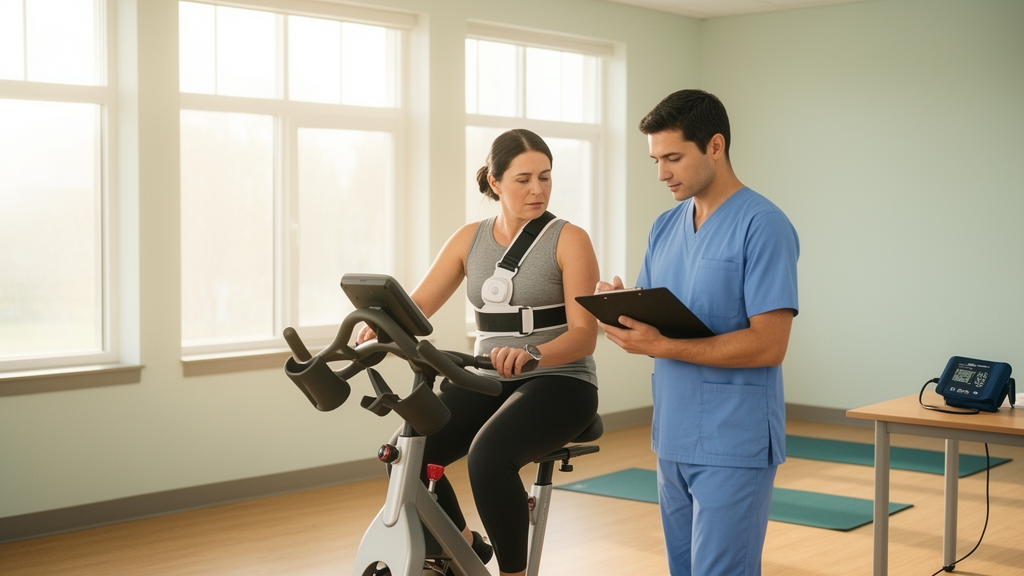
Exercise-based rehabilitation delivered before, around, or after surgical or transcatheter valve procedures may improve walking distance, cardiorespiratory fitness, heart function, and postoperative recovery, according to a systematic review and meta-analysis published in Frontiers in Cardiovascular Medicine. But the authors, a team led by Shanshan Lin of Sichuan Provincial People’s Hospital in Chengdu, China, are unusually blunt about the limits of their own findings: the certainty of the evidence was rated very low for five of six outcomes, and for most measures the statistical uncertainty was wide enough that a future study could plausibly find no benefit at all.
The review pooled 29 randomised controlled trials published between 1987 and 2026, spanning 11 countries, with 17 of the trials conducted in China. The trials enrolled adults undergoing surgical valve repair or replacement, transcatheter aortic valve replacement, or both, and tested rehabilitation programmes ranging from preoperative inspiratory muscle training lasting just three days to months of combined aerobic and resistance exercise. Comparators varied just as widely, from usual care and exercise advice to sham training and standard cardiac rehabilitation. In total, the group sample sizes listed across the trials came to 3,336 participants, with individual comparisons ranging from 12 to 978 people.
The headline numbers favour rehabilitation. Across 19 trials involving 1,574 participants, rehabilitation increased the six-minute walk distance by an average of 40.95 metres (95% confidence interval 27.10 to 54.81 metres). Eight trials with 518 participants showed a small standardised improvement in peak oxygen uptake (SMD 0.32, 95% CI 0.07 to 0.57), and 14 trials with 1,197 participants showed an average gain in left ventricular ejection fraction of 4.41 percentage points (95% CI 2.26 to 6.56). Hospital stay after the procedure was shorter by 1.77 days across 16 trials involving 2,327 participants (95% CI −2.41 to −1.13 days).
The safety signals were similarly encouraging on their face. Reported adverse events were less frequent in rehabilitation groups across 14 estimable trials (risk ratio 0.53, 95% CI 0.33 to 0.85), and postoperative pulmonary complications were reduced across seven trials involving 1,554 participants (RR 0.62, 95% CI 0.50 to 0.77). Pulmonary complications were the one outcome where the statistical picture held together: heterogeneity was modest, and the prediction interval, which estimates the range of effects a new trial might show, remained entirely on the benefit side, from 0.42 to 0.93.
For nearly everything else, that prediction interval told a more sobering story. For six-minute walk distance it stretched from −16.23 to 98.13 metres; for peak oxygen uptake from −0.33 to 0.97; for ejection fraction from −3.89 to 12.71 percentage points; and for hospital stay from −4.24 to 0.69 days. All of these included no effect. Heterogeneity was substantial for walking distance, ejection fraction, and hospital stay, with I-squared values near or above 90%, meaning the trials differed from one another far more than chance alone would explain. The pooled averages, in other words, describe a heterogeneous mix of interventions, populations, and comparators rather than the expected effect of any single programme.
Sensitivity analyses exposed further fragility. The peak oxygen uptake result, already based on only eight small trials, was no longer statistically significant after the authors excluded results rated at high risk of bias (five studies; SMD 0.33, 95% CI −0.14 to 0.80), and it also lost significance when a single influential trial, Tamulevičiūtė-Prascienė 2021, was omitted. Across all 29 trials, none of the 83 selected study-outcome results reached an overall low risk-of-bias rating under the Cochrane RoB 2 tool; 17 were rated high risk and 66 raised some concerns, with missing outcome data the leading problem.
Subgroup analyses hinted at differences but could not confirm them. Walking-distance gains appeared larger after open surgery (13 trials; mean difference 51.59 metres) than after transcatheter aortic valve replacement (six trials; 10.20 metres), with a nominally significant interaction test (P = 0.036). Yet this P value emerged from 18 unadjusted comparisons, several involving subgroups with fewer than three estimable studies, and the authors explicitly frame it as a signal for further research rather than an established difference. Analyses restricted to specific time windows found that the ejection fraction benefit disappeared beyond 90 days in three TAVR trials, though the authors caution this cannot establish a decline in effect over time.
The adverse-event finding demands particular caution. The trials combined exercise-associated symptoms, general postoperative complications, and broader clinical events over different observation periods, so the pooled reduction in reported events describes clinical events in general rather than a uniform measure of exercise-related harm. The authors state plainly that a lower pooled risk ratio does not establish that rehabilitation itself is safer, and that trials reporting no events in either group do not demonstrate an absence of harm. Hospital-stay reductions likewise cannot be attributed solely to exercise, since discharge practices and accompanying care also shape how long patients remain admitted.
The mechanistic discussion offers plausible biology without overclaiming. Regular exercise improves vascular function through nitric oxide availability, supports mitochondrial energy pathways such as AMPK/SIRT1/PGC-1α, and may improve ventricular filling and autonomic balance, while breathing exercises and early mobilisation strengthen respiratory muscles, improve ventilation, limit bed-rest muscle loss, and support airway clearance. The authors stress these mechanisms were not directly tested by the meta-analysis, and that ejection fraction in particular varies with valve disease, measurement method, and follow-up duration, so patients can become more active and less symptomatic without any short-term change in resting cardiac function.
Where does this leave patients and clinicians? The review suggests that exercise-based rehabilitation may support recovery across the valve intervention pathway, and pulmonary complication reduction is the most consistent signal. But the evidence does not identify an optimal start time, intensity, duration, or programme type, and it does not establish exercise-specific safety. The authors call for larger multicentre randomised trials that conceal allocation, blind outcome assessment, study surgical and transcatheter populations separately, report exercise prescriptions in full, standardise outcome timing, and follow patients long enough to capture readmission, major cardiovascular events, and survival. Until then, the apparent 41-metre gain in walking distance remains a promising average over a very bumpy evidence landscape, not a promise for any individual patient.
Subject of Research: A systematic review and meta-analysis of exercise-based rehabilitation before, during, or after surgical or transcatheter valve intervention
Article Title: Efficacy and safety of exercise rehabilitation across the valve intervention pathway: A systematic review and meta-analysis
Article References: Lin, S., Wang, H., Zhu, Y., Zhao, D., Yu, T., Huang, K., He, X., & Jiang, Q. (2026). Efficacy and safety of exercise rehabilitation across the valve intervention pathway: A systematic review and meta-analysis. Frontiers in Cardiovascular Medicine, 13, Article 2004830. https://doi.org/10.3389/fcvm.2026.2004830
Image Credits: AI Generated
DOI: 10.3389/fcvm.2026.2004830
Keywords: cardiac rehabilitation, valvular heart disease, meta-analysis, TAVR, exercise capacity, six-minute walk distance, peak oxygen uptake, ejection fraction, pulmonary complications, hospital stay, randomised controlled trials, GRADE certainty
News Source: Ophelia Keating. (October 29, 2026). Exercise Rehabilitation Around Valve Surgery Shows Modest, Uncertain Benefits in Meta-Analysis. Scienmag.



