A comprehensive institutional and organizational capacity audit of the Expanded Programme on Immunization in the Democratic Republic of the Congo has identified widespread administrative, structural, and operational shortcomings across the country’s public health apparatus. Published in Discover Health Systems, the qualitative exploratory case study evaluated the programme’s readiness to achieve the strategic targets outlined in the World Health Organization Immunization Agenda 2030. Despite historic public health milestones in the central African nation, including the official certification of wild poliovirus eradication in 2014 and the elimination of maternal and neonatal tetanus in 2019, the national routine immunization machinery has struggled with profound structural bottlenecks. Routine coverage rates remain severely depressed, with complete immunization estimates ranging between 21 percent and 38 percent across surveyed areas. According to official estimates from the World Health Organization and UNICEF, more than 839,000 children in the country had not received an initial dose of the diphtheria-tetanus-pertussis vaccine in 2023, placing the country among the leading global contributors to the zero-dose child burden while recurrent outbreaks of measles, yellow fever, and vaccine-derived poliovirus types 1 and 2 continue to threaten vulnerable communities.
To investigate the institutional foundations driving these persistent vulnerabilities, an investigative research team evaluated the governance structures, operational execution, and administrative workflows of the national immunization apparatus between November 2024 and February 2025. The investigation examined institutional activities covering the programmatic period from 2020 through 2024, an interval during which service delivery faced compounding disruptions from the COVID-19 pandemic and lingering administrative weaknesses identified during an earlier external review conducted in 2018. The researchers adopted an exploratory case study design grounded in a socio-constructivist paradigm to capture how institutional arrangements operate in the complex reality of administrative decentralization and health sector reform. Operationalizing an adapted version of the United States Agency for International Development Participatory Institutional Capacity Assessment and Learning framework combined with the Balanced Scorecard model developed by Kaplan and Norton, the investigators systematically reviewed organizational performance across six distinct functional dimensions: organizational and administrative functioning; material and financial resource capacity; operational execution, institutional learning, and knowledge management; system integration and national alignment; performance incentives and accountability mechanisms; and results achievement and stakeholder satisfaction.
The study sampling strategy incorporated a four-stage purposive selection process designed to achieve balanced geographic and operational representativeness across provincial health divisions and operational health zones. Provinces were categorized across three spatial geographic blocks—Eastern, Central, and Western DRC—and further segmented according to third-dose diphtheria-tetanus-pertussis coverage thresholds drawn from 2023 national survey data, using cutoffs established at the first tercile of 42.7 percent and second tercile of 62.9 percent. A simple random draw assigned high coverage to the eastern block, low coverage to the central block, and medium coverage to the western block, leading to the selection of three representative provinces: Haut-Lomami in the east, Kasaï-Central in the center, and Mongala in the west. Within each selected province, researchers identified the most representative health zones relative to provincial coverage averages, selecting Kinda health zone in Haut-Lomami, Mutoto health zone in Kasaï-Central, and Lisala health zone in Mongala. Field teams also selected one operational health facility within each health zone, prioritizing accessibility and service delivery diversity while conducting fieldwork across central offices in Kinshasa and subnational operational entities.
Data collection integrated qualitative and consensus-based assessment techniques across health system tiers. The team completed 74 semi-structured in-depth interviews in French with public health officials, programme managers, technical partner representatives, and frontline health workers, comprising 32 interviews in Kinshasa and 42 across the provincial sites. Interviews averaged one hour in duration and were administered by experienced qualitative researchers holding Master of Public Health degrees before undergoing professional transcription and quality validation by provincial supervisors. Six focus group discussions using local language guides engaged community health workers and female caregivers of children under five years old to examine service quality, trust, and barriers to access. In parallel, investigators completed a documentary analysis of more than 40 official policy texts, including multi-year national plans, operational guidelines, supervision reports, and financial tracking records. Capacity scoring was finalized through structured consensus workshops, bringing together 30 participants representing the four national divisions in Kinshasa and 10 provincial health division personnel at subnational levels to establish validated consensus ratings for each evaluated institutional parameter.
Consensus ratings generated through the adapted assessment tool demonstrated substantial capacity deficits across the entire national immunization architecture. Under established benchmarking standards, assessment percentages exceeding 80 percent indicate robust capacity requiring no specific intervention, ratings between 60 and 80 percent reflect acceptable functionality requiring targeted optimization, and marks falling below 60 percent denote insufficient institutional capacity demanding urgent corrective intervention. Across all evaluated areas, the national management structure achieved a consensus average of only 54 percent, while provincial structures recorded an average score of 56 percent. None of the six core organizational dimensions met the 60 percent acceptability threshold at either the central or provincial level. The lowest institutional ratings occurred within administrative and organizational functioning, which scored 42 percent at the central tier and 44 percent in the provinces. By comparison, leadership and the capacity to attain results satisfactory to partners and beneficiaries recorded higher relative scores, reaching 60 percent and 65 percent centrally, and 66 percent and 70 percent across the subnational sites.
Documentary and legislative analysis revealed a profound misalignment between the official mandate of the immunization programme and its underlying legal architecture. Established in 1988 by Ministerial Decree, the programme was initially mandated to improve child survival by addressing childhood infections, acute respiratory conditions, diarrheal diseases, malaria, and viral hemorrhagic fevers. Over subsequent decades, national authorities expanded this portfolio through a 2003 organic framework incorporating antigens against yellow fever, hepatitis B, Haemophilus influenzae type b, and meningitis, while a 2018 public health law reaffirmed the free provision of routine immunization. Recent strategic instruments, including the 2020–2024 comprehensive multi-year plan and the National Vaccination Strategy 2024–2030, further expanded operations to address emerging public health threats including Ebola, COVID-19, and Mpox across broader age cohorts. However, the governing 1988 Ministerial Decree was never updated to reflect this expanded scope, nor did it account for the reallocation of earlier priority diseases to specialized vertical disease programmes, generating acute role confusion among newly deployed personnel and undermining institutional coherence.
Organizational structures suffered from severe administrative ambiguities, communication bottlenecks, and staffing vulnerabilities across all operational tiers. Although the national administrative model is replicated in provinces through coordination units and antenna offices embedded within Provincial Health Divisions, this multi-tiered architecture frequently dilutes the direct chain of command and impedes supervisory accountability. Central headquarters documented notable discrepancies in personnel records, reporting a declared workforce of 247 staff members in January 2024 against official payroll documentation listing only 242 individuals. Provincial structures employed an estimated 709 workers, including 84 physicians, 319 other healthcare professionals, and 306 administrative staff, but positions were unevenly distributed, and formal post descriptions dating back to 2009 remained obsolete. Key informants reported widespread reliance on non-standardized recruitment channels influenced by political sponsorship and personal connections, leaving personnel without standardized job descriptions, equitable benefits, or prospects for statutory career advancement.
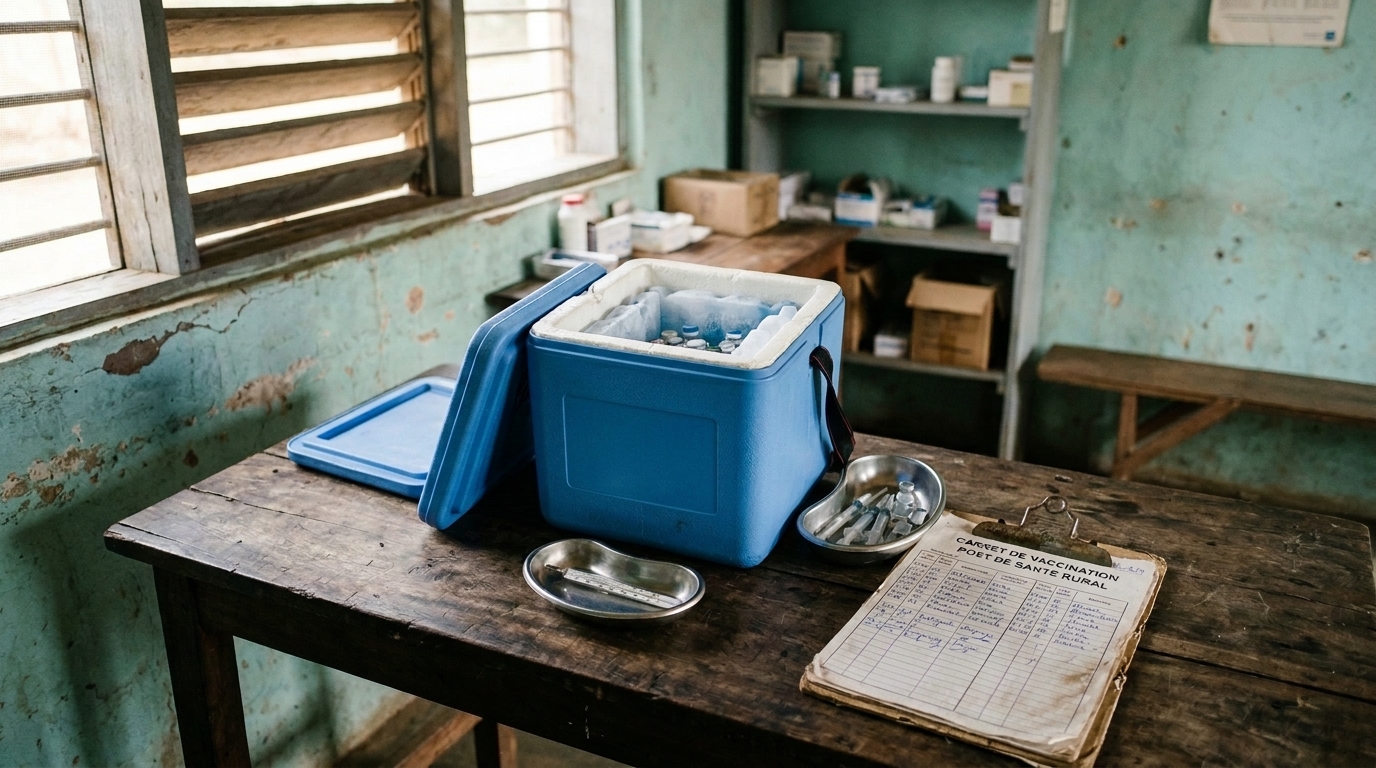
Material infrastructure and supply chain logistics emerged as critical barriers to sustained routine immunization coverage, particularly in remote health zones. Health facilities reported frequent stock-outs of vital vaccines driven by distribution challenges and inadequate cold chain equipment. Field reports highlighted widespread mechanical failures among field refrigerators, severe shortages of qualified maintenance technicians, and insufficient regional storage capacity, which forced field teams to navigate unreliable distribution chains. Because regional logistics depots outside Kinshasa operated with limited functionality, approximately 80 percent of vaccine shipments within the country depended entirely on expensive air transport networks.
The assessment highlighted substantial vulnerabilities in financial resource management, resource allocation, and external donor reliance. Although the programme receives substantial financial assistance from international development partners, including Gavi, the World Bank, UNICEF, USAID, and the World Health Organization, external assistance accounted for more than 90 percent of overall funding, with domestic government contributions largely confined to core civil service salaries. Incomplete data availability during the audit period precluded comprehensive quantitative modeling of national expenditure flows, but qualitative accounts documented severe procedural bottlenecks, including centralized budget formulation that excluded technical departments, lengthy disbursement delays to operational health zones, and minimal independent expenditure auditing.
Operational execution, institutional learning, and workforce training displayed acute functional gaps that impaired service delivery quality and monitoring reliability. Technical partner organizations noted that structured technical immunization training had not occurred systematically since 2019, creating widening competency deficits among newly recruited personnel and supervisory staff. When provincial health divisions demonstrated incapacity to conduct routine supervisory coaching in peripheral health zones, central authorities intervened by deploying national directors to conduct field inspections, a practice that addressed immediate oversights but marginalized subnational institutions and prevented local skills development. Furthermore, internal monitoring systems exhibited stark contradictions: while national staff members assigned high performance scores to their activities based on routine administrative reporting, independent population-based coverage surveys documented far lower immunization rates. This recurring discrepancy undermined technical partner confidence in official administrative datasets and weakened data-driven decision-making across the health system.
Integration between the immunization programme and the wider primary healthcare architecture remains fragmented despite shared strategic commitments to the WHO Immunization Agenda 2030. Study authors emphasized that closing the gap between international immunization targets and operational reality will require comprehensive structural reforms, including modernizing the governing legal decree, implementing competency-based recruitment policies, expanding domestic fiscal allocations, rehabilitating cold-chain equipment, and standardizing supervisory procedures to build a resilient, equitable, and sustainable immunization delivery system capable of reaching every child.
Subject of Research: Institutional and organizational capacity assessment of the expanded programme on immunization in the democratic Republic of the Congo
Article Title: Institutional and organizational capacity assessment of the expanded programme on immunization in the democratic Republic of the Congo
Article References: Ngo-Bebe, D., Kwilu, F. N., Bwira, E. M., Egbende, L. M., Mayala, V. M., Musawu, Y. K., Ngumbu, E. M., Bukasa, A. K., Mbunga, B. K., & Bukele, T. K. (2026). Institutional and organizational capacity assessment of the expanded programme on immunization in the democratic Republic of the Congo. Discover Health Systems, 5(1), Article 67. https://doi.org/10.1007/s44250-026-00408-w
Image Credits: AI Generated
DOI: 10.1007/s44250-026-00408-w
Keywords: Institutional, organizational, capacity, assessment, expanded, programme, immunization, democratic, Republic, Congo, scientific research
News Source: Ophelia Keating. (November 7, 2026). Evaluation Exposes Institutional Gaps in Congo’s National Immunization Programme. Scienmag.