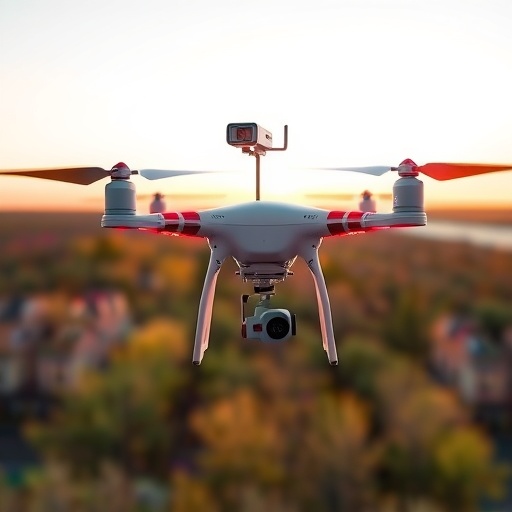
In the rapidly advancing domain of unmanned aerial vehicles (UAVs), navigation accuracy and security have become paramount concerns, especially as drones see expanding applications in commercial, military, and civil sectors. A groundbreaking study published in Scientific Reports in 2026 sheds critical light on the vulnerabilities of UAV navigation systems to GPS spoofing attacks and introduces an innovative telemetry-based detection methodology leveraging software-defined radio technologies.
Global Positioning System (GPS) spoofing, a form of cyber-attack where counterfeit GPS signals are transmitted to UAVs, has emerged as a sophisticated threat. These misleading signals can deceive drones into miscalculating their position and trajectory, potentially causing mission failures, collisions, or unauthorized rerouting. The gravity of such risks escalates in time-sensitive operations like disaster relief, sensitive cargo transport, and defense applications, where reliable navigation is crucial.
The research team, comprised of Hakani, Rawat, Shah, and colleagues, embarked on a comprehensive evaluation of how GPS spoofing affects UAV navigation. Their approach diverged from conventional detection methods by focusing on the real-time analysis of telemetry data. Telemetry, essentially the data transmitted by UAVs concerning their status, position, speed, and other parameters, offers a rich source for anomaly detection if captured and interpreted correctly.
To simulate GPS spoofing scenarios, the researchers utilized software-defined radio (SDR) platforms, which impart remarkable flexibility by allowing radio signals to be generated, manipulated, and decoded through software. This adaptability proved critical for replicating diverse spoofing attack strategies under controlled laboratory conditions, enabling precise observation of the resulting UAV behavioral deviations.
The SDR-based experimental setup allowed for the injection of counterfeit GPS signals with varying degrees of complexity and intensity. By monitoring the telemetry data alongside these interventions, the team identified distinct signatures indicative of spoofing attempts. These signatures included abrupt shifts in drone velocity, erratic altitude changes, and inconsistencies between onboard inertial measurement units and GPS-derived data, all traceable within the telemetry streams.
Crucially, the study emphasizes the real-time application potential of this telemetry-based detection paradigm. Unlike hardware-intensive anti-spoofing devices or passive jamming countermeasures, the described method integrates seamlessly with existing UAV communication infrastructures. This is achieved by implementing advanced signal processing algorithms and machine learning techniques to automatically recognize suspicious telemetry patterns suggestive of GPS deception.
Further analysis demonstrated that the detection framework retains high sensitivity and specificity across various UAV models and operational conditions. By training the detection algorithms on diverse flight datasets, the researchers ensured robustness against false positives that might arise from environmental factors or natural navigational anomalies, thereby improving trustworthiness in practical deployments.
The innovative melding of SDR capabilities with telemetry-driven analytics marks a significant step forward. It opens new avenues for bolstering the cyber-resilience of UAV fleets without necessitating costly hardware retrofits. This scalability is especially vital as the proliferation of UAV technology continues unabated across multiple industry verticals with differing security needs.
Moreover, the findings underscore the importance of developing standardized telemetry data formats, which can foster interoperability and facilitate widespread adoption of spoofing detection mechanisms. The establishment of open protocols would also encourage collaborative defense efforts, where drone operators share threat intelligence gleaned from telemetry analytics.
Beyond the immediate implications for UAV security, the research contributes to the broader field of wireless communication vulnerability assessment. The deployment of SDRs as versatile experimentation tools offers a blueprint for simulating and defending against other signal-based cyber-attacks affecting critical infrastructure reliant on satellite navigation.
As drone swarms and autonomous flight operations become more prevalent, ensuring navigation integrity through resilient detection strategies will be indispensable. The methodology presented in this study equips stakeholders with a powerful diagnostic tool capable of preempting and mitigating GPS spoofing before catastrophic outcomes arise.
Looking ahead, the researchers advocate for integrating their telemetry-based detection framework into flight control software, enabling onboard threat recognition and response. Such an embedded system would act instantly upon detecting spoofing, triggering safe fallback modes or alerting operators, thus enhancing UAV survivability in hostile environments.
This pioneering work exemplifies a synergy between advanced radio communication technology and data-driven analytics, embodying the multidisciplinary approach required to address emerging cyber-physical threats. It sets a precedent for continuous innovation to safeguard increasingly autonomous aerial assets navigating complex, contested airspaces.
In conclusion, the study by Hakani and colleagues represents a definitive stride toward the future of secure UAV operations, wherein smart detection mechanisms proactively safeguard against GPS spoofing. It furnishes the drone community with both theoretical insight and practical tools, nurturing confidence in UAV navigation as these aerial platforms continue to integrate deeper into societal, commercial, and defense frameworks.
The research highlights an urgent call to action for industry players, regulators, and academia alike to adopt and refine telemetry-centric security solutions. This proactive stance is essential to preserve the operational integrity and trustworthiness that underpin the transformative potential of unmanned aviation technology worldwide.
Subject of Research: Evaluation and telemetry-based detection of GPS spoofing effects on UAV navigation using software-defined radio
Article Title: Evaluation and telemetry-based detection of GPS spoofing effects on UAV navigation using software-defined radio
Article References:
Hakani, R., Rawat, A., Shah, M. et al. Evaluation and telemetry-based detection of GPS spoofing effects on UAV navigation using software-defined radio. Sci Rep (2026). https://doi.org/10.1038/s41598-026-53481-9
Image Credits: AI Generated
Tags: cybersecurity in unmanned aerial vehiclesdrone navigation vulnerability assessmentenhancing UAV navigation accuracyGPS spoofing attacks on dronesGPS spoofing countermeasures in dronesGPS spoofing impact on drone operationsreal-time UAV telemetry analysissoftware radio techniques for UAV protectionsoftware-defined radio for GPS spoofing detectiontelemetry-based anomaly detection in UAVsUAV mission safety and GPS spoofingUAV navigation security